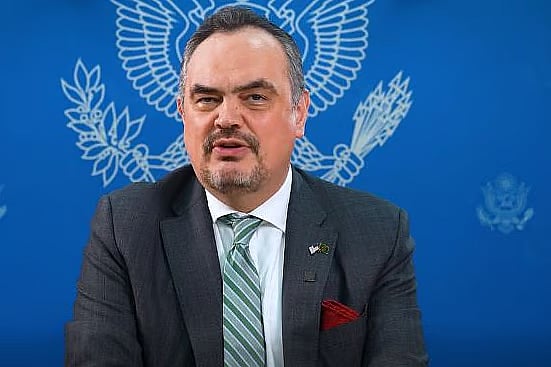
United States ambassador's address in Dhaka
New trade agreement is beneficial for both the US and Bangladesh
Before I begin, let us take a moment to remember Forrest Cookson, who passed away last week. Forrest, the first President of AmCham Bangladesh, contributed greatly to the US-Bangladesh relationship over many years. I knew him well from my previous time here, and will miss our vigorous debates.
It’s a genuine pleasure to be with you today as we stand at an exciting moment in the US-Bangladesh commercial relationship.
The United States has long been a partner to Bangladesh, but we, Americans and Bangladeshis, now have an unprecedented opportunity to transform the future course of this relationship.
The Enormous Potential of US-Bangladesh Trade
This moment is one of extraordinary opportunity for Bangladesh. With a population of over 170 million people, one of the most dynamic (and youngest) workforces in the region, and a strategic location in South Asia, Bangladesh has tremendous potential to become a major manufacturing center in the 21st century.
The United States and Bangladesh recently concluded an Agreement on Reciprocal Trade, which we call the “ART,” that if fully embraced and executed, can propel not just trade between our two countries, but Bangladesh’s economic development to new levels.
The ART is an excellent agreement, which preserves Bangladesh’s access to the critical US market with competitive 19 per cent tariffs – down from 35 per cent without the agreement — while making changes in Bangladesh’s tariffs and non-tariff trade barriers designed to encourage imports from the United States to balance our trade.
We cannot have lasting economic prosperity if those countries that export to the United States then import primarily from other countries – creating massive and chronic trade deficits that impoverish the very market you rely on.
If you are going to sell to us, you need to make an effort to buy from us. And at the very least, not impose massive tariffs and arcane and even absurd non-tariff trade barriers like radiation tests of our wheat and tests for pesticide we don’t use, together with total tax incidence on our exports of up to 150 per cent.
Let me share the concrete steps Bangladesh has committed to besides improving the treatment of US exports in general: Bangladesh has committed to purchasing $3.5 billion in US agricultural products—wheat, soy, cotton, and corn.
These are high quality US commodities, which the Government of Bangladesh and private buyers have assured us are of outstanding quality which makes them high value purchases.
The press and pundits like to focus on the price, but experts focus on things like quality and protein content. You get what you pay for.
The spoilage rate on wheat bought by the Ministry of Food from other countries was as high as 20 per cent, while the US wheat spoilage is just 2.5 per cent.
The protein content jumped from 11.5 per cent to 14 per cent. I call that high value, and I’m proud that Bangladeshis will be able to enjoy high quality US agricultural commodities as a result of this agreement.
The agreement also commits Bangladesh to $15 billion in energy products over the next 15 years, something that would be met by simply continuing the current rate of LPG from the US
Given the role of the US as one of that largest and most reliable suppliers of energy in the world, this seems like a commitment that will likely be surpassed by market forces alone, while improving availability of energy across Bangladesh.
These aren’t aid packages; these are commercial deals that create jobs and opportunities in both our countries.
And beyond the direct commercial benefits – lower tariffs for Bangladeshi exports to the United States and better access to the Bangladeshi market for US exports – Besides these direct purchase agreements, the Bangladeshi government has also made commitments in the ART to improve the business climate – commitments that should be applauded by every Bangladeshi businessman, politician, and consumer.
This is about Bangladesh unlocking its potential.
It’s not a secret Bangladesh has long been a very tough place to do business. You all live this every day. And I am not just talking to American or foreign companies. Local companies have also long called for the reforms that are laid out in the ART.
The ART is not a list of demands from the United States. It’s a shared commitment to Bangladesh’s future. The United States is excited about this country’s future, and the ART provides a vision for an incredible future for both of our countries.
Working Together: What Success Requires
Now, let me speak candidly about what we need to work on together to unlock Bangladesh’s full potential and show American companies that Bangladesh is open for business.
First: Predictability and Contract Certainty
The foundation of successful commercial relationships is trust, and trust requires that contracts be honored.
American companies need confidence that agreements with Bangladesh companies and the government will be respected and implemented consistently.
When contracts are honored, investment flows. When they’re not, investors look elsewhere. This is something we can work on together to improve trust and the business climate in Bangladesh.
Second: Stable and Transparent Policy Environment
Investors need predictability. They need to know that the rules today will be the rules tomorrow. They can’t face unfair tax burdens or blocks on the movement of capital and data.
Our trade agreement commits Bangladesh to transparent, non-discriminatory import licensing and regulatory practices. I’m encouraged by the steps Bangladesh is taking, and I want to support continued progress.
Third: Modernising Business Practices
Let me be frank: some business practices—informal arrangements, opaque processes—create barriers to the kind of large-scale American investment that can truly transform Bangladesh’s economy.
American companies operate under strict compliance requirements. They need transparent procurement processes, clear regulatory frameworks, and level playing fields.
This means: streamlining business registration and licensing; digitalising customs procedures; ensuring regulatory decisions are based on objective criteria; protecting intellectual property rights; enforcing labour and environmental standards that meet international norms.
Our agreement commits Bangladesh to important reforms, including prohibiting imports of goods made with forced labour and strengthening labor law enforcement.
These aren’t just American demands; they’re the standards that will make Bangladesh more competitive globally.
As the US Ambassador, together with the Embassy team represented here today, I am committed to work with you on implementing these reforms to unleash the true potential of US-Bangladeshi trade.
Why Partner with America
Let me be direct about what makes the United States the best long-term commercial partner for Bangladesh.
First, we believe in transparency and fairness.
American companies operate under the rule of law, with clear contracts and predictable business practices. We offer genuine partnerships built on mutual benefit, not back room deals, projects without real business cases, white elephants, or debt-trap diplomacy. We do due diligence on our projects, and don’t leave Bangladesh on the hook for a billion dollar tunnel to nowhere.
Second, we bring cutting-edge technology.
From advanced manufacturing to digital infrastructure, from clean energy to artificial intelligence, American companies are at the forefront of innovation globally.
Third, we focus on building capacity.
American investment doesn’t just build facilities; it trains workers, transfers skills, and creates sustainable employment that lifts families and communities. As the representatives of American companies in Bangladesh, you know this better than anyone.
Let’s talk now about the opportunities. I want to focus on a couple sectors today.
Energy: Building Bangladesh’s Power for the Future
First, energy. Bangladesh needs significant energy sector investment—an estimated $180 billion by 2050—to meet growing demand and power economic growth.
American energy companies are already key economic partners for Bangladesh. Chevron provides half of Bangladesh’s natural gas supply – and is ready to produce more.
Excelerate Energy facilitates the import of an additional third via LNG – and wants to bring in more.
And GE Vernova is a major player in the combined-cycle gas turbine market. It and other US companies stand ready to build out more energy infrastructure including modernizing the grid.
Together, these US companies already provide over half of Bangladesh’s power.
But we can do so much more together.
My team has been working closely with the government to create innovative flexible mechanisms for Bangladesh to do business with US energy companies, and has helped spread the word among US companies about the opportunities in Bangladesh and the urgent need for energy.
We have already been able to help fill gaps, including significant new imports of LPG.
The United States is now the world’s largest exporter of liquefied natural gas, and we’re ready to help Bangladesh diversify its energy sources further, build reliable
and affordable energy infrastructure, and provide America’s unmatched technology and expertise in all types of energy including advanced nuclear power.
The United States is partnering with Bangladesh to meet today’s energy demands, and we are ready to help build energy security and power Bangladesh’s industrial future for many years to come.
Technology: Connecting Bangladesh to Global Opportunities
Second, technology.
With over 100 million internet users, 160 million mobile phone subscribers, and plans for hi-tech parks across the country, Bangladesh needs to scale up its digital infrastructure.
This creates real opportunities for collaboration with American technology companies, the global leaders across this space.
US firms like Starlink, Google Pay, Oracle, Microsoft, and Augmedix have already begun introducing services in Bangladesh.
We can work together to help Bangladesh build trusted digital infrastructure that connects rural areas to global markets, enables e-commerce, and creates opportunities for your tech startups and innovators, creating the kinds of high paying jobs that are key to the modern economy, and to meeting the aspirations of your young people.
With the right infrastructure and regulatory environment, Bangladeshi entrepreneurs can compete globally, creating high-value jobs and driving economic growth.
Our trade agreement includes provisions for digital trade to ensure Bangladesh can participate fully in the global digital economy and we want American know-how and technology to be your pathway to greater opportunity.
The Prime Minister has called for a million new jobs in the tech sector – it’s hard to imagine that happening without a major role for US tech companies, who will come invest if they can trust the infrastructure, trust the business environment, and trust their contracts will be honored.
That includes financial technology companies.
This is an opportunity that really excites me: 70 per cent of financial transactions in Bangladesh are still conducted in cash. 70 per cent.
This represents an enormous growth opportunity, not just to strengthen the country’s financial sector, but also to transform the country itself.
American companies like Visa and Mastercard see massive potential in Bangladesh’s financial services sector.
When people can access financial services digitally, small businesses can expand across borders, farmers can access credit, and families can save and invest more effectively.
Together, we can help Bangladesh revolutionize its digital financial serves to be more modern, more efficient, and more secure.
Powering Growth Through Modern Infrastructure
Bangladesh’s remarkable growth story is creating new demand for modern, efficient infrastructure—and the United States stands ready to be a trusted partner in meeting that demand.
In rail, US companies can support the modernisation of locomotives, signaling, and safety systems to move people and goods more efficiently.
At ports, American expertise in logistics, automation, and cargo management can help reduce congestion and strengthen Bangladesh’s position as a regional trade hub.
And in civil aviation, US firms offer world-class capabilities in maintenance, repair, and operations—helping ensure safety, reliability, and workforce development as the sector expands.
Beyond these areas, US companies are leaders in engineering, design, and construction for highways, bridges, and urban transit—delivering infrastructure built for quality, transparency, and long-term resilience.
Our approach is not just about delivering projects—it’s about building lasting partnerships.
The United States looks forward to working together to build the infrastructure that will power Bangladesh’s next chapter.
From Framework to Action: Moving Forward Together
Here’s where we are: we have an excellent framework in the ART, and incredible opportunities in these sectors and more; now we need action. And I want to emphasize again—we’re ready to work with Bangladesh every step of the way.
The United States has demonstrated its commitment. We’ve negotiated in good faith. We’ve opened our markets. We’re ready to invest.
Now we need to take the actions that will move things forward.
This means: passing necessary legislation to implement our trade agreement; reforming regulations that create unnecessary barriers to US companies; training customs officials and regulators on the new procedures; creating one-stop shops for foreign investors; establishing clear timelines for approvals and permits.
As American companies working to navigate the challenging environment that has been Bangladesh, I encourage you to reach out, to share challenges, and to work with us on finding and implementing solutions.
Closing: Join Us in Celebrating America’s 250th Birthday
As I close, I want to extend a personal invitation. This year we are celebrating America’s 250th birthday. Some of you may have already noticed the giant banners that drape the US Embassy. There is a lot more to come, especially as we approach America Week in July.
You are all invited to partner with us to celebrate this golden moment in American history.
There are so many ways you can participate, and if you are interested in sponsoring or supporting one of our events, my team would be happy to talk with you.
The relationship between the United States and Bangladesh has never been stronger, and the opportunities that lay before us have never been greater.
But opportunities require vision, commitment, and partnership. The United States is ready. I’m ready. And I believe Bangladesh is ready too.
Let’s work together to seize this moment to chart a course toward shared prosperity.
* Brent T Christensen, the United States ambassador to Bangladesh
* The views expressed are the author's own