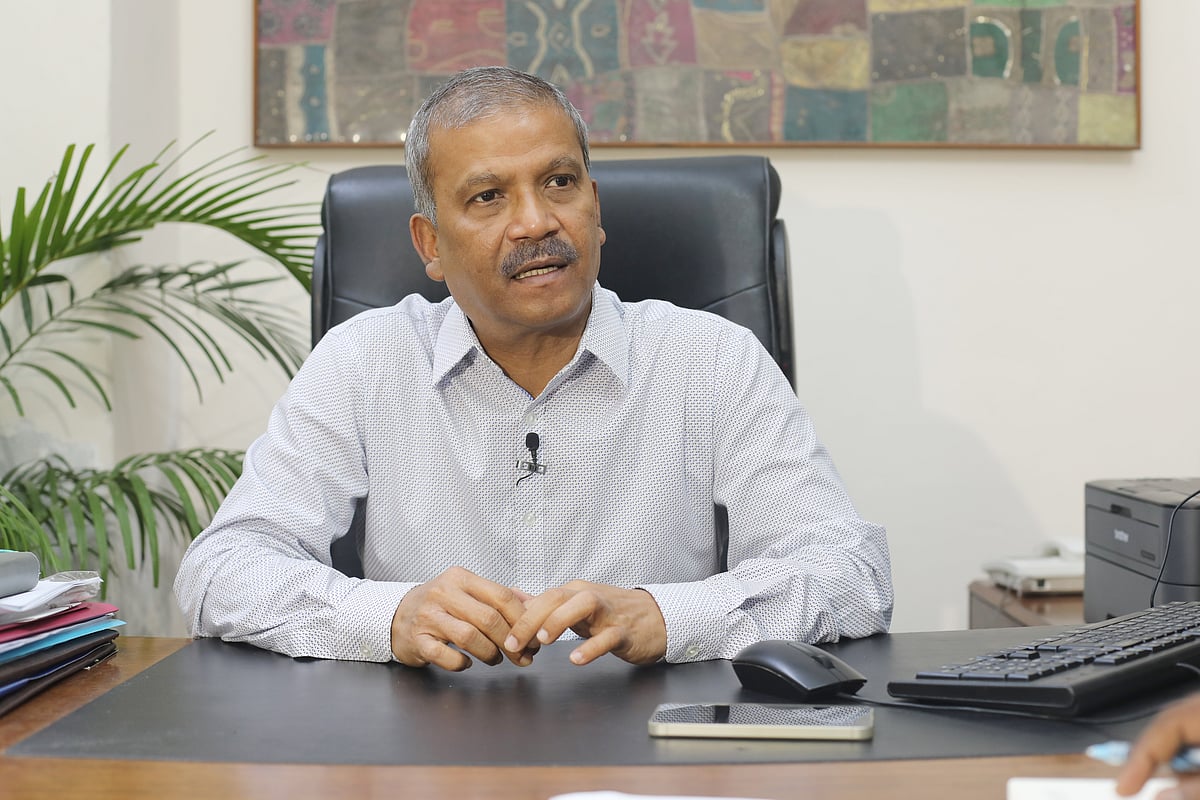
Interview: Asif Nazrul
Every govt in the world has a govt within
Professor Asif Nazrul is the advisor on law, justice, and parliamentary affairs in the interim government. In an interview with Prothom Alo, he spoke on a range of topics: the successes and failures of the government in its first year, the trial of the July killings, widespread lawsuits and arrests, mob violence, allegations of political favoritism, social inequality, the civil service pay commission, elections, and the ban on Awami League activities. Rajib Ahmed took the interview on 1 August at the official residence of the law advisor. Today read the first part of that interview.
Prothom Alo: On 5 August 2024, the Awami League government fell following a student–people's uprising. Did you foresee the government’s downfall?
Asif Nazrul: I had a sense it was coming. I was seeing familiar faces at marches and rallies—people who had never participated before. Despite brutal crackdowns, student leaders remained determined to continue their movement. There were waves of people risking their lives to take to the streets. After hearing the Army Chief’s remarks at the Army Headquarters, it felt clear to me that Sheikh Hasina would not survive this time. On 3 August, at a massive student–people's gathering at the Shaheed Minar, I said, “Be assured of victory.”
Prothom Alo: Did the military contact you before 5 August? If so, what did they say?
Asif Nazrul: In the very last days of July, one night, a man in plainclothes identifying himself from the army came to our neighborhood. He warned me to be very cautious and advised me not to sleep at home. At the time, I was uncertain whether he truly was from the military. Out of fear, I didn’t try to verify his identity. Then, around noon on 5 August, a brigadier from the military called, introduced himself, and invited me to the cantonment. After consulting with Rizwana Hasan and Mirza Fakhrul Bhai, I decided to go. My wife was extremely frightened—she kept reciting prayers. She took a photo of the army vehicle sent to pick me up. The officers repeatedly assured her of my safety. What I experienced on 5 August was truly unimaginable and unbelievable.
Prothom Alo: I interviewed you when the interim government had completed one month in office. Back then, you said that if people have honest intentions, patriotism, and willpower, anything is possible. Now that a year has passed, I want to know: what has the government actually accomplished? And what has your ministry achieved?
Asif Nazrul: What I told you back then has largely proven true. While not everything is possible, much can be done. I gave an overview of our ministry’s work on 31 July. We passed or amended 16–17 laws. There have been groundbreaking reforms in civil and criminal codes. We enacted the Prevention of Violence Against Women and Children Act, expanded legal aid services, introduced laws for online bail bonds, and made progress on digitization. We’ve done things no previous law ministry has done. For example, we recommended the withdrawal of over 16,000 harassment cases. That’s not something done in just meetings—we had to review case files in detail.
In Bangladesh’s history, no ministry has ever appointed nearly 5,000 government legal officers in a single year—but we did.
I believe the government’s biggest success has been bringing discipline to the economy. During Sheikh Hasina’s time, even she warned of possible famine. The signs of economic collapse were clear. But we were able to avert it. I used to hear that in situations like this, the exchange rate (dollar price) rises sharply—but it didn’t; in fact, it’s now declining. Our foreign currency reserves have increased, financial management has improved, inflation is under control, stability is returning to the banking sector, and public confidence is growing. During Ramadan, we managed to keep the prices of essentials down to some extent. Hajj management has improved.
We’ve cut down on waste. Under the leadership of power and energy advisor Muhammad Fouzul Kabir Khan, we’ve saved Tk 450 billion by eliminating unnecessary expenditures and dropping unneeded projects. In the aftermath of a revolution, there is often a period of disorder. Had that not been the case, we could have achieved even more.
Prothom Alo: As a representative of civil society, you spent 30 years criticisng the injustices of various governments. Now that you’re part of the government, what do you think you have failed to accomplish?
Asif Nazrul: Our two biggest failures are mob violence and the indiscriminate filing of lawsuits.
The problem with controlling mob violence is that the police lacked the morale. The same police force that opposed the July uprising later saw certain groups involved in mobs claiming to represent that very uprising—and so they failed to act. At times, the home adviser seemed helpless and would say, “Please tell me clearly—should I use force or not?” After the public’s traumatic memories of police brutality, it's hard for us to advocate for force. In fact, in many cases, the police have been attacked themselves.
After a revolution or mass uprising, discipline often breaks down in parts of society. People have just overthrown a fascist regime—they don't become orderly overnight. Look at the situation after the Liberation War: there was one-party dominance, yet they still couldn’t establish discipline. That said, we’ve managed to keep the current situation relatively under control.
Prothom Alo: You mentioned the post-Liberation War period. But Sheikh Mujibur Rahman had to pay the price for that—his government quickly became unpopular, and eventually, he was assassinated.
Asif Nazrul: Back then, a lot of violence was carried out to serve the government’s interests—take the actions of the Rakkhi Bahini or the killing of leaders like Siraj Sikder.
But today, do you see Asif Nazrul or any advisor inciting mob violence? Are we deploying forces to hold onto power? Back then, there was clear misrule by one party. Today, the context is different.
Prothom Alo: We haven’t seen you directly inciting mobs, but we have seen police officers attempt to control mobs, only to be removed from their positions afterward.
Asif Nazrul: In a few cases, officers were transferred in the interest of maintaining law and order. As you know, social media can spread massive disinformation. In some cases, officers were reassigned to better positions, not as punishment.
Prothom Alo: You were talking about indiscriminate lawsuits.
Asif Nazrul: Look, these lawsuits weren’t filed by the government—they were filed by victims. In some cases, a certain group of lawyers hoping to profit from legal settlements teamed up with the complainants.
Prothom Alo: But some political party leaders were involved as well.
Asif Nazrul: The question is—why didn’t the police filter the accused more effectively? We told the police to do this early. But when they tried, they were told, “You’ve been accepting cases against 200 people all your life—what’s the problem now?”
That shows a lack of moral courage in the police. Sara Hossain, a senior lawyer of the Supreme Court, asked, “Why aren’t you able to fix this?” I replied, “Then give me a solution.” It’s been three months now.
Eventually, we took our own initiative and amended the Criminal Procedure Code.
Prothom Alo: Apologies for interrupting, sir, but I have to ask: you're saying the government hasn’t filed a single case—but government public prosecutors and the attorney general are opposing bail in these very cases. When someone secures bail from the High Court, it’s being challenged and blocked. People are being re-arrested in new cases even after getting bail in one.
Asif Nazrul: Those cases involve killings. There’s little reason to believe that the Awami League had a hand in supporting or instigating those acts. Outside of those, however, many ordinary and innocent people have received bail. Some political leaders have too. Let me mention a few names: Professor Abdul Mannan was granted bail, Saber Hossain Chowdhury received bail, and Anwar Hossain Manju was never even arrested. So there are indeed such examples.
Prothom Alo: I should add that a professor from Jagannath University also received bail. There are several such cases—but only after public criticism. It’s also being said that there’s no justification for holding journalists close to the previous government in murder cases. It would be more appropriate to investigate issues of corruption or illegal wealth.
Asif Nazrul: I believe there have been cases filed against over a hundred journalists. As far as I know, seven or eight have been arrested. I can assure you—none of these cases were instigated or backed by any part of the government. Now let me put it this way: when ordinary victims witnessed people being killed, and a journalist told a bloodthirsty prime minister, “What you’re doing is right. We support you”—isn’t that a form of complicity?
Prothom Alo: That sort of incitement can be judged by a tribunal. But is it reasonable to implicate them directly in specific murder cases?
Asif Nazrul: For those accused under the International Crimes Act, the idea of command responsibility may apply. But beyond that, some individuals actively incited violence—that’s a serious offence.
Prothom Alo: So are you saying they should remain in jail throughout the trial?
Asif Nazrul: That’s not for me to say. If a judge believes so during the course of the trial… that’s entirely up to judicial discretion.
Prothom Alo: But are judges really free to deliver rulings independently? There are claims that a climate of fear exists in the courts. Suppose a judge grants bail to journalist Shyamal Dutta—how can we be sure that same judge won’t face mob retaliation the next day?
Asif Nazrul: I can’t comment on a judge’s mental state. But let me tell you this—judges were under a culture of fear for 15 years. They were told who to grant bail to, and who not to. A judge might now recall their own past actions and how they were once used politically. Expecting that such a judge, after 15 years in that environment, will suddenly begin making decisions free from fear or past bias—that may not happen in every case.
Prothom Alo: But sir, a major expectation of the July uprising was justice.
Asif Nazrul: But how do we define justice, and according to whom? At least a thousand people were killed. At least a hundred thousand were injured in some way. Over the past 15 years, millions have lost their livelihoods, faced enforced disappearances, and endured other forms of repression. If they now believe that filing these cases is justice—can you deny them that? Show me a law that says we can stop someone from filing a case.
Let me ask again: why isn’t the police scrutinising these cases? In the past, police would accept cases from one side and reject from the other. Now they’re accepting cases from everyone.
But it’s the same police force, the same courts, carrying 15 years of guilt—they won’t change overnight. Also, let me clarify—the cases aren’t fabricated. You can argue that too many people have been named in a single case, or that some names were added for benefit. But that doesn’t make the entire case false.
Prothom Alo: I’m not saying the cases are fake. Under the previous government, there were “ghost cases.” Now, it seems like defendants are being picked at will.
Asif Nazrul: That’s a fair point. But the difference is—under the previous government, the state filed those cases. Now, the victims are filing them. Previously, the entire case was often fictitious. Now, the core allegation is real—though it may be true that too many people are being implicated in some cases.
Prothom Alo: Still, sir, under the previous government, people were held in jail indefinitely through these cases. Bail was routinely denied. We’re seeing the same thing now.
Asif Nazrul: There is a difference. Under the previous government, fake cases led to mass arrests. We’ve instructed the police very clearly: no arrests unless there’s evidence. To my knowledge, under our government, no more than 10 per cent of the accused have actually been arrested.
Prothom Alo: Let’s take a recent example. Former chief justice Khairul Haque has been accused of delivering highly controversial verdicts and even altering judgments. But do you think it’s logical for him to be arrested in a murder case?
Asif Nazrul: There are three cases against him. The police initially produced him in court under a murder case, but later showed his arrest in the case related to verdict manipulation. The remand request was also made under that case alone. Let me tell you something—two of the justices who wrote the final verdict on the caretaker government issue stated that justice Khairul Haque’s full verdict contradicted the short verdict. That’s not legally acceptable. So, you can’t really question his arrest or remand under such circumstances.
Prothom Alo: My question isn’t about his arrest or remand. My question is—why was he arrested under a murder case instead of the verdict manipulation case?
Asif Nazrul: For 15 years, police recruitment was heavily influenced by the Awami League. Considerations often included political affiliation or whether someone was from Gopalganj. Expecting that entire force to now work with full sincerity for us may be asking too much.
There are shortcomings in police capacity. But there are also many officers who are responsible and sincere.
Prothom Alo: The trial of the July killings should be one of the government’s top priorities. How much progress has been made?
Asif Nazrul: The trials are taking place in two forums: one is the regular criminal court, the other is the International Crimes Tribunal. In my view, the case at the tribunal is progressing quite well. From the beginning, we’ve expected our investigation and prosecution team not to handle the case carelessly. We wanted solid evidence that could withstand scrutiny—so that the verdict holds up even at the appellate level.
Under Sheikh Hasina’s government, verdicts at the International Crimes Tribunal were sometimes drafted over Skype or phone calls. That won’t happen now. We began working last November. In just eight months, the trial has reached the hearing stage. That’s significant progress.
I know you’ll ask why I earlier claimed the verdict would be delivered by now. Look, I was speaking based on my expectations and understanding. When I see the families of martyrs crying, I feel compelled to share what I believe. I stay in close contact with the prosecution team and know where the case stands.
Based on that analysis, I previously said a verdict might come by October, even though progress was modest at the time. Now, based on the current pace, I can say with much more confidence that if not by October, the verdict should come by December or January.
When I said “by October” earlier, some tribunal judges cautioned me about making such predictions. That in itself shows how independent our judiciary really is.
Prothom Alo: What’s the progress on establishing a separate secretariat for the judiciary?
Asif Nazrul: A separate secretariat doesn’t just mean giving judges tables and chairs. A few days ago, a rule was passed stating that new judicial posts should be created under the leadership of the chief justice. Posting regulations have been finalised. Some additional rules still need to be drafted. I believe, based on our roadmap and planning, the separate judicial secretariat will be implemented before December.
Prothom Alo: The anti-discrimination student movement was followed by a mass uprising. What steps has the government taken to reduce social and income inequality? The chief advisor, Professor Muhammad Yunus, has spent his life working for the poor. Shouldn’t the government under his leadership have played a more active role? What has this government done in the past year for the poor?
Asif Nazrul: To be honest, I don’t fully understand economic matters. But I always saw him (Professor Yunus) emphasising two things: that the cost of living should not increase under any circumstances, and that employment should rise.
If you look at it now, prices of essentials have been kept relatively stable in many cases.
Prothom Alo: Previously, inflation was around 11–12 per cent. Now it has come down to 8 per cent.
Asif Nazrul: Isn’t that a success?
Prothom Alo: I’m not saying it’s not a success. I’m saying that even this level of inflation is not affordable for the poor.
Asif Nazrul: When it comes to employment, there’s a lot of delay in the recruitment process through the Public Service Commission. Perhaps we could have done more in this area.
Prothom Alo: In the budget, we saw that allowances for the poor were increased by just Tk 50, in some cases Tk 100—the same rate at which Sheikh Hasina used to increase them. The labour commission’s report is sitting in cold storage.
Asif Nazrul: Many have raised the question of why these five commissions were formed (the five commissions not covered in the National Consensus Commission: women, health, media, labour, and local government). Following Sir’s (Professor Yunus’) instructions, I personally sent the commissions’ immediately actionable recommendations to the relevant ministries a couple of months ago. But I don’t have the authority to follow up on how much progress has been made. However, Sir regularly sits with the advisors and asks about the progress of reforms in their respective areas.
Prothom Alo: During the July uprising, it was mostly working-class people and students who lost their lives. Government employees didn’t resist or disengage from the previous government even at the very end. To keep the bureaucracy on her side, Sheikh Hasina had provided car loans and housing loans. You didn’t revoke those. Instead, your government gave civil servants additional annual increments, and now a pay commission has been formed. It's fine to increase salaries for government employees, but what have you done for the working class?
Asif Nazrul: I can’t speak in detail about the pay commission—it falls under public administration. But even now, there are questions about the loyalty, competence, and sincerity of many officials toward this government. So can we suddenly say, “Give back the government cars and houses you're using”? Is that realistically possible in the context of Bangladesh?
Prothom Alo: But couldn’t you have at least reclaimed the project vehicles that officials continue to use instead of returning them to the government transport pool?
Asif Nazrul: I can’t give you detailed information on that. But I can say we are taking a very strict stance when it comes to the misuse of project vehicles.
Prothom Alo: Is there a government within the government?
Asif Nazrul: Tell me, is there any country in the world where there isn’t a government within the government? Every government has an inner circle—what we call the “kitchen cabinet”—whose influence is greater. But no one outside the government is controlling its decisions.
* Read the second part of the interview tomorrow.