Exclusive Interview: Syed Abdullah Mohammed Taher
‘Election sans reforms will lead towards previous darkness again’
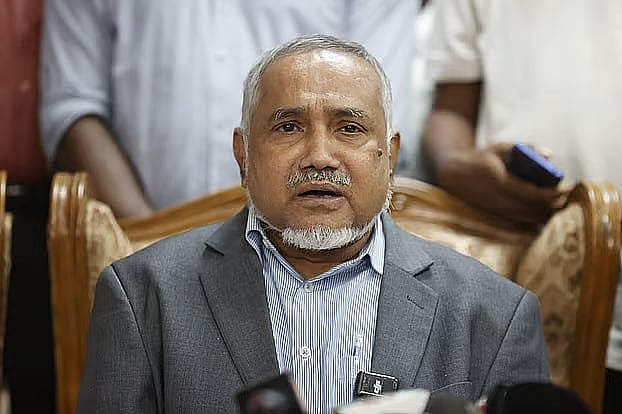
Syed Abdullah Mohammed Taher, senior Naib-e-Ameer of Bangladesh Jamaat-e-Islami is leading his party in the National Consensus Commission’s dialogues with various political parties. He spoke to Prothom Alo on reforms, elections, and politics. Selim Zahid and Riadul Karim took the interview.
Many political parties have held long discussions with the National Consensus Commission on the question of reforms, and you have led the Jamaat-e-Islami in the dialogue. What is your experience?
Abdullah Mohammed Taher: This is the first and a historic event in the political history of Bangladesh where the Reform Commission brought together 30–32 parties in a joint meeting. Where there used to be very little interaction among the right, left, centrists, and Islamic parties—we did not even know each other. From this perspective, the initiative of the commission has been successful.
People of different ideologies and paths have had the opportunity to know each other, and a kind of relationship has been built. From this angle, I consider it very positive. However, I think there was some immaturity in the selection of parties (for the discussion). For that reason, a lot more time had to be spent in making decisions on certain issues.
What is the outcome of it?
Abdullah Mohammed Taher: In terms of outcome, we have successfully passed a certain stage. Despite thousands of ideological differences, we have been able to come together on many fundamental issues. So, I consider this stage to be a success.
But there have been many notes of dissent on fundamental issues—especially on matters such as appointments to four constitutional bodies, and whether the Prime Minister may hold multiple offices. BNP has notes of dissent on such crucial proposals. Then what is the future of these?
Abdullah Mohammed Taher: Throughout the entire discussion we noticed one thing—that BNP (Bangladesh Nationalist Party) showed somewhat reluctance on the question of reforms. Still, I want to thank them, because at the beginning their reluctance was more, but later they tried to avoid it. At the final stage, on many issues they showed some leniency. They accepted the majority opinion with notes of dissent. I think this is a kind of positive stand. Because you can give a note of dissent, but on the main question of consensus, you were in agreement.
Now, the question is what will happen regarding the matters where notes of dissent were given? I also spoke with lawyers. They said what the majority accepts—that is the final decision. A note of dissent is for record. It does not carry legal basis or importance of that kind. Just like in the High Court, where there is a bench of three judges: if two judges agree on one matter and one dissents, the ruling is given based on the two. Another person’s opinion is just kept on record as a different view.
From the BNP, a point has been raised regarding the majority: it is that the number of parties is not the issue here; what is important is how much each party represents the people.
Abdullah Mohammed Taher: I would not dismiss this completely. But when you sit in a meeting, if everyone there is an equal member, then in decision-making the majority will prevail. When you sit in one meeting, your position, my position, and others’ positions are equal. And every participating party has got its one single vote or opinion equal to everyone else. So, inside that meeting, whose popularity is greater or lesser, who represents more or fewer votes—there was no such indication. Therefore, whether theoretically or practically, you cannot officially say like this.
You said BNP showed reluctance about reforms. But it is also true that two years ago BNP itself first placed 27 points, and later 31 points of reform proposals before the nation.
Abdullah Mohammed Taher: That is exactly the surprise. Where reforms were BNP’s proposal two years ago, when the real initiative for reforms was taken, they themselves stepped back from their earlier announcement.
Suppose BNP comes to power, and then says: “I had given a note of dissent on this matter, so I will not implement it.” Then what happens?
Abdullah Mohammed Taher: Who will come to power, I don’t know. But if any party, after giving a note of dissent, then says this, they can also say: whatever I said before, I don’t accept now. That would be a breach of commitment. What we are saying is—here, in this very matter, a qualitative change must come.
The July Charter is one proposal. And we will add PR (Proportional Representation). So, a referendum can be held on these two points.
In the first phase of discussions with the Consensus Commission, you had said that on the matters (fundamental reforms) where there is no consensus, a referendum should be held. What is your position now?
Abdullah Mohammed Taher: Our position is exactly the same as before. Now the question of giving it a legal basis has come. On the matters where we have agreed, and on the matters where fundamentally there was no consensus—taking everything together, we are in favour of a referendum.
BNP leaders are saying that a referendum is held on one or two specific issues. How is it possible to have a referendum on so many proposals?
Abdullah Mohammed Taher: No, this is a package proposal. The July Charter is one proposal. And we will add PR (Proportional Representation). So, a referendum can be held on these two points.
Your demand is for PR elections in both houses of parliament. But in the Consensus Commission, you were not seen to push PR in the lower house strongly. Now it seems you are demanding PR in the lower house too.
Abdullah Mohammed Taher: When the Consensus Commission gave us many written proposals in the first phase, in our written replies we asked for PR in both houses. But the Commission only drafted a proposal for PR in the upper house. There, discussion was allowed only on the matters proposed by the Commission. In that discussion, I personally spoke about PR at least three times. Other parties spoke too, Islami Andolan Bangladesh gave it in writing. So, it is not that we did not raise it strongly. It may be that we were not violent.
Suppose your demand for PR is not fulfilled. What will be your decision regarding the election then?
Abdullah Mohammed Taher: We believe that the PR system is beneficial for the country. Through our demand, it will be realised, and on that basis the election will be held.
But how will PR in the lower house be possible—since the Consensus Commission’s reform proposals have already been mostly finalised?
Abdullah Mohammed Taher: Two things may happen. PR can be an agenda outside the Consensus Commission. We are asking the government to discuss on that basis.
Why do we want this? For three reasons. First reason is the context of Bangladesh. In 54 years of Bangladesh’s history, there has been no instance of a free and fair election. Even in the ‘Yes-No’ vote during Shaheed President Ziaur Rahman’s time, 99 per cent of votes were cast. That is absurd.
You said there is no instance of free elections in Bangladesh’s history. But three elections (1991, 1996, and 2001) are considered free and fair.
Abdullah Mohammed Taher: Those three elections were comparatively better. Relatively okay, but not fair. I myself contested in elections, I know the real situation. That is one reason.
In the context of Bangladesh, we think that if elections are held in the traditional method, they will be like in the past. Centers will be captured, ballot papers will be snatched, voting at night will take place, buying and selling will occur. If there is a new PR system, then there will be no muscle power at centers, no flood of black money, no rush for vote buying. If the vote is under PR, there will be no mastani (thuggery) at centers. A smooth vote will be held.
Experts say PR also has downsides. For example, in PR elections, the government becomes hostage to small parties. This creates instability, which is a major obstacle for government.
Abdullah Mohammed Taher: There is no question of becoming hostage to any party here. Because if your popularity is so high, then under PR you will get majority seats anyway. If you have 50 per cent popularity, then you get 150 seats. There is no reason to be hostage. And if you are not such a big popular party, then why should you alone bear power?
Besides, I do not consider it being hostage to small parties. Rather, I consider it participatory governance. We are saying fascism can no longer return. Fascism will be curbed, and in addition, other parties who represent the people will have the opportunity to participate in governance under PR. So, those who say it will be hostage, that is their concept; and we who say it will be participatory governance, that is our concept.
If there is no PR in the lower house in the end, what will be your decision about the election?
Abdullah Mohammed Taher: I already said, elections will be held after our demand is realised. We believe that elections without reforms will lead the country into that era of Awami Jahiliyya (darkness). If such an election happens again, then there will be no salvation—rather, we will create new problems. So, the question you asked—whether we will join elections or not—that is not the question now. The real question before the nation now is whether reforms are happening or not. Here lies the main dispute.
One big party does not want reforms, while all other stakeholders want reforms. So, the majority of people want reforms, this government too had committed to reforms, July also had committed to reforms—that has to be settled first.
Here I will mention the government’s fault. The government is not talking on the matters that need to be done before elections. The government has intentionally become a part of one party and pushed the other parties into defense. For example, BNP is saying elections will be held and there is no more to discuss. But my point is, reforms must happen.
A political imbalance has been created in the case of a level playing field. This must be addressed first. If now you stand two hands ahead of me, and then tell me to run a race—while I am two hands behind—if you then ask me whether I will participate in the race, or not, what does that mean? It does not means that I do not want to join the race.
Here, the matter must be made clear: those who are conspiring with the state, the idea of an election without reforms has dawned in their mind. An election without reforms means a conspiracy against building a new Bangladesh. In the context of the July uprising, elections must be held in the context of new Bangladesh, new circumstances, and new methods.
On the two hands ahead/behind metaphor you mentioned—what will you do to make the two hands equal, if the government does not do it itself?
Abdullah Mohammed Taher: For that, we will go for a movement if necessary. Either I must be given two hands ahead, or the one advanced must be pulled back two hands to equal position.
You had objections about the July Declaration. Now is the July Charter also going towards that?
Abdullah Mohammed Taher: We had objections about the July Declaration, we still have objections, and the people of Bangladesh also have objections. You ask—how do I know this? Look, only BNP has welcomed the July Declaration. No one else has congratulated it. Everyone else said, “We are viewing it positively.” We also said that.
But then came the “but, but, but.” That is, major political parties are attaching “buts” to it. We did not become violent over it. We achieved something in July, we did not want to publicly diminish that achievement. You may call it our patience, or you may call it our generosity.
BNP says that in the final draft of the July Charter, some issues have been given precedence over the Constitution, which is unacceptable.
Abdullah Mohammed Taher: We think it is acceptable. Because our Constitution itself says people’s will is supreme. Therefore, the July Charter being created is just a reflection of the people’s opinion. So, I do not see any objection if this stands above the Constitution from the perspective of spirit.
Let me add another point. Does the current interim government have any legal basis? Is it mentioned in the Constitution? Is the election commission mentioned in the Constitution? Yet we are accepting it. Why? Doctrine of necessity. This is the will of the people. Why are we accepting it? Because it is the outcome of our movement. If you can accept the government this way, why can you not accept the July Charter in the same spirit?
British journalist David Bergman recently said: “The consensus has been reached internally among some undemocratic political parties, many of which are very small, who either have not been tested in any fair election since 2008 or have never participated in a national election at all. To consider their agreement as a ‘clear and supreme expression of the people’s will’ is laughable.”
Abdullah Mohammed Taher: We believe in people’s freedom of speech. He has expressed his opinion. But what he is saying is not correct. Because, there was no scope for reflecting the will of the people in the three so-called elections since 2008. If he considers those three elections as representative of the people’s will, then it means he is essentially certifying fascism and autocracy. As much as I personally know him, this does not suit him. Because in this consensus commission, 30 parties have gathered—there are small parties, big parties. Here, excluding only one party and its allies, the rest of the nation is being represented in the discussion. So, undoubtedly this reflects the majority.
You want legal basis for the July Charter. What could be the method of implementation?
Abdullah Mohammed Taher: Let me first explain the essence of the July Charter. Like, iman (faith) has three parts—acknowledgment by mouth, belief in the heart, and then translating into action. Similarly, I see three parts in the July Charter. First is consensus. Second is giving it legal basis. Third is implementing it based on that foundation. So far, we have only reached consensus on various issues. I would not call this the July Charter yet. Only when the other two are implemented, then altogether it will become the July Charter.
Now, what method for implementation? Experts are saying there can be three ways. One, a legal framework, through which a Constituent Assembly can be formed, and it will be based on the July Charter. It must then be ratified. Two, proclamation by the president. This is somewhat weaker, but later ratification solves the problem. The best way is referendum. In case of a referendum, there is no room for debate. We think we should go to referendum without wasting time.
That means you want this before the national election?
Abdullah Mohammed Taher: Of course. Because these will be selected through referendum. The proportional representation (PR) system we are talking about, that is also for the new Bangladesh. We want this too in the referendum.
There is an opinion that national election and referendum could be held on the same day.
Abdullah Mohammed Taher: That has several complications. Those who are saying this are thinking hypothetically.
On the issue of legal basis and implementation of the July Charter, there seems to be major differences. Do you see any risk that the reform process might collapse at this stage?
Abdullah Mohammed Taher: I will not dismiss the risk. Everyone says reforms are needed, even BNP says so. If BNP was completely against reforms, they would not have joined the discussion at all. If they want reforms, then why should there be any problem in giving it legal basis? And if legal basis is given, why should there be a problem in holding elections on that basis? These questions make us concerned whether some motivated rigidity is being imposed to derail the election itself.
BNP says, if some reform proposals are implemented, it will weaken the executive branch. At the end of the day, it is the executive branch that is accountable to the people.
Abdullah Mohammed Taher: One big aspect of Bangladesh is the lack of balance of power. It is we ourselves who created dictatorship; it is we ourselves who created this system. All tasks, all power are in the hands of one person. The concern BNP is expressing, this concern exists from an authoritarian mindset and it may happen. But when I will want balance, when I will want the state, then here we think the balance is necessary. The current proposal of reform, this is the right one.
Some people think that, in the present context, it is BNP who has more possibility of going to power, you do not have that in that sense. For that reason, you have taken a strong position on reforms.
Abdullah Mohammed Taher: If I take your words, that we have no possibility of going to power, then for that reason we are asking for reforms. Is the reform harmful for the state? If it is harmful for the state and for the people, then you can consider that. And if without going to power I want reform for the welfare of the country, then you should appreciate that. Number two, now let me answer the earlier one. BNP will go to power, may go—this is a kind of myth everywhere. Because they are considering everything from the previous situation. But after July there has been a huge change in people’s psychology (mindset), and no one is considering this.
I am not saying that BNP will not go to power. But I am also not saying that BNP will go. I am also not saying that Jamaat will go. I am also not saying that Jamaat will not go. The BNP that existed during martyred president Ziaur Rahman’s time was a huge organisation, it was popular. Now BNP is a huge organisation but not popular, this is the reality.
On what basis are you saying this?
Abdullah Mohammed Taher: On the basis of opinion polls. The latest BRAC University survey gave BNP 12 per cent. Jamaat got 10.47 per cent. What is the difference? One month before that, or earlier, SANEM did a survey. In SANEM’s survey, BNP got 42 per cent, we got 32 per cent. What is the difference? Neither of these institutions is one that gives Jamaat extra points; if they can, they deduct two points. So, it appears Jamaat is narrowing the gap over the time. By the time of the election, it may narrow further.
Do you have any internal survey?
Abdullah Mohammed Taher: We have our survey too. But I will not focus on it now. Let me add one more thing, which is important for the psychological change narrative. In the survey, 48 per cent did not express any opinion. Who are they? Surely, they are neither BNP nor Jamaat. They are waiting to see whom to support.
Then BNP’s secretary general is correct, that the right-wing is rising.
Abdullah Mohammed Taher: I do not know what he meant by right-wing. Sometimes we go north, sometimes we tour the south.
He surely did not mean north and south as directions, but in politics…
Abdullah Mohammed Taher: By right-wing, what he has said, in left politics or in international politics it means something a bit non-democratic, a bit radical. If he has said this, then he has not said it correctly. Because in Bangladesh there is no such radical party in politics, nor are they rising. Rather, in Bangladesh the position of honest people against corruption, looting, and extortion has advanced in public mind more than before.
So, you think that as time goes on, your popularity will increase. Is that why you want the election to be delayed?
Abdullah Mohammed Taher: No, we have never said to postpone the election, we are not in favour of postponing. We want to hold the election on that date (the first week of February). But for the election, the conditions that I have mentioned, those have to be satisfied. It is not like this, that if it is in December you will not fulfil these demands, and if it is in June you will. If the government says this, then we want June. And if the government says, no, I will fulfil these demands, will make a level playing field, will remain equal, then we want December as well. So, by bringing the timing, BNP or the government is trying to hide the main point, trying to confuse. This is now our politics, to remove this confusion and to come to the level playing field.
See, what has Mr. Yunus done? He has said that I want reforms, he still says so. But before the reforms were finished, he announced the date. This is the electoral conspiracy. What he should have done is to announce in February itself after finishing the reforms that the election will be held in February. For example, if reforms are finished in September, then the date of February election should have been announced in October. Then you would not have had to go forward with an unclean bamboo. Now we are thinking whether the reforms will happen or not. And BNP is saying, reforms are not needed, I have already got the election date. Here a fundamental difference has been created between the two positions. We have gone to the defense. And this benefit the government has given to BNP.
Why is there a distance between you and BNP? You were together, weren’t you?
Abdullah Mohammed Taher: There is no distance between us and BNP. The distance here is in principle, not as parties. Because when I meet BNP, we embrace, and they do too. That brotherhood exists.
Then will there be no alliance with you and BNP?
Abdullah Mohammed Taher: BNP has said there will be no alliance. We have not declared that. But we are building an alliance where BNP will not be. There, major right, some left, and Islamists outside BNP will be included. We are trying for that, Inshallah.
So far, what is visible is that on the July Declaration and reform issues, Jamaat, National Citizen Party (NCP) and Islami Andolon share the same demands. Does this indicate an electoral unity?
Abdullah Mohammed Taher: We are not bringing the election issue forward yet. We have talked about many areas, we have talked about reforms. In reforms and other issues, our goal is now close. In that case, at least up to this point we are still united.