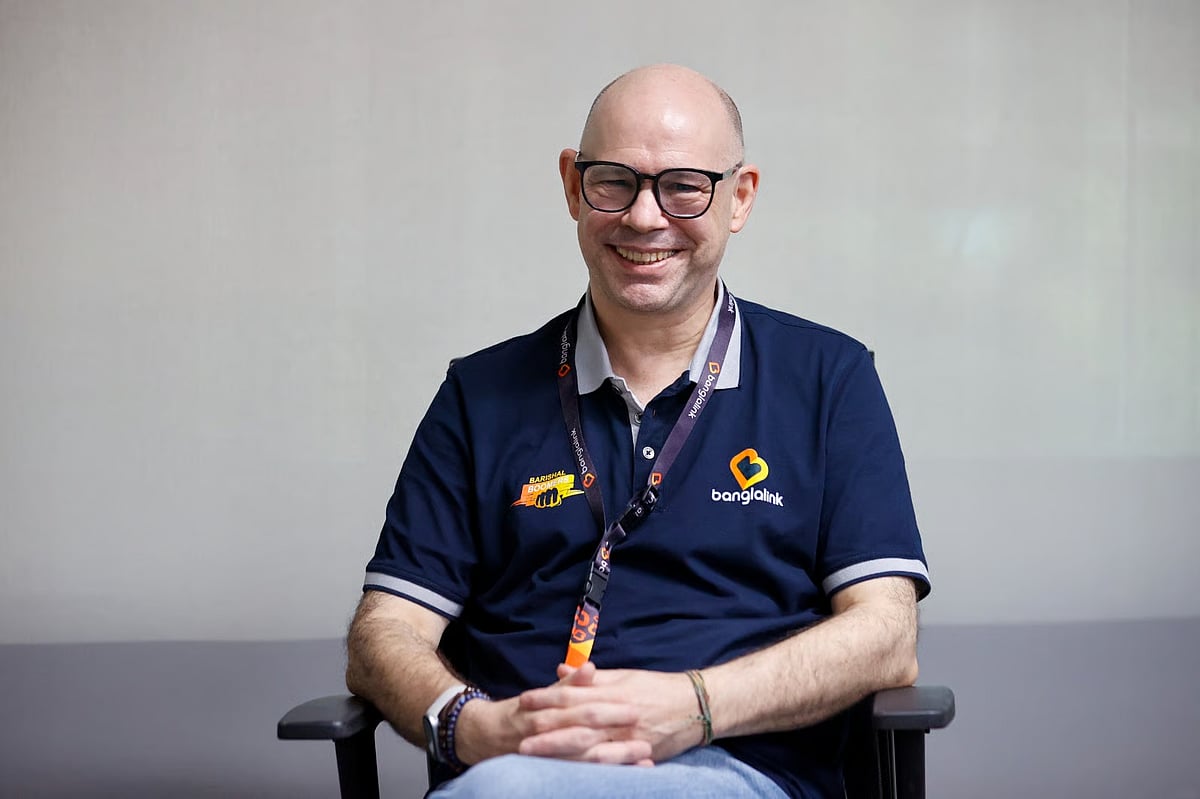
We will continue investing in Bangladesh: Johan Buse
Banglalink, one of the leading telecom companies, has been operating in Bangladesh for 21 years. The company has invested around $2.5 billion in the country. Recently, Banglalink Chief Executive Officer (CEO) Johan Buse discussed the company’s current operations, investment plans, interest in digital banking, and future outlook in an interview with Prothom Alo. The interview was conducted by Sujoy Mahajan and Shafiqul Islam.
You have led major telecom operators across Europe, Asia, and the Middle East. In that context, what do you consider the main challenges in Bangladesh’s telecom sector?
Johan Buse: The first challenge, in my view, is the tax structure. Compared to other countries, taxes in this sector in Bangladesh are unusually high. The second challenge is the complexity of the regulatory framework and the lack of policy continuity. And the third is the macroeconomic and political environment.
You mentioned high taxes and a complex regulatory system. How are these affecting business?
Johan Buse: Before coming to Bangladesh, I worked in Singapore, where corporate tax is around 22–23 per cent. In Bangladesh, the effective corporate tax is close to 50 per cent. In addition, there are various duties and taxes, including SIM card taxes. Overall, in the telecom sector, if we collect Tk 100 from customers, about Tk 70 goes directly to the government treasury.
There are also some unusual revenue rules here. For example, companies are taxed on turnover (revenue), whereas taxation should ideally be on profit. Spectrum costs in Bangladesh are also among the highest in the world. Pakistan can be a good example here. A few months ago, Pakistan reformed its spectrum strategy, reducing prices and making spectrum more accessible. The government still earns the same revenue, while operators can invest more efficiently and improve service quality.
However, I must say that in the last six to seven months, I have seen several positive steps in Bangladesh. For example, telecom licensing categories were reduced from around 26 to 13. These are positive developments.
For foreign direct investment (FDI), which is more important—good tax policy or political stability?
A good tax system is more important. Our parent company VEON operates in Ukraine, Pakistan, Uzbekistan, Kazakhstan, and Bangladesh. We know how to operate even in politically unstable environments. But high and complex taxation limits FDI in Bangladesh.
There is still a large informal economy here and many tax exemptions across sectors. That is not healthy for the economy. Bangladesh has excellent investment potential, but it needs to be unlocked. The solution is not to further increase taxes on those who are already paying high taxes. The system should be simplified, tax rates should be reduced, and the tax base should be broadened to make investment more attractive.
What is your view on turnover tax? And how do you see investment prospects in Bangladesh?
Johan Buse: We have been operating in Bangladesh for 21 years. Our total investment here is around $2.5 billion. Only in the last four years, we invested about $400 million in infrastructure and networks. We have never received any dividend, meaning Banglalink is operating as a loss-making company here.
When 70 per cent of revenue goes as tax, it becomes very difficult to make profit. Still, why are we here? Because we strongly believe in Bangladesh’s potential. Let me be very clear—we will continue investing in Bangladesh. We also have around $100 million ready for further investment in the country.
Does Banglalink have any plan to be listed in the stock market?
Johan Buse: We want Banglalink to be as locally owned as possible, and for that, we want to go for an IPO. Two years ago, we were very close to launching an IPO, but due to various complications, it did not materialise. The main challenge is the limited number of institutional investors in the market. However, we do have plans. We aim to go for both local and international IPOs in the coming years. Last year, VEON’s Ukrainian company Kyivstar was listed on NASDAQ in the United States. We also want Banglalink to become the first Bangladeshi company listed on NASDAQ.
What are your plans for expanding Banglalink’s business in Bangladesh?
Johan Buse: We have a three-year plan that we started last year. By the end of this year, Banglalink will transform into a group of companies. Connectivity remains our core strength, and we aim to evolve from a telecom operator into a digital operator.
We have already applied for a digital banking license. In the third quarter of this year, we will launch a PSP (Payment Service Provider) platform. We are also exploring opportunities in healthcare, e-commerce, and ride-hailing, similar to other markets where VEON operates.
A common complaint is that internet prices are high and quality is inconsistent. What is your response?
Johan Buse: No country in the world has 100 per cent coverage. There are natural limitations due to physics—signals cannot penetrate very deep underground or through thick walls. There are also practical issues, such as not getting permission to install base stations in certain buildings, which causes network gaps. In terms of pricing, when adjusted for per capita income, the cost of per-GB internet in Bangladesh is among the lowest in the world.
Active tower sharing is often suggested as a solution. What is the progress?
Johan Buse: Infrastructure sharing is profitable. It is especially essential in rural areas. However, to address network issues, we will soon be introducing Starlink services.
How will Starlink impact Banglalink’s network system?
Johan Buse: From next month, Banglalink will introduce internet services through Starlink. Customers will be able to use it on their existing mobile phones. If there is no ground-based base station, the phone will automatically connect to Starlink satellites. For example, a fisherman 20 kilometers out at sea will still be able to use the internet via Starlink. For indoor coverage issues, we have also introduced Voice over Wi-Fi.
Is Bangladesh ready for 5G right now?
Johan Buse: The local market is not ready for 5G. The number of 5G-enabled devices is very low, and nearly half the population does not even have smartphones. So for them, 5G is irrelevant at this stage. That said, we should start preparing now.
What steps are needed to improve spectrum management?
Johan Buse: Bangladesh can significantly improve spectrum efficiency. We need more low-band spectrum because it provides better indoor coverage. High-band spectrum is mainly for speed and capacity.
You have applied for a digital bank in partnership with Square Group. What is the progress?
Johan Buse: We are fully ready. We know how to operate this business, and we have the required capital. A large portion of the $100 million FDI we mentioned is intended for the digital bank. Together with Square Group, we can quickly build a large distribution network. Around half of the population in Bangladesh is still outside the banking system. We are now waiting for approval from the central bank. If approved, we will launch a full digital banking service, including microloans, by the end of this year.