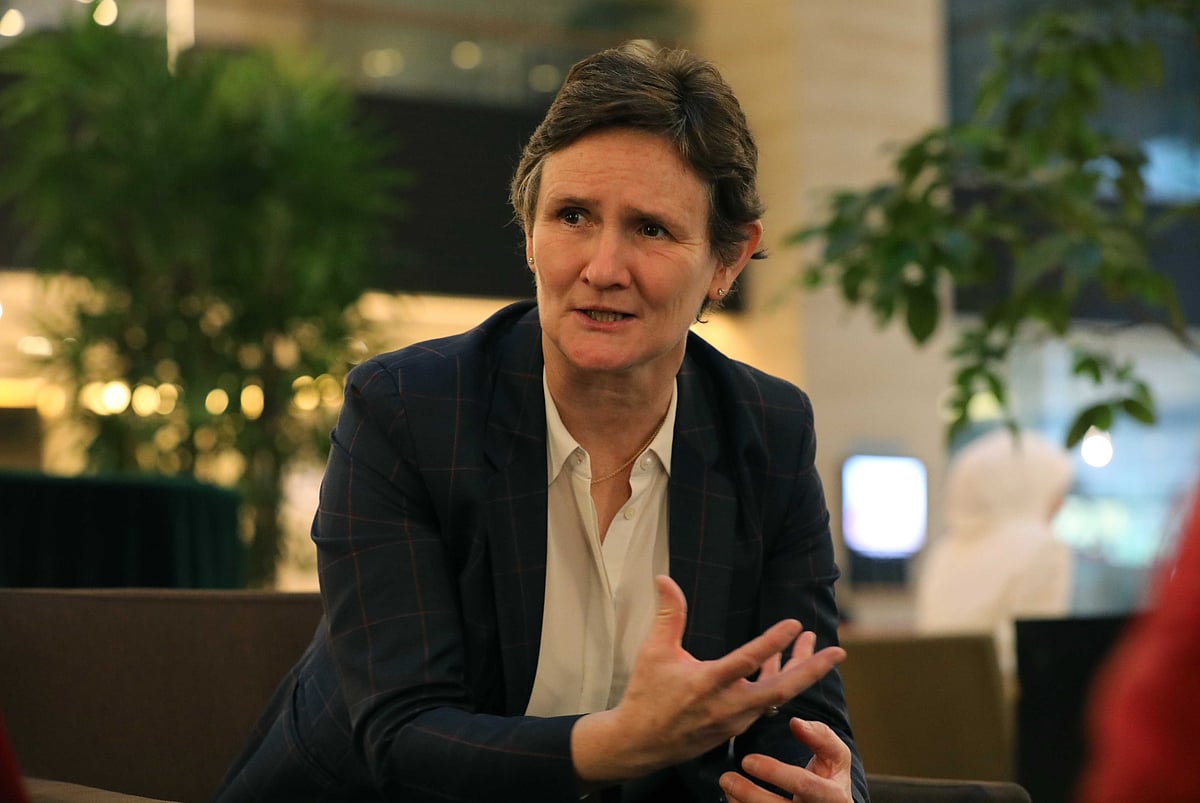
Exclusive Interview: Oxford VC Irene Tracey
A woman in leadership doesn't have to change and become like a man
Professor Irene Tracey is the Vice-Chancellor of the University of Oxford and Professor of Anaesthetic Neuroscience in the Nullfield Department of Clinical Neurosciences. She did her undergraduate and graduate studies at Oxford University, Merton College. Prof. Tracey is Oxford's 273rd Vice-Chancellor and only the second woman Vice-Chancellor in the history of this prestigious university. Professor Tracey has been awarded multiple prizes, honours and fellowships in academia and science, including a CBE. She is a fellow of the Royal Society and Academy of Medical Sciences.
During her recent visit to Bangladesh to attend the 12th commencement of Asian University of Women, Prof Irene Tracey spoke in an interview with Prothom Alo. She spoke of women's leadership, the importance of social sciences and more. This interview was taken by Ayesha Kabir.
You are here in Bangladesh to attend the commencement of the Asian University for Women. How do you see the significance of an institution like AUW in today’s global higher education landscape?
It certainly fills a much needed gap and I was aware of that before coming. But having been here to witness directly, by visiting the campus, meeting the students and the faculty, I am even more inspired about how unique this place is. There really isn't anything quite like it that I know of, worldwide. It is not just special and filling a gap in the higher education global market, it is doing something exceptionally different to most places and that is to be congratulated, applauded.
I have been truly overwhelmed by my first visit to Bangladesh and how friendly and kind the people are. I have been very inspired coming to the country.
Oxford is one of the world’s oldest and most prestigious universities. AUW was founded with a mission to educate women from marginalised and conflict-affected communities. So while these two institutions are very different, you did mention in your speech that there were similarities. What, in your view, can institutions like Oxford learn from universities like AUW, and vice versa?
That's a great question. I made the parallel today that we are very old and AUW is very young, but there are still commonalities which we've experienced historically which have no doubt been experienced here. Oxford has been around for a thousand years and has seen a lot of life and history. And as an institution that is still standing, we are still teaching largely in the same way that we taught a thousand years ago, still trying to discover truth and disseminate it and look after it for the next generation, discover research and understanding about ourselves as humans, about the planet and the universe. These are things that academic institutions have done for hundreds of years, through wars, through famines, throughout plague, through pandemics, yet we are still there, doing the same thing. And I hope that will give AUW, in its early infancy, confidence that it can get through difficult periods, and stick to its core mission of teaching and research and trying to make the education transformative for society.
And we can learn from here because when it is a new institute and smaller, it can be nimble and be a bit more experimental, a bit more able to pilot different ways of doing things. And that's great for us to observe because it is less easy for huge institutions to do that. It is wonderful for us to observe the template and model by which AUW has set itself up to target women and girls from displaced backgrounds.
Oxford is one of the few universities in UK that has now been awarded sanctuary status because of our historic looking after refugees that started during both the world wars and continued during the Greek famine -- that was the birth of Oxfam, it came from Oxford University. So we have a long history of also looking after refugees, giving them an education, caring for them and then seeing what impact that little bit of kindness has, the hope it gives.
But AUW is doing it in a very targetted fashion. That is wonderful to see. We can see just how well we are looking after our displaced students including from AUW who come to us as graduates. Clearly, these women are thriving. So we look at the ways that these women coming from different backgrounds, different cultures and different languages are able to find very quickly common ground, friendship and are able to thrive here. I hope a very bilateral, reciprocal relationship can be developed further with AUW.
Despite decades of progress, women remain underrepresented in leadership across academia, science, and public life. What do you see as the most persistent structural barriers that still hold women back?
That's another great question. These are issues we still deal with in Britain and our western universities. It's not as if it's a resolved problem. Some people think it is fixed, that the woman problem is fixed, but it is far from fixed. We still have gender pay gap. We still have glass ceilings. We still don't have the full representation of women in the private sector, in leading companies at the percentage that we populate the world, which is 50 per cent. So we see that still.
I have to always remind people that the work is not done for women representation even though it is very clear through the pipeline from schools, universities, it is fifty-fifty, it attenuates as it goes through. And we look at where those points of loss are -- we call it the leaky pipe -- where these women are dropping out.
We can't avoid the fact that, at a time when one's career is being established, it often coincides with the time if you want to have a family, have children. That is still a challenge for society to grapple with and it still largely -- not always -- falls on the women to do that. So these are still issues that have to be resolved. It can only be resolved if we are more equitable in our thinking around jobs, being more flexible to allow women to have that time and still come back rather than saying, "if you've gone, you've gone."
If you've trained somebody for years and they've gone to have a family and they want to spend four days a week with their family and one day at work, I would sooner have her for one day than no days. Having her amazing training, why would I not be more flexible for her even come in half a day? That's better than no days. This is talent that we could be using. So more flexibility is needed at the employers end.
Also, we do a lot of women's gathering, women's talks, women's empowerment, and I often say, enough! Men now need to come into the room and learn about what they need to do. The women have done enough and now it's the men who have to join the party. The men have to realise what their responsibility is in this journey. They need to be advocates and champions in the workplace for having that flexibility and supporting their wife or partner in terms of that family phase.
So those are some of the things we are still dealing with and this will be very common here as well. There is progress, but it is slow. I believe the quotas can be really problematic. We've never gone down that route in the university or largely in Britain. You just have to work harder to find the women, because one thing I have observed in my career, women are just less visible. So when people are thinking about who would be good for this job, it's very easy to remember the men because men are very visible. Women don't tend to put themselves forward as much. Or they are not just around because they are doing these other roles. So you just have to work a little harder. It is up to the people in leadership to say, we are really going to find the women out there. You just have to work a little harder to find them.
As a woman in a leadership position, do you feel the expectations placed on women leaders are still much higher than those placed on men, even in progressive academic spaces?
Yes, actually I think they are. Whether it is expectations being higher or not, people certainly judge you
You too?
Yes, certainly. I have always been a confident person and a person that tries to find a common ground in a situation with people and to build trust so that people aren't threatened necessarily by the fact that I am a woman in a leadership role. But you will, and I have, like all women, experience those biases and frustrations and these are live and present. I am sure men will experience similar ones in different ways as well. That is human nature, sadly.
I have observed slightly different rules apply to women leadership. They are judged a little bit more harshly and one of the things I emphasise is, a woman doesn't have to change and become like a man in leadership because you think that will be easier. You have to be authentic and you have to help shape the world to accept to accept that is going to be your style, that's the way you are going to communicate, and they have to be the ones to be flexible, as opposed to you having to bend to be something to suit them.
If people have a problem with how they think a woman should speak or be firm about things, well, that's not my problem. That is why I say in these training sessions and such, you don't need to do any more. You have done enough. It's the men who need to be in the room. They need to think of their mansplaining, explaining to a woman in a condescending way something she understands better than him. They have to learn this is very frustrating to us. Emphasis has to be given to training men to take ownership of the changes that need to happen.
Your own academic background is in neuroscience, yet you now lead a comprehensive university spanning the sciences, humanities, and social sciences. How has your scientific training shaped your approach to leadership and decision-making?
It all links to the question of being an authentic leader and recognising your personality, your characteristics, the way you approach problem solving. You are a product of your education and your genetics and your nurturing environment. You have to understand yourself, be honest with yourself about those characteristics and traits that you have and then use them, because that is who you are.
One of the things I observed running a big clinical neuroscience department to running my own college and now the university, is I was very used to dealing with medical people, scientists. We think quite similarly, we are quite quantitative, we are very analytical, we will solve problems by evidence-based data. We can use our intuition, emotional intelligence, but we are quite comfortable with evidence-based data-driven decision making. We are often quite quick decision makers because quite often the situation calls for quick response.
Then you start looking to other disciplines and it's more of a qualitative analysis of the whole problem and more of an emotional way to decide. They are slower, less risk-taking, take their time. You have to adapt to the fact that not everybody is going to want to make a move with you at the same pace and so you have to learn. Leadership is always learning, it's about flexibility -- that's okay. It doesn't mean that my way of doing things is the best way. But that is who I am and I have to accept that there are other ways of thinking about a problem and learning from them. It is a really healthy thing for me. It won't change who I am, but I have to learn to be flexible. And in all these leadership roles, you are always refining your own leadership style, learning how to be flexible.
But to answer your question, yes, I have a very particular way of leading that is drawn from my science training, which means I am very analytical, very data driven, I will balance evidence and then I will take risks because you have to be quite a risk taker to be a scientist.
I am a big sports fan so I am always inspired by brilliant athletes as well because of their commitment, dedication and the fact that they get beaten down and they have to get up and get going again.
At a time when universities are under pressure to prioritise “marketable” disciplines, how would you defend the value of the humanities and social sciences?
Being a scientist and speaking up for the humanities has been something that my colleagues from those disciplines have valued. Of course I am very passionate about STEM, but there is no point in having STEM if we don't understand what it is to be human, and we don't understand how to implement the STEM discoveries into society. So I have really learnt to appreciate, in this phase of my career over the past 15 or 20 years, the value of the humanities and social sciences and the fact that STEM subjects will have no impact if you don't work with humanities and social sciences. You can make a vaccine but if everyone is an anti-vaxxer because that's what the society is telling you, you are not going to have an impact. It is evidence-based, it should be true, but they don't care about the evidence. So I have really come to appreciate the value of interdisciplinary working. We have to be trained in our areas, but when you want to solve complex challenges, you have to work as an interdisciplinary team.
I really champion and speak up for the humanities, actually even more so now with AI. I think AI is going to destroy all the STEM subjects more than humanities. So there has to be even bigger emphasis on the need to have people trained in the humanities and social sciences because these are going to be critical when we are living along with AI, to remind us of the importance of being human and the value of human society. So hopefully humanities is going to be more popular in this period of our lives.
You certainly are an inspiration yourself. What about you? Was there a particular mentor that made a difference in your life, shaped your belief in education as a force for social change?
I have been very lucky when I reflect that I was very fortunate in the very early stage of my academic career, I had two of the only women professors in Oxford who were running departments so I was in an exceptional environment where there were women in leadership in two of the departments I worked in at that time. One of them is still my mentor. I look back and realise how important that was for giving me that sense that it was possible to be a great scientist, to run a department and to be a mother, and to be a nice person.
I have also been inspired by fantastic men too. Look at Kamal Ahmed [founder of AUW], what an inspiration! Here is this man that has created this extraordinary university. He is deeply committed. He is giving it his absolute life and soul. What an inspiring person. We need more men like him. He is the type of guy we need for men to model themselves on. And women can be inspired as well by him.
So I very much look to people, history as well, and people in sports too. I am a big sports fan so I am always inspired by brilliant athletes as well because of their commitment, dedication and the fact that they get beaten down and they have to get up and get going again.
So yes, it is important to have mentors and to have people who inspire you in your life.
Finally, what will you take back with you from this visit to Bangladesh, intellectually or even emotionally?
That's a difficult one! I'm taking back a lot, a lot more than I expected to take back. I am inspired by what AUW is doing. That is something that is unique in the world. That is intellectually really exciting and interesting. And I am excited about the new campus. I am inspired by the students. They are extraordinary because of the journey they have taken just to get here. I will be sharing these stories with my students and my children to make them realise just how fortunate they are.
It has helped me to calibrate the good fortunes that we have where we are from, and it's always good to juxtapose that with the passion for education that these women have, the sacrifice and the journey they have had to go through to get here. I am going back and will share these stories with our students, to inspire them.
Thank you so much.
Thank you and best of luck to you all.