Opinion
The defence industry model from which Bangladesh has lessons to learn
Discussions about Bangladesh's defence sector in public forums typically revolve around two main topics: the purchase of new weapons for enhancing military capabilities and allocations for the defence budget. Questions like how many new aircraft were purchased, how many warships were added to the fleet, and whether the defence budget share has increased or decreased dominate news headlines.
However, one important question often remains unaddressed—does this expenditure create a foundation for any domestic industry, technology, or research within the country?
The answer is not very encouraging. A significant portion of Bangladesh's defence expenditure goes towards purchasing foreign technology and equipment. In the short term, this certainly adds new capabilities, but in the long run, the opportunity to develop domestic technology industries, entrepreneurship, and university research capacity remains untapped.
Yet, since the time of the Second World War, many countries have been using their defence expenditure not only as an investment in security but also as a strategic investment in technology development and industrial growth. It’s time for Bangladesh to adopt this new perspective.
Armed forces-industry-academia nexus
During the Second World War, a unique cooperation structure began forming in many countries of North America and Europe, known today as the ''Armed Forces-Industry-Academia Nexus.''
The core idea of this model is simple—the armed forces identify their technological problems and various needs, the government creates special research funds based on these demands, and universities and private institutions seek solutions. The successful technologies are used by the defence forces and, in many cases, exported to international markets.
The benefits of this process are multifaceted. Government funds reach domestic entrepreneurs, university research is connected to practical technology development, creating new industrial sectors and employment opportunities. Almost all the technologies that have transformed our daily lives today (such as the internet, GPS, satellite communication) began with state-funded defence research. Many world-renowned technology companies received their first investments from military research programmes.
The notion that only renowned large corporations can contribute to defence technology is now quite outdated. Developed countries have launched various direct investment programmes to engage small and medium entrepreneurs and startups in defence innovation.
In the United States, programmes like Small Business Innovation Research (SBIR) and Small Business Technology Transfer (STTR) encourage numerous startups to work on defence technology innovation and development. Canada’s Innovation for Defence Excellence and Security (IDEaS) programme directly finances private entrepreneurs for testing and developing new technologies. Recently, NATO has launched the Defence Innovation Accelerator for the North Atlantic, aiming to accelerate the innovation of defence technologies.
The common thread among these programmes is that the armed forces do not make all technologies themselves. Instead, they identify needs and challenges for entrepreneurs and innovators in the private sector, fund suitable proposed projects, and create an open and sustainable environment for innovation in their respective markets.
Bangladesh’s untapped potential
Bangladesh's defence expenditure is still primarily purchase-centric. The usual trend is to buy necessary technology or equipment from abroad. This can quickly enhance military capability, but it does not develop a domestic industrial and research ecosystem.
Yet, the potential is not insignificant. Bangladesh’s universities have skilled researchers in fields of engineering and technology. There is also a growing number of small entrepreneurs working in information technology, electronics, and robotics. However, they have no effective connection with the country’s defence sector. As a result, the money spent in the defence budget fails to harness the potential for developing technology research within the country.
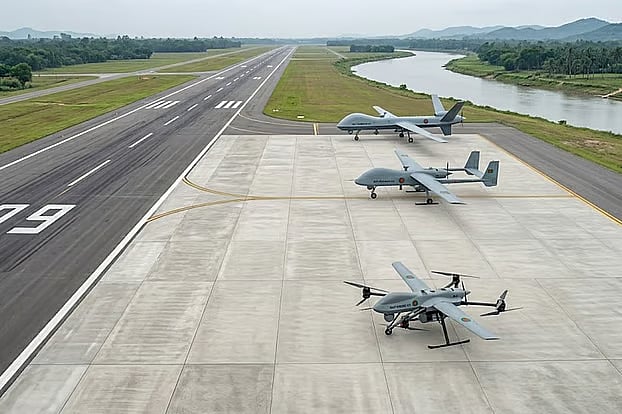
There are also significant transformations underway in the global defence technology supply chain. New opportunities have particularly emerged in the drone or unmanned aerial vehicle industry. NATO countries want to reduce dependency on Chinese technology and seek alternative production partners. However, producing all components in their own countries is expensive for them. Therefore, they are looking towards countries where high-quality technological components can be produced at comparatively lower costs.
Neighboring India has sensed this opportunity and made major investments in drone technology development, encouraging local startups with policy support. The door of opportunity remains open for Bangladesh as well, but time is limited. With appropriate policy support, Bangladesh’s private industrial sector could become an important part of this global supply chain.
Recently, it has been learned that the Bangladesh Air Force has initiated a plan for drone production and assembly under a contract with China. Such steps can open a path for technology acquisition in the short term. However, these strategies have a significant limitation. If the armed forces themselves manage the production framework, the potential to build a broad technology ecosystem centered around private industry and university research diminishes.
Developed countries have generally not followed this path. Instead, they have positioned the government not as a direct manufacturer, but as an active sponsor of innovation, where private entrepreneurs play a central role. The government and armed forces support emerging local entrepreneurs as buyers.
Need for a national defence industry policy
If Bangladesh truly wants to transform defence spending into long-term technology capability, then drafting a clear national defence industry policy with this goal is essential. This strategy could be based on four main pillars. First, forming a special fund for defence technology innovation, where startups, researchers, and technology companies have the opportunity to propose solutions to specific problems.
Second, effectively linking university research with defence technology development. In areas like artificial intelligence, robotics, and materials technology, there is an opportunity for Bangladesh’s researchers to make substantial contributions.
Third, providing policy support to integrate local private industry into the defence supply chain and establishing an Innovation Challenge Fund. This could create new and sustainable markets for small and medium entrepreneurs.
Fourth, devising a strategy to expand defence-related business in an export-oriented industrial policy with future prospects in mind. Preparations must start now to broaden the opportunity for participation in the global defence technology market.
Not an expense, but an investment
The time is running out for viewing defence expenditure merely as a cost. Countries that have been able to use the defence sector as an engine of innovation and industrial growth have advanced not only militarily but economically as well.
Due to new innovations in small and medium drones, robotics, and artificial intelligence, a sort of overhaul is occurring in the global defence industry this decade. As a result, Bangladesh has a new opportunity to prepare itself for participating in the global defence industry market afresh. Bold policy decisions and effective initiatives are necessary, centered around transforming defence expenditure from a budget for purchasing equipment into a long-term investment in building domestic technology capability. The time for this new thinking is now.
*Galib Ibn Anwarul Azim is an conomist, working at the Department of National Defence, Canada.
*Opinions expressed are the author's own.
#This article, originally published in Prothom Alo online edition, has been rewritten in English by Rabiul Islam.