Zahed ur Rahman’s column
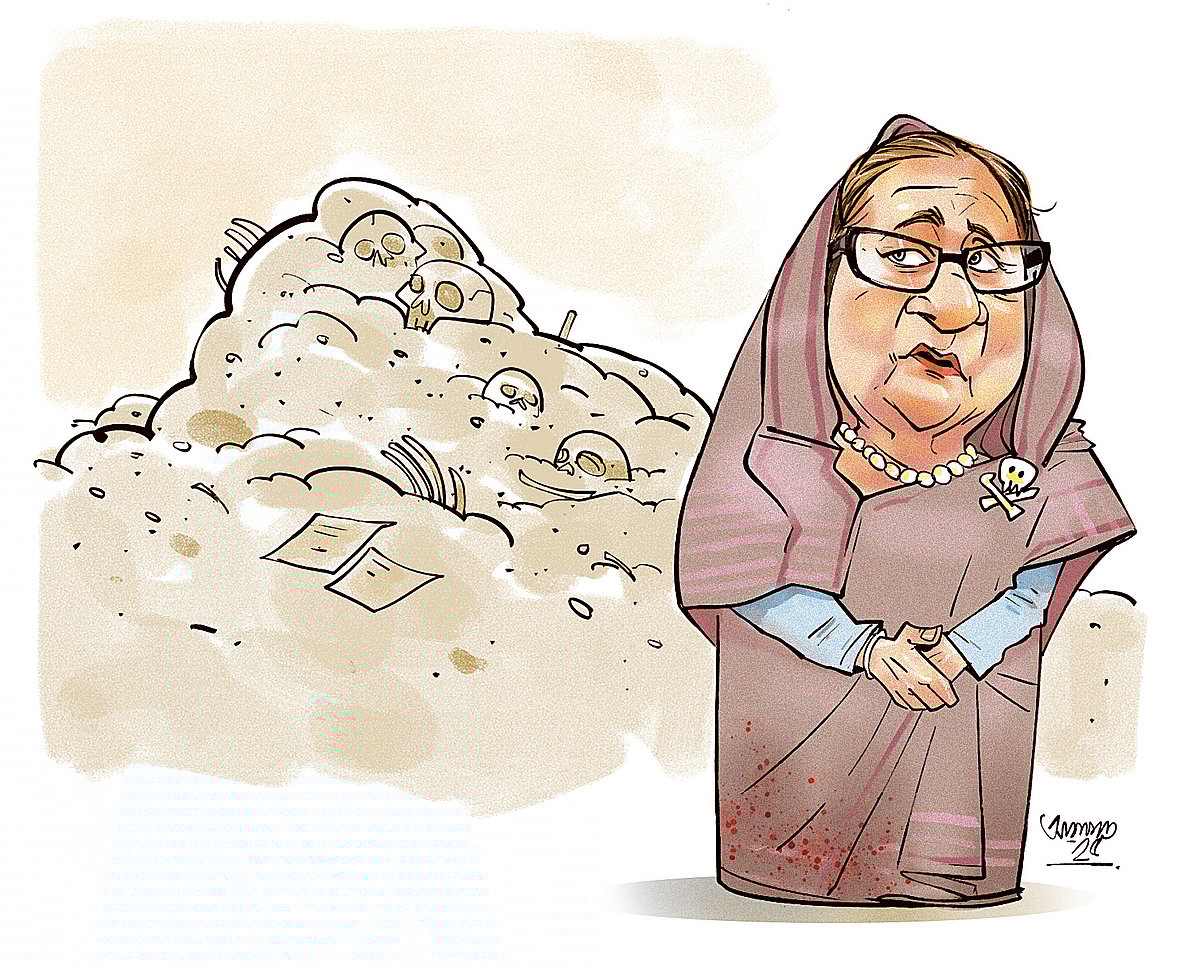
Crimes against humanity: Sheikh Hasina’s sentence and her political demise
As a nation, it is profoundly tragic and deeply shameful that crimes against humanity have been committed in this state in contemporary times. Yet it is also a matter of immense pride that through a genuine mass uprising, we succeeded in toppling those responsible and compelling them to flee the country. Following their fall, the responsibility of ensuring justice for those crimes has rested upon us as a nation.
Every act of justice serves as a deterrent against the repetition of similar crimes in the future. And because Sheikh Hasina’s crimes and trial have drawn international attention, the verdict is likely to have global implications as a deterrent as well.
The allegations against Sheikh Hasina went far beyond mere killings or acts of torture; they constituted crimes against humanity. Not only during the July mass uprising, but throughout her tenure, enforced disappearances and extrajudicial killings were carried out systematically.
Beyond that, the planned torture of BNP (Bangladesh Nationalist Party) activists, and for a time, custodial torture, filing fabricated cases, and various forms of persecution of Jamaat-e-Islami activists also fall within the ambit of crimes against humanity.
In the verdict of the first case filed against Sheikh Hasina, she received, as widely expected, the maximum penalty, death for three of the five charges. She was sentenced to life imprisonment for the remaining two charges.
The mass uprising against Sheikh Hasina will remain an extraordinary example in world history. Unarmed civilians, relying on nothing but moral force, confronted state forces and endured unimaginable brutality. There are records of mobile phone conversations that reveal that Sheikh Hasina is coolly instructing the use of lethal force in suppressing the protests. News media such as Al Jazeera and the BBC independently carried out forensic analyses for their documentaries and confirmed that the recordings were authentic and not technologically fabricated.
The possibility that Sheikh Hasina will be brought back to Bangladesh during her lifetime to face execution currently appears remote. The way the Indian government is providing refuge and security to her, makes it almost certain that she will not be handed back.
Those who were involved in resisting Sheikh Hasina’s mafia-like system, especially the bereaved families of the dead, those who were blinded or maimed, and the injured, were naturally keeping a close watch on this trial. But we must also remember that the verdict held significance for countless political activists and apolitical citizens, who suffered repression for opposing the Awami League’s prolonged rule over 15 years (including 10 and a half years in power unlawfully), and, also for the millions whose democratic rights were eroded and who were reduced to mere subjects in their own land.
This verdict has unquestionably delivered justice. Yet one may ask: will the verdict ultimately remain merely symbolic?
The possibility that Sheikh Hasina will be brought back to Bangladesh during her lifetime to face execution currently appears remote. The way the Indian government is providing refuge and security to her, makes it almost certain that she will not be handed back. Evidence of India’s mindset may be found in the fact that despite repeated objections from Bangladesh, including from the chief adviser himself, India has not prevented Sheikh Hasina from persistently making provocative statements against Bangladesh. Even on the day before the verdict, she issued grave threats against the forces behind the uprising.
Given the UN’s and international organisations’ opposition to capital punishment, it will be nearly impossible to mount pressure on India through them to return Sheikh Hasina. Nevertheless, the Bangladesh government should still exert direct diplomatic pressure on India for her extradition. The Indian government must consider that if it seeks to develop a sustainable bilateral relationship not merely with an individual or a single party, as in the Hasina era, but with the people of Bangladesh, then it must reconsider its position on Sheikh Hasina.
Under the Rome Statute, a confirmation-of-charges hearing may in special circumstances be held in absentia, but neither the main trial nor the subsequent hearings can take place without the presence of the accused.
Some questions may arise internationally regarding Sheikh Hasina’s trial. The UN and the Western countries oppose the death penalty. Additionally, the trial of an accused in absentia for crimes such as crimes against humanity is regarded as inconsistent with international standards.
Under the Rome Statute, a confirmation-of-charges hearing may in special circumstances be held in absentia, but neither the main trial nor the subsequent hearings can take place without the presence of the accused.
We can hope that the government, particularly the chief adviser, will be able to use his international stature to manage such pressure. Commissioning a full investigation by the UN High Commissioner for Human Rights will be considered as an extraordinary decision by the interim government. In its report, the OHCHR stated that crimes against humanity were committed on a large scale in Bangladesh during the July uprising, and that Sheikh Hasina was the principal decision-maker in the planning, leadership, direction, and coordination of those crimes.
Time will tell whether Sheikh Hasina can ever be brought back to face the verdict. But even if that proves impossible, the verdict has definitively sealed the end of her political future.
Discussions are ongoing regarding the possibility of trial of the Awami League as an organisation at the international court. Even if, for the sake of argument, such a tribunal were to conclude that the Awami League as an organisation is not guilty of crimes against humanity and thus is not banned, the fact remains that age does not favour Sheikh Hasina.
And even if the political context somehow permitted her return, it is virtually inconceivable that she could regain control of the party or resume leadership. At most, she may continue issuing incitements through occasional audio statements (she may avoid video messages to prevent showing her defeated appearance), which is likely to have only negative consequences for her party.
Given how well-known Sheikh Hasina and those at the centre of her power structure are, it is unsurprising that neither she nor those complicit in crimes against humanity will come close to acknowledging their guilt. But it is disheartening that a large section of the party’s supporters still have not grasped the scale and severity of the crimes committed by her and her associates. We want to hope that this verdict will prompt some of them to rethink.
People founded the state to establish a system within which all would live under a set of rules, and where breaches of those rules would be addressed through justice, thereby setting precedents for state and society. When a state fails to deliver justice, especially in cases involving crimes against humanity, it undermines its own legitimacy to administer justice in any matter. We must remember Martin Luther King’s famous dictum: “Injustice anywhere is a threat to justice everywhere.”
* Zahed Ur Rahman is a teacher and political analyst
* The opinions expressed are the writer’s own.