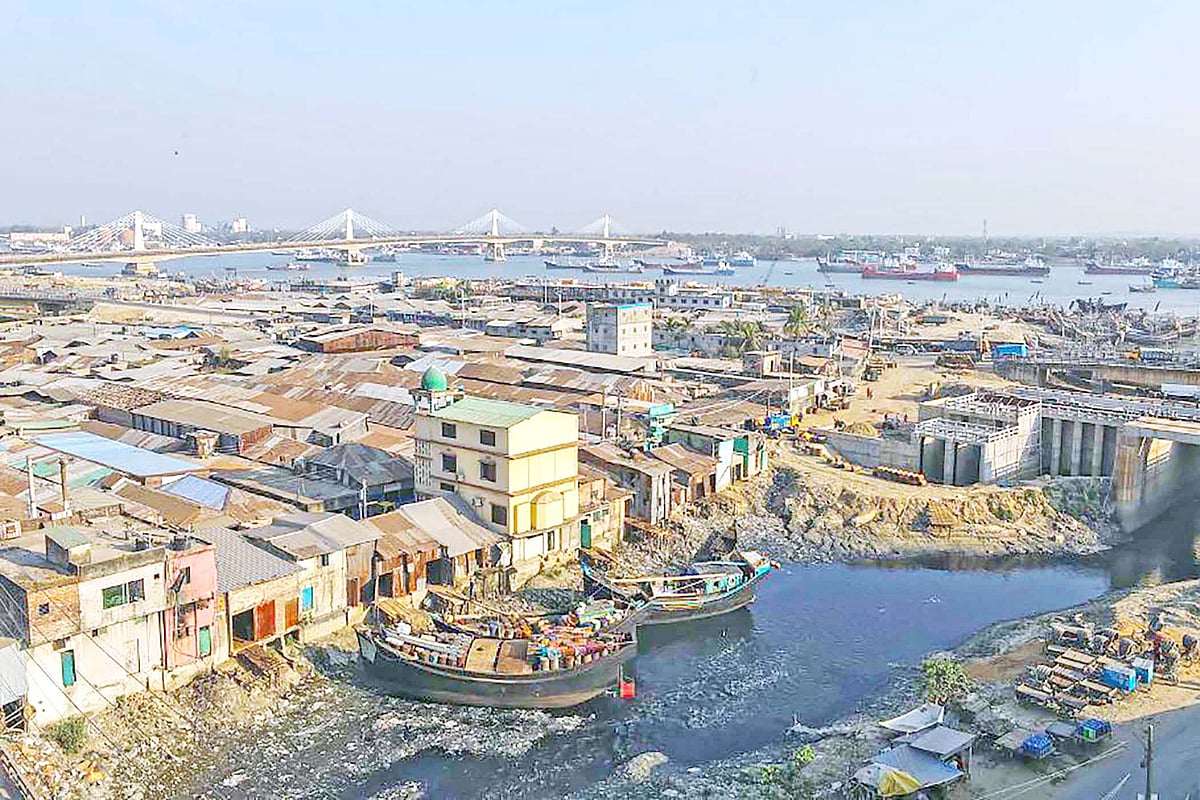
Before the upcoming election on 12 February, political parties in the country are releasing their election manifestos and using them in their campaigns. Naturally, the election manifesto and promises from the BNP are drawing special attention from the public.
One of the election promises announced by the BNP is to excavate 20,000 kilometers of canals throughout the country. On 20 January, at a prayer and discussion event organised by the Banani Society in memory of former Prime Minister Begum Khaleda Zia in Banani, Dhaka, Tarique Rahman made this announcement.
To explain why canal excavation is necessary, he primarily mentioned issues of waterlogging and drainage problems in urban areas. He stated, "The canal digging programme initiated by my father, the late President Ziaur Rahman, was significant for people across different regions of the country. Residents of Dhaka city also feel the necessity of canals now, as problems have been created due to the closure of canal after canal. Therefore, if the BNP is able to form the government with the people's vote in the upcoming elections, 20,000 kilometers of canals will be excavated throughout Bangladesh." (Source: bnpbd.org//all-news)
Canals are an important part of Bangladesh's flowing water bodies. From the perspective of size, flow volume, and function, some canals are even more crucial than many rivers. Despite that, there is a fundamental difference between canals and rivers. Rivers are entirely natural constructs, whereas canals are generally man-made.
In the 1950s, foreign agencies and consultants disregarded this reality and imposed the ''enclosure approach'' with so-called ''water development'' projects. This method of permanently separating floodplains from riverbeds through embankments has proven unsuitable for Bangladesh, being a primary cause of the degradation of the river system and the expansion of waterlogging in urban and rural areas.
That's why we talk about constructing canals but not rivers. To clarify this man-made characteristic, many canals are referred to as ''cut canals.'' In many places, canals were cut so far back in the past that they now appear to be part of nature. Sometimes even natural rivers are referred to as canals.
Regardless, like rivers and small water channels, canals are significant components of the country's river system. Hence, canal excavation should be considered a part of the rejuvenation of the river system in the country. Without re-establishing connections with rivers, merely excavating canals within cities will not solve the problems of waterlogging and drainage. This raises the question—where will the water in the canals go? (See my article, ‘Where Will the Canal Water Go?’ The Daily Star, 10 August 2009)
Let's consider Dhaka city. At one time, there were nearly 50 canals running through this city, connecting it to the Buriganga, Turag, Tongi Khal, and Balu rivers. Due to neglect and encroachment, these canals have been deteriorating for a long time. Following the flood of 1988, the ''Greater Dhaka Western Embankment'' was constructed, severing Dhaka's canals from the Buriganga and Turag rivers.
Later, a project was also enacted to disconnect the eastern side from the Balu river, although environmentalists recommended constructing it as an elevated expressway to maintain the city's connection with the rivers. Because of these embankments, the flow of water from Dhaka’s canals to the rivers virtually stopped, exacerbating the waterlogging issue. In this reality, merely excavating canals will not resolve Dhaka's waterlogging; the connections with surrounding rivers must be restored.
The programme for digging 20,000 kilometers of canals signifies a nationwide initiative. It shouldn't require such extensive excavation solely for the restoration of urban canals. Ziaur Rahman’s canal excavation programme was also spread across the nation. Along with canals, he initiated the re-excavation of rivers, such as the Brahmaputra. The question is, what will be the overarching purpose and specific targets of canal excavation?
To find answers, attention must be given to two fundamental characteristics of Bangladesh's rivers. One is the extreme seasonality of flow, with approximately 80 per cent of annual rainfall occurring in just four months. Moreover, nearly 93 per cent of our rivers' water source areas lie outside the country's borders, further amplifying the seasonal variations. The second characteristic is the large amount of silt load. Despite some reduction due to upstream interventions, around one billion tonnes of silt still arrive in Bangladesh annually.
Because of these two characteristics, an "open approach" is suitable for Bangladesh’s river systems, allowing river water to overflow into floodplains during the rainy season, depositing silt, raising land elevation, and replenishing all reservoirs including groundwater. Stored water aids river flow in the dry season and supports activities like irrigation.
Due to this institutional void, villages have become somewhat disempowered, looking upwards for any collective effort. To make the canal excavation programme successful, we must consider re-introducing village governments. However, care must be taken to ensure these do not become centres of corruption and political division. The aim of this system should be the optimal use of resources available within villages through collective effort, rather than relying on government funds.
Meanwhile, less silt is deposited in the riverbed, maintaining river depth.
To address this reality, the people of Bangladesh historically developed the eight-month embankment approach. During the four months of the rainy season, these embankments were opened to let silt-laden water enter the floodplains. For the remaining eight months, the embankments were closed to store water.
However, in the 1950s, foreign agencies and consultants disregarded this reality and imposed the ''enclosure approach'' with so-called ''water development'' projects. This method of permanently separating floodplains from riverbeds through embankments has proven unsuitable for Bangladesh, being a primary cause of the degradation of the river system and the expansion of waterlogging in urban and rural areas.
There should be a return to the open approach to eliminate waterlogging and rejuvenate rivers and floodplains. The canal excavation programme could support this return, but if used otherwise, it may become aimless.
The success of canal excavation is closely linked to another factor: the use of the soil excavated. Often, this soil is left on canal banks, only to wash back into the canals, negating the benefits of the excavation. Utilising this soil to raise the plinths of villages located in floodplain and tidal areas can also help mitigate the impacts of climate change.
However, implementing these actions requires effective institutional structures at the village level. Currently, the local government system is limited to the union level, creating a void in joint management of people, land, and water in villages. Ziaur Rahman's ''self-reliant village government'' initiative is noteworthy here. This system emphasised the joint utilisation of available labour and resources within villages. Since its abolishment in 1982, no effective local government structure has been established at the village level.
Due to this institutional void, villages have become somewhat disempowered, looking upwards for any collective effort. To make the canal excavation programme successful, we must consider re-introducing village governments. However, care must be taken to ensure these do not become centres of corruption and political division. The aim of this system should be the optimal use of resources available within villages through collective effort, rather than relying on government funds.
Overall, to make the 20,000-kilometer canal excavation programme meaningful and effective, its technical and environmental objectives need to be clarified on one hand, and the necessary institutional reforms must be given serious consideration on the other.
#Dr. Nazrul Islam is a professor, Institute of Asian Growth Research and Former Head of UN Development Research
(nislam13@yahoo.com)
*Opinions expressed are the author's own.
#This article, originally published in Prothom Alo print and online editions, has been rewritten in English by Rabiul Islam