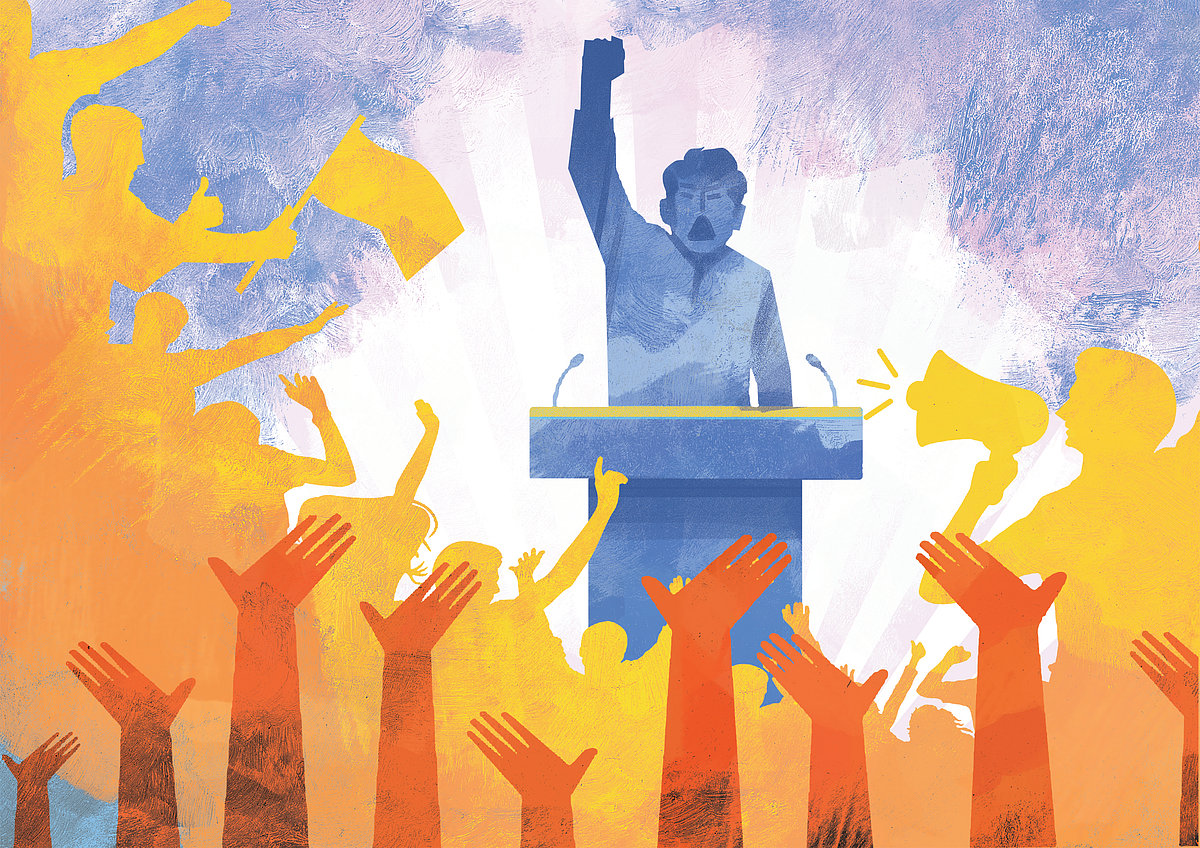
In this country, there is a popular phrase—people's court. Politicians are quite fond of this saying. It's very appealing. Once they are on stage and have a microphone in hand, they make their demands in the people's court. Here, the people are those sitting or standing in front of the stage. Their numbers sometimes range from ten to fifteen, or even more than a hundred thousand. Some come voluntarily, while others are brought in by various means.
If there are more people at a public meeting, the esteem of the leader and their party grows. If there are fewer people, they cannot show their face. There are projects to increase the crowd. Agents are appointed. Many of these agents are petty leaders at the local level of the party, while some are professional crowd suppliers. A large budget is allocated for this. The funding comes from the party or a leader’s personal fund. This fund is created with collected money. There are no written accounts for this, so it doesn’t get caught in audits.
Let’s say, a petty leader has the responsibility of bringing a thousand people. The petty leader sometimes outsources this task, meaning they assign ten others to bring people. Here, the petty leader acts as a wholesaler. Then the action begins. Groups of people start arriving at the field. Some come in trucks, some in buses. For this occasion, many trucks and buses are rented. Many vehicles are forcibly brought in. If it’s a government party meeting, few transport owners dare to ignore the whim of the petty leader.
These people come with much trouble, losing a day's wages. Attempts are made to compensate them with cash. This is somewhat like government officials' TA-DA. Often, they receive this special allowance in advance. Sometimes its distribution happens right at the field. If the allowance is not given properly, chaos ensues. Sometimes there are scuffles and fights over the share of the allowance. Occasionally, some curious journalist asks a recipient, whose meeting have you come to attend? The poor person doesn’t even know whose meeting it is, or who the speaker is. They know only the contractor who brought them. They got money, so they came. A few days ago, an inquisitive journalist provoked a woman to say she came to the public meeting of ''Pipinul’. I think Pipinul will become as popular as ‘Joj Mia’ in due time and enter our vocabulary.
There are hardly any open fields or greenery left in this city. Whatever there was, has disappeared due to development and urbanisation. In the eighties, there used to be an open field to the south of Baitul Mukarram. The roof of the ticket office in the stadium was used as a stage. There was no chance of holding public meetings in Paltan Maidan. Everyone would crowd into Baitul Mukarram Square. Announcements for public meetings could be heard on the microphone—on such and such date, an historic public meeting of such and such party will take place at the holy premises of Baitul Mukarram. Every public meeting in this country is historic.
Small parties have various problems. They don’t have money. They don’t have a vast workforce. The party lacks captivating speakers. Few people attend their public meetings. I remember, Nazir Ahmed, the president of the National Awami Party, once jokingly said—one can gather a few thousand people just to eat nuts at Baitul Mukarram Square in the evening. This is used to claim there are many people at the public meeting. He once said—fifteen speakers, thirty police officers, and ten listeners in the field. This is not entirely trivial. We still see newspapers publishing pictures of such public meetings. In the pictures, you see the speakers lined up. The audience is not shown.
Even newspapers have empathy! There is also a strategy in taking pictures. To show a large crowd, pictures are taken from very close. It appears there is no room to move in the field. But if taken from a distance or from a high building, it shows large empty spaces. Then the whispers about the photo begin.
Let me get to the main point. I started the article with the people’s court. We often say loudly that the people’s verdict is final. People give a verdict through voting. Many do not like the verdict given through voting. Moreover, many cannot wait until the next election. They bring politics to the streets or the field. There they gather thousands of people. I’ve already given a hint of how they are gathered. So, the leader gets on stage and delivers a fiery speech. The more people in the audience, the happier they are. At one point in the speech, the leader calls out to the people—Do you want this government to resign?
The crowd shouts—Yes. The leader’s voice rises to the seventh sky—Then show your hands. The people raise their hands. No, not just one hand, raise both hands. The people raise both hands. The leader then sighs with satisfaction and says—I have received the people’s verdict; this government no longer has the right to stay in power for even a single day. The movement of people’s hands is much like a ‘conditioned reflex’.
Everyone around them raises their hands, so they do too. The next day, the news is published in the paper—Million voices in thunderous slogans!
There is a constitution in the country. Although not everyone adheres to it. Still, elections are held. The Parliament convenes. Parliament is a place for discussion. However, many of us do not consider Parliament to be the appropriate forum for decision-making. Many of them are few in number.
Decisions are made at the will of the majority. This cannot always be accepted. Thus, voices rise—The decision will be made on the streets. This tactic of taking politics from Parliament to the streets has been applied by everyone sooner or later. Maybe it will be done in the future as well. Because the divine force is not in Parliament. It resides in the street. There, a thousand or so people will set up a court and give a verdict—this government must go.
Those who conduct politics by accepting the crowd on the streets and fields as the supreme commander, their words make the people happy. The people think that this leader is giving them much importance, respecting them. At the words of the leader, the street crowd becomes reckless. They sometimes attack the opposition. They uproot trees planted by the roadside, break neon signs, and loot nearby shops. This people’s activity has been named spontaneous movement by the leaders. They do not see the fights, or the vandalism. They see a movement.
There is no patience to wait for the election. Everything must be resolved on the streets. Let’s go, let’s go to Shahbagh. If you sit at the corner of Shahbagh for an hour, the entire city can be brought to a standstill. People get stuck in traffic jams. They cannot go to school or the office. Patients die on the way since they cannot reach the hospital. So what? For the greater interests of the nation, small personal inconveniences must be accepted. This is called patriotism! On a 26 March, a big party held a public meeting in the middle of the city for Independence Day. Traffic was jammed all over the city. When someone expressed frustration, a petty leader rushed towards him—you scoundrel, how dare you speak against the spirit of independence!
For quite a while, another nuisance has been observed in the country. It’s named mob. A group of people can gather and do whatever they please. Nothing can be said against it. A political pir issued a fatwa—those who deride it as a mob are cronies of dictatorship. If someone is tagged as a ‘crony of dictatorship’, anything can be done against them!
“We haven’t left the streets”—this revered slogan keeps us intoxicated.
*Opinions expressed are those of the writer.
*Mohiuddin Ahmad is a writer and researcher
#This article, originally published in Prothom Alo print and online editions, has been rewritten in English by Rabiul Islam