Opinion
Who spread rumours about Khaleda Zia's illness—and why
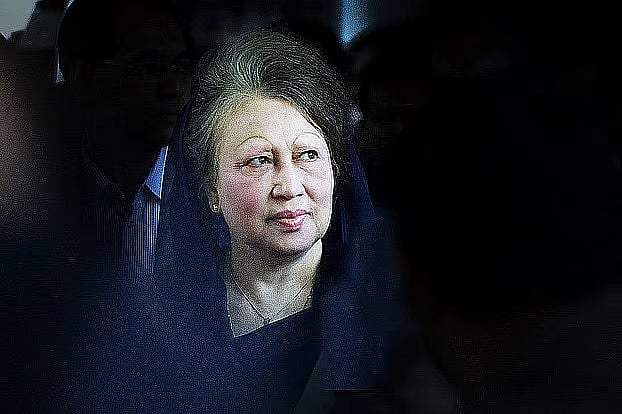
Bangladesh is passing through a period of profound national mourning. Begum Khaleda Zia, the country’s three-time prime minister, passed away at around 6:00am on Tuesday at Evercare Hospital in Dhaka, where she had been undergoing treatment in the intensive care unit.
Her funeral prayer was held on Wednesday afternoon at the South Plaza of the National Parliament Building. In this moment of deep sorrow, hundreds of thousands of people from all walks of life—including political leaders, activists, and supporters—gathered to pay their final respects to Begum Khaleda Zia.
Following the highly emotional and massive funeral, Khaleda Zia was laid to rest beside the grave of her husband, martyred President Ziaur Rahman, at Zia Udyan. With this, the life of an extraordinary leader came to an end—one who reshaped Bangladesh’s democratic journey and left an indelible mark on the nation’s political and social history.
Recently, a deeply troubling rumour has been widely circulated on social media, claiming that Begum Khaleda Zia had actually died earlier and that news of her death was “announced later” for political reasons. This claim is not only an outright falsehood; it is also profoundly irresponsible and undermines the moral foundations of our society.
Such disinformation becomes even more reprehensible when it is directed against a woman who began her life as a homemaker, rose to national leadership after personal tragedy, earned the people’s mandate through democratic struggle, and for decades came to symbolise national unity, constitutional governance, and political stability.
A so-called right-wing group deliberately tried to create confusion by citing the use of life support. This is either a conscious distortion or a serious display of ignorance of basic medical science. Life support is used to maintain the normal functioning of the heart and lungs in a deeply unconscious state. It is in no way a declaration of death.
There are countless documented cases in medicine where people have remained on life support for months, even years, and have recovered to return to normal life. From both medical and legal perspectives, a person cannot be declared dead as long as their heart is beating, blood is circulating, and vital organs are receiving oxygen.
The same was true in the case of Begum Khaleda Zia. While on life support, her heart was functioning, her organs were physiologically active, and she was even receiving regular dialysis. She was alive.
At the same time, this incident highlights a larger and growing problem. The rapid spread of social media, combined with the easy dissemination of rumours, misinformation, and disinformation, has greatly increased the risk of confusion and false narratives.
In a complex and polarised political environment like Bangladesh, such uncontrolled falsehoods spread quickly, stir emotions, and weaken public trust, making responsible communication and access to accurate information more critical than ever.
Death is a precise medical and legal determination. It is not a political opinion, a social media speculation, nor can it ever be used as a tool for partisan provocation. Those who knowingly blur this boundary not only attack political differences but also violate ethical standards and dangerously misuse modern communication technologies.
This issue is not limited to politics alone: if social media can be used to insult and strip a nationally respected figure like Khaleda Zia of her dignity, no ordinary citizen will be safe tomorrow. Such actions generate fear, disorder, and deep mistrust, ultimately undermining the social fabric and moral foundation of society.
The harm caused by such rumours is not limited to a single individual or family. In politically polarised Bangladesh, with its painful history of divisions, such falsehoods fuel public anger, mental distress, and collective despair. They strengthen a vicious cycle in which lies survive, trust erodes, and basic human decency is sacrificed for political gain.
Even those who disagree with Khaleda Zia’s politics—or with the Bangladesh Nationalist Party as a whole—must acknowledge that respect for the truth and for human life is never negotiable. Democracy does not survive on elections alone; it endures through principles, integrity, restraint, and mutual empathy. When these values collapse, politics becomes a stage for cruelty rather than a contest of ideas.
Spreading rumours about the death of any individual, especially a former head of government, is not an exercise of “freedom of expression”; it is social sabotage. It dishonours the family, misleads citizens, and pollutes the public sphere. Even more alarming, it normalises the idea that lying for political gain is acceptable.
Such behaviour must be unconditionally condemned—not selectively, not silently, but firmly and publicly. It is the responsibility of political leaders, journalists, civil society, and ordinary citizens alike to stand against such falsehoods. In these times, silence is not neutrality; silence is complicity.
#Dr. Ziauddin Haider is advisor, Chairperson, Bangladesh Nationalist Party
*Former Senior Official, World Bank
*The opinions expressed are the author’s own