Prothom Alo explainer
Foreign operator at Chittagong Port: What's in the agreement, what are the pros and cons?
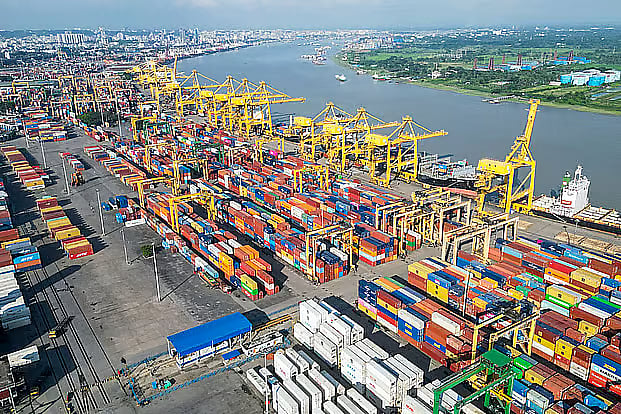
The New Mooring Container Terminal (NCT), the largest container terminal at Chittagong Port, has been leased to a foreign company. An agreement to this effect was signed on Thursday in Dhaka with DP World, a port operator based in the United Arab Emirates (UAE). With this deal, foreign operators have now been appointed to invest in and operate three terminals at Chittagong Port. These agreements were signed under three successive governments: the Awami League government, the interim government, and the current BNP government.
Why is the government appointing foreign operators? What are the objections raised by protesters? How much revenue will the port earn under the agreement, and to what extent will service quality improve?
This correspondent sought answers to these questions. Based on documents related to the terminal lease, information from the port authority and the National Board of Revenue (NBR), World Bank publications, and statements from relevant individuals, the issues are presented in a question-and-answer format.
Why is there so much discussion about leasing terminals at Chittagong Port?
A large share of Bangladesh’s foreign trade passes through Chittagong Port. According to the National Board of Revenue (NBR), 85 percent of the country’s total foreign trade was handled through this port in the 2025–26 fiscal year. Approximately 99 percent of the country’s seaborne container traffic also passes through Chittagong Port. The remaining 1 percent goes through Mongla Port.
Export goods, industrial raw materials, capital machinery, and various other products are transported in containers. As a result, the quality and cost of services at Chittagong Port are directly linked to the country’s import and export trade.
Of Bangladesh’s three seaports, Chittagong is the oldest. Its institutional operations began in 1888. Mongla Port opened in 1950, while cargo transportation at Payra Port began in 2016. However, container handling has not yet begun at Payra. Mongla offers limited facilities for berthing container ships.
Container handling at Chittagong Port began in March 1977. According to the rankings published by Lloyd’s List, a shipping industry news outlet, the port ranks 68th in terms of container traffic.
Although container traffic at the port has increased, facilities at its jetties and terminals have not expanded accordingly. Of the four terminals currently in operation, only two have been built over the past 35 years. The port also faces problems such as vessel congestion and delays in cargo handling. The central issue under discussion is how much these problems can be resolved by appointing foreign operators.
The main function of a container terminal is to unload imported containers from ships and load export containers onto vessels. A jetty is the infrastructure where ships berth. A terminal consists of one or more jetties, a container storage yard, and equipment for loading and unloading containers.
How many terminals have foreign operators been appointed to, and for how many is the process still underway?
Agreements have been signed with foreign operators for three terminals at Chittagong Port: Patenga, Laldia, and New Mooring.
An agreement for the Patenga Terminal was signed with Saudi Arabia’s Red Sea Gateway Terminal International in December 2023. The company began operations in June 2024. The agreement has a term of 22 years.
In 2025, an agreement was signed with APM Terminals, a subsidiary of Denmark’s Maersk, to build and operate the Laldia Terminal. The company is expected to construct the terminal within three years and operate it for the following 30 years. If the conditions are met, the operating term may be extended by a further 15 years.
On Thursday, an agreement was signed with DP World to operate the New Mooring Terminal for 15 years. The agreement allows for an extension, subject to the consent of both parties. This terminal handles 44 percent of the port’s total container traffic.
Four container terminals are currently operational at the port. Besides the New Mooring Container Terminal (NCT) and Patenga, the other two are the Chittagong Container Terminal (CCT) and the General Cargo Berth (GCB). Both are operated by domestic companies.
The process of leasing the CCT is also underway. Saudi Arabia’s RSGT and Bangladesh’s MGH Group have submitted proposals to operate the terminal.
In addition, the process of leasing two terminals at the Bay Terminal project to foreign companies is underway. Infrastructure construction has not yet begun there.
Work is also progressing on the construction of a deep-sea port terminal at Matarbari in Maheshkhali. The Chittagong Port Authority is implementing the project with funding from the Japan International Cooperation Agency (JICA), the Government of Bangladesh, and the port authority itself. Construction is scheduled to be completed in 2029. According to the initial decision, the terminal is to be operated by the Chittagong Port Authority.
How were operators appointed in the past, and how are they being appointed now?
Previously, operators were generally appointed for five-year terms through competitive bidding. The company offering the lowest rate for loading or unloading each container from a ship was selected.
Operators carried out their work using their own workforce, while port officials and employees also performed various duties. The port authority was responsible for the jetties, equipment, and their maintenance. It collected fees from users and paid the operators at the end of each month based on the number of containers handled.
The three new agreements have been signed under the public-private partnership (PPP) framework through a government-to-government (G2G) arrangement. Initially, the PPP Act of 2015 did not include provisions for G2G projects. A policy covering such arrangements was introduced in 2017, and the law was subsequently amended in 2019.
Under this framework, operators are being appointed through agreements reached with different countries. Under the new arrangement, the operator assumes responsibility for constructing or developing the terminal, investing in equipment, and managing operations over an extended period. The company collects fees in exchange for its services. The port authority also receives payments in accordance with the agreement.
In other words, day-to-day management of the terminal is transferred to the operator, while ownership remains with the port authority. The agreement defines the rights and responsibilities of both parties, as well as the limits of their respective control.
What does the agreement for the New Mooring Container Terminal (NCT) contain?
According to information from multiple sources, the agreement contains provisions covering operating rights, the obligations of both parties, maintenance and repairs, environmental and social responsibilities, minimum service standards, fees, and ownership of assets.
It also addresses the contract term and renewal, dredging in front of the jetty, natural disasters and political instability, contract termination and compensation, the port authority’s right to intervene, confidentiality, dispute resolution, and handover arrangements.
DP World is expected to invest $150 million in modernizing the terminal, upgrading equipment, and improving its technological capabilities. Of this amount, the company will make a one-time payment of $50 million to the port authority.
According to the agreement, 25 percent of this one-time payment is to be paid on the day the contract is signed, with the remaining 75 percent due before the terminal is handed over.
The contract term is 15 years, with the possibility of an extension subject to the consent of both parties.
According to sources, the agreement also stipulates a minimum handling requirement of 1.23 million container units. In the last fiscal year, the New Mooring Container Terminal (NCT) handled 1.385 million container units.
Here, a “container unit” refers to a twenty-foot equivalent unit (TEU), the standard unit of measurement equivalent to a container measuring 20 feet in length.
Under the agreement, the operator will face financial penalties if the prescribed handling target at the NCT is not met.
How much revenue will the port receive from the NCT?
At a press conference following the signing of the agreement on Thursday, Shipping Minister Sheikh Robiul Alam said the port would receive 67 percent of the revenue generated per container.
A subsequent statement issued by the Bangladesh Investment Development Authority (BIDA) said the port would receive between 40 and 67 percent of the revenue per container unit, depending on the terminal’s average revenue. In addition, the port would receive a fixed annual fee of Tk 100 million.
According to the port authority’s figures, the NCT generated total revenue of $161.82 per container in December 2025. Applying the 67 percent share to this amount would give the port approximately $108.42 per container.
However, the minister said the NCT currently generates $140 to $150 per container. Based on those figures, the port’s share would range from $93.80 to $100.50 per container.
During negotiations that were suspended under the interim government, DP World had proposed paying the port according to different revenue tiers. If revenue reached $161.82 per container, the company proposed paying the port $97.50. If revenue fell below $160 per container, the proposed payment would be $93.50.
Concession agreements of this kind are generally not disclosed in their entirety. Since private companies assume investment risks, the two parties negotiate and decide which provisions will be made public and which will remain confidential, in order to protect the interests of the private investor.
The terminal has a handling capacity of 500,000 container units, but it handled approximately 150,000 units in the last fiscal year.
What are the main differences between the agreements for the three terminals?
The nature of investment differs across the three terminals. At Laldia, a new terminal will be built on vacant land. At Patenga, a foreign operator is investing in equipment for a terminal constructed by the port authority. The NCT is already operational and equipped with machinery; DP World is taking responsibility for its modernization and operation.
Laldia
An agreement was signed with APM Terminals on November 17, 2025. On April 22 this year, the port authority handed over 49.15 acres of land to the company. APM Terminals is expected to invest $760 million in constructing the terminal.
Under the agreement, the port will receive $21 per container for volumes of up to 800,000 container units. For volumes exceeding 800,000 and up to 900,000 units, the port is expected to receive $23 per unit.
QNS Container Services Limited is participating in the project as a local investment partner. The company, which has experience operating container depots, will have an opportunity to gain experience in terminal operations alongside an international operator. The project is also expected to create new jobs.
Patenga
The port authority constructed the terminal using its own funds, at a cost of Tk 11.5 billion. RSGT has invested in equipment and is operating the terminal. Under the original agreement, the port is to receive $18 per container.
The terminal has a handling capacity of 500,000 container units, but it handled approximately 150,000 units in the last fiscal year.
New Mooring
Construction of the terminal began in 2004 and was completed in 2007. The construction cost was Tk 5.67 billion. Including subsequent investments in equipment and other facilities, the total investment reached Tk 27.12 billion.
At the NCT, the port will receive revenue through a revenue-sharing arrangement. Based on the minister’s figures for current revenue per container, the port’s share could range from $93.80 to $100.50 per container.
However, because the investment requirements, services, and contractual arrangements differ across the three terminals, the agreements’ relative financial benefits and costs cannot be assessed simply by comparing the amount the port receives per container.
At which terminal will the port’s handling capacity increase the most?
Once the Laldia Terminal is built, it is expected to add capacity for handling 800,000 to 900,000 container units annually. The Patenga Terminal has a full handling capacity of 500,000 container units per year.
The NCT is already operational. In the 2025–26 fiscal year, it handled 1.385 million container units. If the new operator can handle more containers than this, the additional volume would represent an increase over the current level of traffic.
However, having capacity and actually using it are two different things. Actual container traffic also depends on ship arrivals, available container storage space, cargo handling, and transport connections beyond the port.
Why appoint foreign operators when domestic companies are available?
The government’s position is that the selected companies have international experience. Their investment, technology, and operational expertise could help increase the port’s capacity. Building new terminals and installing equipment also require substantial funding. Foreign investment would reduce the need for government financing in these areas.
On Thursday, Shipping Minister Sheikh Robiul Alam said the agreements were being signed through a transparent process to promote the country’s economic prosperity and expand trade. He said the companies were being given operational responsibility for a specified period to bring the port up to international standards.
However, several domestic companies had also submitted proposals to invest in and operate the NCT, CCT, and GCB. According to the port authority, the process involving DP World had begun before those proposals were received. Consequently, the new proposals were not considered.
How many types of port management models are used around the world?
The World Bank’s 2007 publication, Port Reform Toolkit, identifies four models of port management. They are classified according to who is responsible for investment, ownership, and operations.
Public Service Port: A government agency builds the infrastructure, installs the equipment, and operates the port itself.
Tool Port: A government agency invests in the jetties and equipment, while some operational tasks are assigned to private companies. Until now, Chittagong Port’s New Mooring Container Terminal (NCT), General Cargo Berth (GCB), and Chittagong Container Terminal (CCT) have operated under this model.
Landlord Port: Ownership of the land remains with a government agency. Private companies invest in infrastructure or equipment and operate the port over the long term under contractual agreements. The Patenga Terminal is an example of this model.
Private Port: A private company is responsible for infrastructure development, investment, and operations. This model is prevalent in the United Kingdom. According to information from the House of Commons Library, 43 percent of the country’s ports are operated under private ownership.
In Bangladesh, the landlord model is being followed for the construction and operation of new terminals. Since the port’s infrastructure and equipment were already in place at the NCT, its management arrangement incorporates features of both the landlord and tool port models.
According to UNCTAD’s Review of Maritime Transport 2024, there are 937 active container ports worldwide. Data from the organization’s TrainForTrade dataset indicate that 67 percent of ports operate under the landlord model.
However, the port management model and the method used to appoint an operator are two separate matters. Under the landlord model, operators can be appointed through competitive bidding. In Bangladesh, the agreements currently under discussion have been signed with specific operators through government-to-government (G2G) arrangements.
How do other countries operate their ports?
Port management arrangements vary from country to country, encompassing public, private, and joint management. Even different terminals within the same country may operate under different models.
A 2022 container market report by Drewry and Maritime Gateway, along with a World Bank publication on ports in South Asia, provides information on 30 container terminals in India. Of these, 12 are operated by Indian companies, nine by foreign operators, seven by joint ventures between domestic and foreign companies, and two by government port authorities.
The same publication reports that five terminals in Pakistan are operated by foreign companies. DP World operates two, Hutchison Ports Holdings operates two, and International Container Terminal Services operates one. In Sri Lanka, three of the country’s five terminals are operated by the port authority, while the other two are managed by joint ventures involving domestic and foreign companies.
PSA plays a major role in Singapore, DP World in the United Arab Emirates, and state-owned companies at China’s major ports. In the United States, port authorities are involved in operations alongside domestic and foreign operators. In Rotterdam, the Netherlands, terminals are operated by domestic and foreign private companies.
The appointment of a foreign operator does not automatically mean that charges will increase. The level of fees and who has the authority to revise them depend on the contract and government decisions
In these countries, domestic companies operate their own ports because they have developed the expertise and capabilities to meet international standards.
What are the objections raised by the workers’ and political organizations opposing the agreement?
Workers’ organisations have been campaigning for the cancellation of the agreement with DP World. On Thursday afternoon, following the signing of the agreement in Dhaka, the Bandar Jatiyatabadi Sramik Dal (Port Nationalist Workers’ Party) and the Bandar Rakkha Sangram Parishad (Port Protection Action Council) held a protest march and rally near the main gate of the Chittagong Port building. They warned that they would begin a hunger strike on Monday if no avenue for negotiations was opened.
Meanwhile, several organisations, including the Communist Party of Bangladesh (CPB) and the Socialist Party of Bangladesh (BASAD), protested against the agreement by gathering outside the office of Bangladesh Investment Development Authority (BIDA) on Thursday. At around 2:45 p.m., police dispersed the protesters by beating them with batons.
The main argument put forward by workers’ organisations is that the port has invested nearly Tk 27.12 billion in the terminal, including its jetties and modern equipment. The terminal’s main equipment, the gantry cranes, can remain in service for another 19 to 23 years. Therefore, they argue, handing over a terminal that can operate without major additional investment to a foreign operator would cause financial losses for the port. They also fear that workers could lose their jobs.
During the interim government’s tenure, various professional and political organisations, alongside workers’ groups, also opposed the appointment of foreign operators.
Will workers and other employees lose their jobs?
The government says no one will lose their job. Shipping Minister Sheikh Robiul Alam has stated that there is not the slightest possibility of any port official or employee being dismissed. Rather, he said, modernizing the terminal and introducing automation would create additional job opportunities and improve workers’ skills. More personnel would be needed as container loading and unloading became more efficient.
Consequently, he argued, no worker would be adversely affected.
A statement issued by Bangladesh Investment Development Authority (BIDA) said that, under the agreement’s explicit provisions and in accordance with international standards, existing employees would be systematically integrated into the new operating arrangement.
In practice, changes to employees’ recruitment arrangements, responsibilities, and benefits will depend on the terms of the agreement and how it is implemented.
Second, customs procedures. After containers are unloaded from ships, they are placed in the container yard. Importers collect their goods after completing customs clearance. According to the National Board of Revenue’s (NBR) 2022 Time Release Study, clearing goods through Chittagong Customs House takes an average of 11 days and 6 hours. The entire process is not under the operator’s control.
Both paper-based and online systems are used for customs assessment. It can also take time to obtain laboratory test reports for samples of certain goods. Until those reports are available, the containers remain at the port.
At least 60 per cent of imported containers are opened and their goods cleared within the port premises. Numerous trucks enter the terminal to collect these goods, causing traffic congestion and putting additional pressure on the space available for storing new containers.
Third, road, rail, and waterway connections. Operational efficiency also depends on how quickly goods can be transported from the port to different parts of the country and how quickly export containers can reach the port.
Around 5 per cent of all containers are transported by rail, while less than 1 per cent move by waterways. Due to capacity constraints, transporting containers by rail can take two to three weeks. Road transport also faces congestion. Delays in bringing export containers from various depots in Chattogram can force ships to wait at the jetty.
So far, there is one example demonstrating the efficiency of a foreign operator: the Patenga Container Terminal. According to port authority data, more than 20 containers were loaded or unloaded per hour on average at this terminal during the last fiscal year. At the other terminals operated by domestic companies, the average was at most 17 containers per hour.
Will charges increase when foreign operators take over?
The appointment of a foreign operator does not automatically mean that charges will increase. The level of fees and who has the authority to revise them depend on the contract and government decisions.
The three agreements stipulate that operators will collect fees set by the government. However, operators may charge for additional services provided beyond those covered by the standard tariff. The port must receive a share of the revenue generated from charges for additional services at the NCT and Laldia terminals. The rate of that share has not been disclosed.
Chittagong Port’s tariffs were increased before the agreements with APM Terminals and DP World were signed. As a result, foreign operators will collect fees under the revised tariff structure.
What do port experts, businesspeople, and protesters have to say?
Anu Muhammad, economist, member of the Committee for Democratic Rights, and former professor: “Chittagong Port is not an ordinary commercial facility. It is central to national security, strategic geopolitics, and the country’s economic future. In this context, the government’s decision to hand over the port to foreign operators is not merely a development or commercial decision; it concerns the country’s overall development, security, and stability.
“No responsible state in the world hands over its principal port to foreigners in this manner. Despite the significance of this decision, the public does not know the terms of the agreement, what Bangladesh stands to gain, what liabilities it will incur, which laws govern the agreement, or how it might affect the country’s future economy, revenue, labor market, and security.”
Amirul Haque, president of the Chittagong Chamber of Commerce and Industry: “I do not know what the agreement contains. However, it can be said that service quality will improve if international operators manage the port. They provide professional services, which can ensure service without harassment. Port efficiency will also increase.
“However, the government must ensure that port charges do not rise, as that would increase the cost of doing business. In the future, it should ensure that international operators are required to have domestic partners before they are appointed. Domestic participation could also be secured through the capital market.”
Zafar Alam, former member of the Chittagong Port Authority board:
“Based on the limited information available, the agreement appears to be a good one. However, it is not possible to comment without knowing how much risk each party is assuming.
“It is true that DP World and the other foreign operators coming in will modernise and overhaul the terminals to serve their own business interests. This will accelerate import and export trade. They will transform the way we currently manage containers, leading to increased container traffic and improved service quality.
“However, to bring about fundamental changes, they need to invest in the hinterland—the transport routes and networks through which containers move to and from the port. They should also arrange training for port workers so that skilled personnel can be developed for export to ports abroad, not just employed at this port.”
[This is an updated version of the explainer originally published on August 25, 2025]