After a long and labourious journey, the National Consensus Commission has completed its work. Congratulations to the commission. However, the way it has presented its final recommendations risks rendering all its previous efforts meaningless and, at the same time, may push the country toward political conflict.
The primary responsibility of the National Consensus Commission was to prepare recommendations based on the six reform commissions initially formed and to build consensus through dialogue with political parties. Determining the method for implementing the July National Charter was not originally within its mandate. Following demands from several political parties, including Jamaat and NCP, the commission held both formal and informal discussions with political parties and experts after 31 July on ways to implement the charter. Despite long discussions, the commission failed to reach a consensus on the issue.
According to reports published in Prothom Alo, the procedure proposed by the National Consensus Commission for implementing the July Charter involves immediate implementation of certain recommendations through the “July National Charter (Constitutional Reform) Implementation Order 2025,” while those requiring constitutional amendments would be placed in a referendum to seek the people’s opinion. After that, a Constitutional Reform Council would be formed to carry out the necessary amendments.
It has been proposed that constitutional amendments be completed within nine months after the election. Even if the parliament fails to pass those amendments despite a mandate from the referendum, the amendments would automatically be incorporated into the constitution after nine months. We must remember that without political will, legal frameworks alone cannot ensure progress; therefore, our methods should be designed with this reality in mind. This crisis is being discussed globally in recent times, and I hope to write more on this issue soon.
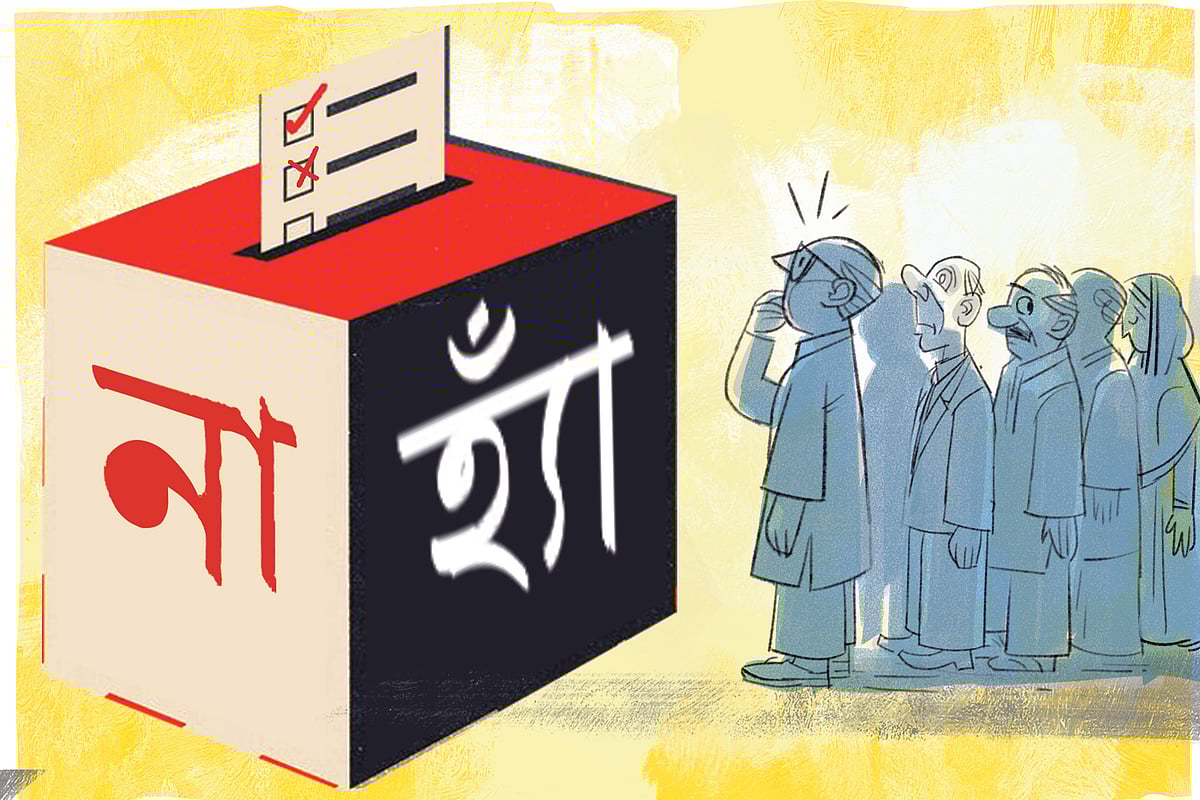
There is an even deeper concern regarding the method proposed for implementing the July Charter. The Consensus Commission has decided that differing opinions of political parties on the proposed constitutional reforms will not be mentioned in the referendum. The referendum will be held solely on the reform proposals as prepared by the commission. If the “Yes” vote wins, the reforms will be implemented exactly as proposed by the commission.
There is reason to believe that this decision was made to accommodate the condition set by the NCP—who initially withheld their signature on the Charter but agreed to sign at the last moment. While such conditions can be part of political negotiation, turning them into an inviolable term of the Charter reflects political immaturity. By accepting it, the Consensus Commission has undermined its own judgment and credibility.
There is no doubt that in many cases, the differing opinions (notes of dissent) of political parties on various reform issues may seem unreasonable to some. However, if a party expresses a dissenting view despite the political risks, it deserves respect. Given the way the referendum is now being proposed, one may rightly ask: why were months of lengthy discussions with political parties necessary?
The initial six commissions submitted their recommendations through discussions with all stakeholders, including political parties. As a member of the Election System Reform Commission, I know how many different stakeholders’ opinions were considered in preparing those recommendations. The National Consensus Commission has enough knowledgeable members to make a final recommendation based on these commissions’ work. Once that was done, the referendum could have simply reflected those recommendations.
During discussions with the Consensus Commission, each political party, in many cases, moved from their previous positions and agreed on several constitutional reform proposals. While we should take advantage of this agreement, the dissenting opinions must also be respected. The proposed referendum by the Consensus Commission could create a serious crisis. If all proposals go to a referendum as a package without including dissenting views, what stance will the country’s largest effective political party (BNP) take?
The BNP has expressed differing opinions, engaged in debate, and maintained its positions on several constitutional reform issues despite political risks—these were recorded as notes of dissent. Will the party now accept all reform proposals in this referendum? On the other hand, given their strong opposition to certain dissenting issues, will they vote “No”?
If the BNP accepts the referendum and votes “No,” and that “No” is joined by the remnants of past authoritarian forces and their allies, leading to a “No” victory, the entire reform process will collapse. More importantly, if the BNP refuses to accept such a referendum and decides to apply political pressure in the field, what will happen then?
Yet, this charter could have gone to a referendum including dissenting views. If the referendum is held on election day (which is administratively appropriate) and the “Yes” vote wins, the reform package agreed upon by the party in power will be implemented.
If a referendum is held on the day of the national election, another advantage would be gained—political parties could include the approved reforms in their electoral manifestos. This would also indicate how ready the public currently is to accept reforms. Since each party assumes that the public wants reforms and that the public wants them in the same way the parties do, the referendum would serve as a test of that assumption. Political parties may claim that the people want reforms, but they should also have the confidence to establish it based on the true mandate of the people—which is how it should be.
If the government organises a referendum as recommended by the Consensus Commission, it will inevitably create political discord, and possibly conflict, in the country. In recent times, tensions among political parties are already increasing. In such a context, this decision is bound to make the situation even more confrontational.
What will ultimately happen with the referendum question is for the future to decide. The National Consensus Commission was formed to establish broad agreement among political parties on reform issues, and it has carried out its work over a long period with efficiency and sincerity. However, on the referendum question, the commission’s role is being called into question at the very last moment.
If elections are held in the second week of February next year, there will be a maximum of three and a half months remaining. The government is already grappling with multiple crises. The country’s economy is not performing well, and law and order is precarious. Amidst this, divisions and conflicts among political parties are growing. The proposed method for implementing the July Charter should not be accepted by the interim government under any circumstances. Implementing the July Charter in this manner would make the national election itself uncertain.
#Zahed Ur Rahman, university lecturer and political analyst
#The opinions expressed are the author’s own.