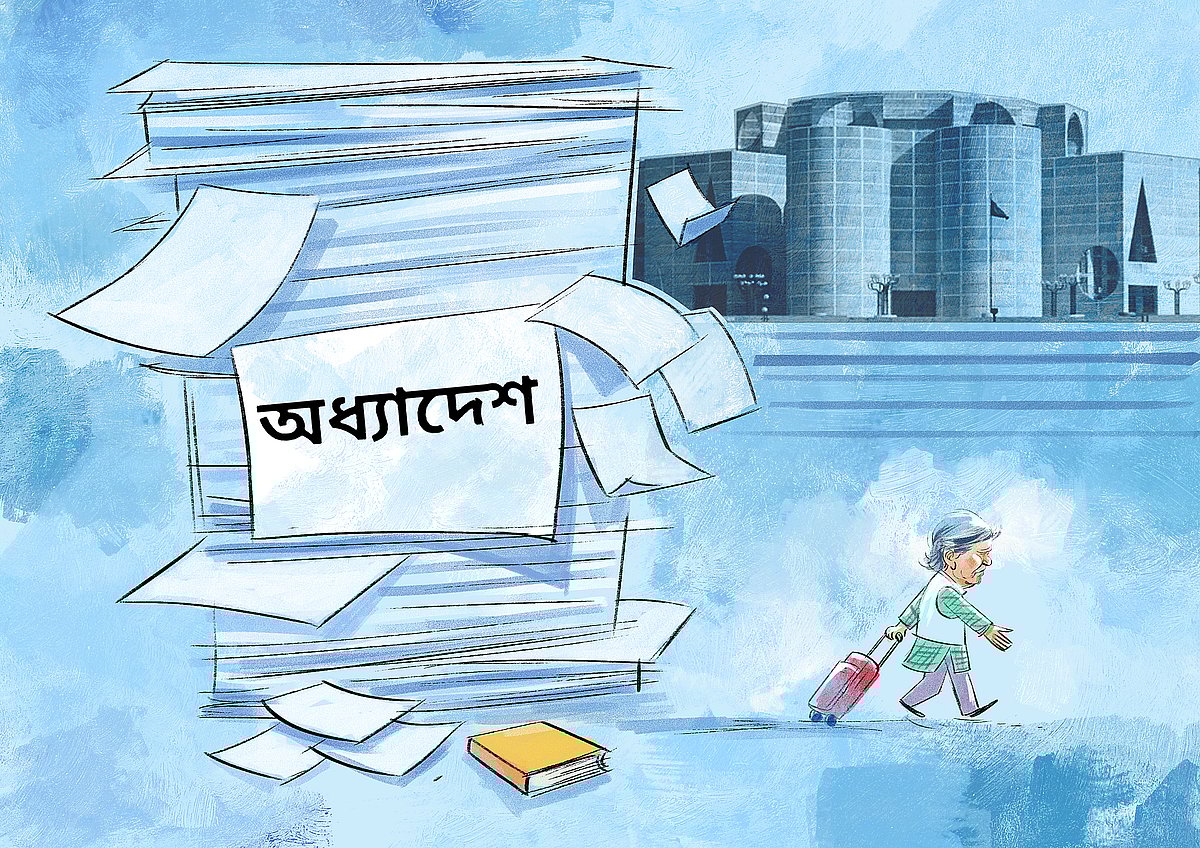
The defunct interim government enthusiastically issued dozens of ordinances. According to the website of the Ministry of Law, in the first 45 days of 2026, that is, up to 15 February, the government issued 36 ordinances. This means an ordinance was issued in less than every one and a half days on average.
In 2025, 80 ordinances were issued; meaning it took around 4.5 days on average for each ordinance. And from 13 August to 31 December in 2024, 17 ordinances were issued. The average time taken for each ordinance was about 9 days.
Clearly, as time passed, the efficiency in issuing ordinances increased significantly. This is natural, as generally, efficiency blossoms progressively with repetition or frequent execution of the same task.
At the beginning of each ordinance, it is stated that the President issued the ordinances by the power of Article 93 of the Constitution. Broadly speaking, Article 93 states that if the parliament is not in session or dissolved, and “if the President is satisfied that circumstances exist which require immediate action...he may promulgate an ordinance.”
This implies that clearly, the President felt the need to take ''immediate action'' 133 times during the tenure of the interim government. It goes without saying, the actual ''realisation'' was that of the advisory council of the interim government, and so many ordinances were issued on their recommendations.
2.
The interim government has left; so what will happen to the ordinances now? It's assumed that most citizens believe the new parliament will pass most of the ordinances as laws to maintain their effectiveness. But there is a major 'complication' here.
Article 93 of the Constitution is quite unfriendly. Firstly, even if the President feels it is necessary, Article 93 imposes three limitations on him. These are—(a) No ordinance can be issued by the President regarding any law that the parliament cannot make according to the Constitution; (b) The provisions of the Constitution cannot be amended or repealed through an ordinance. For instance, the President cannot, by ordinance, make it so that the Prime Minister cannot serve more than two terms; (c) A new ordinance cannot be issued to maintain the effect or continue the effectiveness of a previous ordinance.
For argument's sake, someone might claim that none of the 133 ordinances exceeded these limitations, or a generous person might accept that a couple of ordinances breached these limits. As a result, a few ordinances might be annulled. This means most of the ordinances will remain in effect substantially.
3.
However, Article 93's sub-clause (2) has created a major complication. This sub-clause (2) might seem perplexing or complex to some general readers.
Therefore, we will try to create a simplified explanation.
As already mentioned, the President can only issue ordinances when the parliament is not in session or is dissolved. The first session of the new or thirteenth parliament will commence on 12 March. Sub-clause (2) instructs that the ordinances issued must be laid before the parliament on the very first day it sits. Accordingly, all 133 ordinances will be presented for consideration in parliament on 12 March. What happens next?
According to sub-clause (2), there are three options open to the parliament. On the very day of presentation, the parliament can annul all the ordinances at once. If they are not annulled on the first day, the second course available to parliament is to annul them gradually, like 5 on the first day, followed by 10 in two to three days, and another 20 in the following week.
If the ordinances are not annulled on the first day or sequentially, or if some are annulled and no decision is made on others, then according to sub-clause (2), all ordinances for which no decisions are made will ''lose effectiveness'' on the 30th day of the first session of parliament. In simpler terms, on the 30th day of the first parliamentary session, all ordinances will indiscriminately ''die''!
4.
So what to do? Suppose the new parliament would like to maintain the effectiveness of some ordinances. The ones intended to be kept effective must be passed through the legislative process in parliament as new laws.
Broadly, this process will include—the concerned ministry preparing a brief regarding the necessity of the law; presenting the brief to the cabinet for approval, and approval by the cabinet. After which the concerned ministry will draft the law, which will be submitted again to the cabinet meeting for final approval.
After the cabinet approves the draft, it will be sent to the government press for printing as a bill, potentially with necessary linguistic and grammatical edits. The printed copies will be sent to all members of parliament before being presented in parliament on the specified day for consideration.
There are numerous steps or stages in the parliamentary discussion and debate, which are not necessary to detail at the moment. After traversing these stages and steps, if the bill is passed in parliament, it will be sent for the President’s assent. After the President's approval, it will be published as law, which we will then be bound to adhere to.
In conclusion, it can be assumed that the interim government might have thought that by issuing ordinances, all problems would be solved. But they likely did not consider that these ordinances are short-term or temporary. After a specific time, i.e., within 30 days of the next parliamentary session, all ordinances will be abolished.
Issuing ordinances is by no means the ultimate solution for state reform. Some activities, measures, appointments, or even the annulment of previous activities have been carried out under these ordinances.
However, once the effectiveness of these ordinances expires, there will be significant debates and arguments about the consequences of activities initiated or taken under these ordinances in the near future.
In the past 54 years, this complex legal question has been sought in two rulings. One is Suranjit Sengupta vs. Election Tribunal (1981); the other is Shariatullah vs. Bangladesh (2009). Additionally, there is brief discussion in a couple more cases. However, these precedents are not sufficient to resolve the legal complexities.
The complexity created by issuing so many ordinances would have been better avoided by the interim government. It is better not to make hasty laws than to make them.
#Shahdeen Malik is a senior advocate at Bangladesh Supreme Court
*The opinions expressed are solely the author's own.
#The article, originally published in the print and online edition, has been rewritten in English by Rabiul Islam