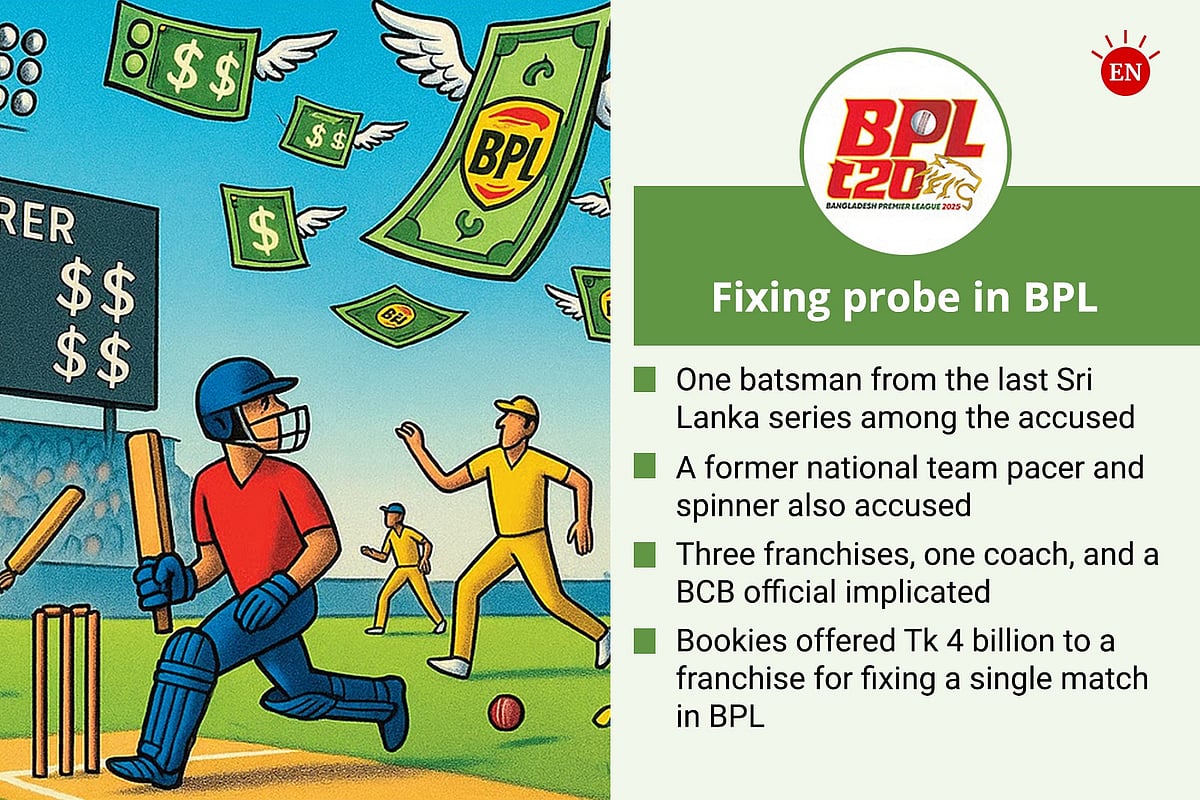
The investigation work had already been completed earlier. The written transcripts of around 300 hours of audio recordings of conversations between the investigation committee and the concerned parties have exceeded three thousand pages.
From that, the preparation of the preliminary report has also been completed. The three-member independent investigation committee formed by the Bangladesh Cricket Board (BCB) to look into spot-fixing allegations in the most recent 11th BPL will submit the report to BCB President Aminul Islam within the next week or so.
Earlier, in February, the BCB’s then board of directors led by former president Faruque Ahmed had formed this three-member independent investigation committee to look into the spot-fixing allegations in the 11th BPL. The committee was headed by former Appellate Division judge Mirza Hossein Haider, with the other two members being internationally renowned lawyer Khaled H Chowdhury and former cricketer Shakil Kasem.
Why only a preliminary report, when will the final one come?
Committee member Khaled H Chowdhury told Prothom Alo that they are submitting the preliminary report mainly in view of the upcoming BPL season. The aim is to alert the BCB regarding franchise selection and the players’ draft, and to provide necessary recommendations so that steps can be taken to prevent fixing from the upcoming season itself.
He said, “In the preliminary report we will mainly mention our findings—why such things happen, what measures the BCB should take to prevent them, how to fix the franchise structure—our observations and recommendations on these matters will be there.”
Khaled Chowdhury added that the final report will be submitted next month, which will contain detailed information about the suspicious incidents of the latest BPL and the accused individuals. However, the committee believes further investigation is still required.
Who are accused, what are the recommendations?
In just the last BPL (2024–25), the committee came across a total of 36 suspicious incidents up to a certain point. Multiple sources told Prothom Alo that in the preliminary investigation, 10–12 cricketers were named as accused in these incidents, among whom 3–4 have been marked as “high flagged.” “High flagged” means that the allegations against these 3–4 are almost confirmed. Among them are two former national team players—one a pace bowler and the other an off-spinner. In addition, another pace bowler who has not played for the national team but drew attention in the last BPL for bowling abnormal wides is also included.
The remaining accused fall under “medium flagged” and “low flagged.” This means that although the allegations against these two categories of cricketers are not fully confirmed, the report will not call them “innocent” either.
For example, in an important moment of a match, a captain might have given the ball to a foreign bowler who had just arrived in Bangladesh the previous day, without any practice, and was fielded the next day.
That bowler then conceded a lot of runs in a single over, costing his team the match—despite the captain having other reliable bowlers available. In this case, the captain falls under the “low flagged” suspicion category.
Sources further revealed that most of the accused players are over 35 years of age and, due to age and form, no longer have prospects in the national team. However, one player who was part of the squad in the most recent Sri Lanka tour has also been named, even though not “high flagged.” A franchise coach is also among the accused.
Additionally, a member of a BCB sub-committee is implicated, who was associated with a franchise in the last BPL. Beyond this, the committee has confirmed that three franchises—Durbar Rajshahi, Sylhet Strikers, and Dhaka Capitals—were indeed involved in illegal activities like spot-fixing during the last BPL.
Until proven completely innocent through further investigation, the committee will recommend barring these franchises, players, and officials from BCB’s cricketing activities.
Suspicions regarding broadcasters too
The investigation committee also made observations about the broadcasting companies and television channels responsible for telecasting the games. Especially concerning were the channels that aired online betting advertisements at various times.
The report may recommend that the BCB keep its distance from such channels and broadcasters. Based on available information, the committee suspects that individuals associated with these channels might be indirectly involved in spot-fixing. It has been revealed that one broadcasting company earned around Tk 1.7–1.8 billion solely through the illegal advertisements of betting.
The investigation also found that suspected agents linked with betting were sometimes present in the corporate boxes of stadiums under the patronage of responsible BPL-related figures, where there was little surveillance from the BCB’s anti-corruption unit.
These agents, coming from abroad, had their security, accommodation, and transport arranged from within. In recent times, many betting companies have started using local agents for this purpose as well.
What else will be in the report?
Although the BCB had primarily formed the committee to investigate the latest BPL, suspicious incidents from the previous four editions also came to light. Across the last five seasons of the BPL, more than 140 suspicious incidents of spot-fixing were identified. The number of suspected local and foreign players is more than 60, with some names appearing in allegations two or three times.
One of the most notable incidents was in the 10th BPL (2023–24), where a franchise was offered Tk 40 billion by bookies to lose a specific match. The committee could not confirm whether the franchise accepted the offer. However, it did not inform the BCB’s anti-corruption unit about receiving such an offer as required by regulations, and that franchise eventually lost the match.
The report is expected to recommend restructuring BCB’s anti-corruption unit. It will also suggest making the unit active in all domestic tournaments, including the National Cricket League and the Premier Cricket League. Recently, the BCB appointed Alex Marshall, former head of the ICC’s anti-corruption unit, as chief of its own anti-corruption department.
The report will strongly recommend reforming current laws against online betting to make them up to date, and possibly even propose enacting new laws. The committee believes the law should empower the BCB itself to take legal action against offenders.
Where the limitations were
There have already been allegations that BCB’s anti-corruption unit did not cooperate with the independent investigation committee. The ICC’s anti-corruption unit and several betting-monitoring organisations regularly send lists of suspicious incidents and individuals to the BCB’s anti-corruption unit for every BPL. But despite repeated requests, the independent committee reportedly did not get that information.
The independent committee also did not have the jurisdiction to conduct forensic investigations. As a result, they could not examine the bank accounts of the accused to look for suspicious transactions. The report will recommend forensic investigations into such matters.