University Teachers' Network
May the culture of fear never return to campuses again
The establishment of a fascist regime relied heavily on a culture of fear, with public university campuses serving as the cradle of this culture.
Different opinions on these campuses were suppressed through the establishment of a dormitory-style guestroom culture.
The aspiration to build a discrimination-free Bangladesh emerged in July as a resistance to that fascist fear.
However, the current reality is that the unity of July was disrupted in various ways after Sheikh Hasina's retreat, and its effects have reached the campuses.
Repetitions of oppression have resumed, and the forces of resistance have been divided and weakened.
This evaluation of the current reality of public university campuses was shared by the University Teachers' Network.
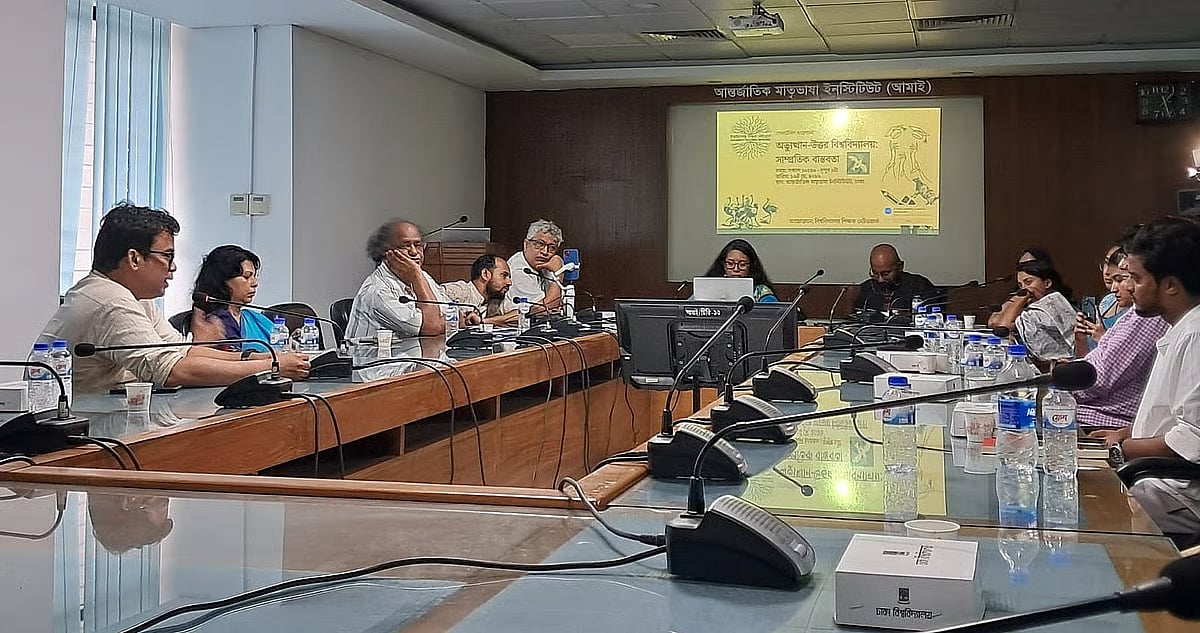
Yesterday, Saturday, the organisation shared its assessment during a roundtable discussion titled "Post-Uprising University: Recent Realities" at the International Mother Language Institute in the capital.
In this roundtable discussion, 13 teachers from 10 universities, including Dhaka, Chittagong, Rajshahi, and Khulna, spoke about the situation in post-uprising universities. Several participants joined virtually.
Additionally, some students from various universities also took part in the discussion. It was discussed that the entire country awoke against oppression in July, with the most massive resistance built on campuses at that time. The reappearance of oppression and mob incidents on campuses has raised fears of the return of a culture of fear. Teachers and students must remain vigilant against this.
Regarding the campus situation during the interim government's rule, the Teachers' Network stated, "Campus after campus, so-called ''pressure groups'' were allowed to function as new policy-enforcers. New forces of aggression were observed, masquerading as student representatives targeting teachers and students. "
At Rajshahi University, deans were forced to resign, while at Chittagong University, "journalists" and different student organisations attacked female students, yet the administration took action against those very women.
The Teachers' Network evaluated that at Khulna University of Engineering and Technology (KUET), the administration appeared hostage to various student and teacher organisations. They mentioned that frequent changes of vice-chancellors at KUET had not resolved the deadlock. The practice of renaming places and halls at Khulna and Islamic University has created new grounds for attacks on dissent. At Islamic University, despite a deplorable comment made about a student by a teacher, that teacher remained in position, highlighting the impunity of those holding power during Hasina's era.
The Teachers' Network claimed that progressive teachers from private universities like Uttara University and the University of Asia Pacific became targets during July. Some teachers at Uttara University were forced to resign, and two teachers faced job termination at the University of Asia Pacific due to mob pressure.
The interim government's 18-month tenure saw educational institutions enter a new level of a culture of fear, as assessed by the Teachers' Network.
The organisation alleged some student council leaders had a role in attacks on Daily Star and Prothom Alo, with calls for attacks on Udichi and Chhayanaut coming from some Rajshahi and Jahangirnagar University student council leaders, giving rise to grave concerns and fear.
Continuing this pattern, the Teachers' Network stated in a written statement that elected members of Dhaka University's student council have physically harassed several teachers and evicted vendors. They have, at times, mustered mobs at Shahbagh to beat up students and hand them over to the police.
This resembles a script of the past during the regime of the student wing of the ruling party—beating perceived opposition and filing cases with the police. This situation has not changed significantly under the elected government, which has also seen similar patterns. There has been no accountability for repression during Hasina's regime, and the recurring repression during both the interim and BNP governments has raised alarms.
University Teachers' Network's discussion was initiated with a written statement read by Dhaka University's Economics Department teacher Roushan Faridi. Later, joining the roundtable, he said Dhaka University's problems stem 99 per cent from the teachers. If teachers work without political agendas or selfish ambitions, universities would progress.
There has been no change in teacher recruitment. Dhaka University professor Mohammad Tanzimuddin Khan, having experience as a University Grants Commission (UGC) member during the interim government's tenure, shared experiences in the discussion.
He stated, "Those who talk about honesty are often the most dishonest—I am a direct witness to this. Repression exists not just mentally or physically but also in recruitment. " Farcical exams were conducted at Rajshahi University, Chittagong University, and Noakhali Science and Technology University in the name of written tests.
Tanzimuddin Khan mentioned there have been no changes in teacher recruitment practices. Even during the interim government, posts of vice-chancellors were divided among various parties. Often, these vice-chancellors are touted for their lengthy CVs, but practically they have conducted teacher recruitment worse than during the Awami League's tenure.
The mindset has not changed. The attitude that "ownership belongs to those who can demonstrate force" persists even after 5 August (the day the Awami League government fell in the 2024 mass uprising), emphasised Khulna University professor Abdullah Harun Chowdhury during the roundtable.
Personal or narrow interests drive everything from behind, he said, and a neutral university administration could solve many problems.
However, it requires neutral governmental support as well.
Professor Kazi Mamun Haider of Rajshahi University noted that after the uprising, fear and a culture of threat re-emerged in a significant way on the campus, with the mob murder of a former leader of the now-banned student wing occurring in September 2024. Despite renaming of buildings and halls post-uprising, no academic reforms have been undertaken.
Professor Kamal Uddin Ahmed Chowdhury from Dhaka University urged universities to ensure proper arrangements for the mental health of oppressed students.
Commenting on post-uprising realities, Assistant Professor Dhiman Sarkar from Jahangirnagar University said, "Even a slight departure from the ideology of a faction results in bot attacks (fake accounts conducting organised smear campaigns on Facebook). An online mob is being formed that spills over into reality. "
Indicating that many teachers have suffered repression and mob attacks post-5 August, Jagannath University teacher Nasir Uddin Ahmed said some extorted money from teachers promising to clear their names from cases.
There is no remedy
KUET's Assistant Professor Maria Bhuiyan noted that since the July mass uprising, KUET has seen five vice-chancellors come and go.
After the uprising, the university remained closed for five months, experiencing dramatic instability, she observed. She believes the campus is returning to being a centre of political conflict.
University of Asia Pacific's teacher, Layeka Bashir, who lost her job last January, observed that relatively progressive and secular people were being unjustly and forcibly removed from various places. Yet, the new government has not provided remedies to these injustices.
Uttara University teacher Shyama Bhattacharya remarked that despite expecting positive changes post-uprising, the practice of harassing teachers is seen in various universities. Students are being encouraged from behind to form mobs.
A warning signal can be discerned regarding academic freedom, commented ULAB teacher Aliur San.
Brac University's lecturer Nirnoy Islam said that following the mass uprising, an unwarranted mob formed by a section of the students intimidated Brac University teachers who had taken a firm stance in favour of the July movement.
"From the afternoon of 5 August. . . " Abdul Kader, a former coordinator of the anti-discrimination student movement, participated in this Teachers' Network discussion. He said that since the mass uprising, a depoliticisation project has been underway at the University of Dhaka, while a lack of tolerance for differing opinions has also become evident. He alleged that from the afternoon of 5 August 2024, a particular group began deciding how the university would be run, and claimed that the group was the Islamic Chhatra Shibir, the student wing of Jamaat-e-Islami.
Dhaka University student Abdul Kader stated that seizing the opportunity of the uprising, the Islamic Chhatra Shibir sought to practice politics exclusively by banning student politics on campuses, thus instating a culture of fear through mob actions.
Joining virtually, Chittagong University student Sumaiya Shikder shared that in the post-July period, their university experienced successive covert attacks, none of which have been investigated or resolved. Efforts to establish dominance on campus continue. Students are facing online and offline harassment, with female students as prime targets. Complaints have not resulted in redress.
Islamic University's student Jarin Tasnim mentioned facing obscene remarks from a teacher while protesting for justice for murder, alongside fellow female students. Seeking punishment for that teacher led to her facing media trials.
'Realities of fear'
Discussion moderator was Dhaka University professor Samina Luthfa, who spoke after the discussion concluded.
In her closing remarks, Samina Luthfa observed rampant arbitrariness over the last 20-21 months. This arbitrariness has further narrowed the space for teachers and academic freedom. On one hand, there is fear of mob intimidation by students; on the other, fear of harassment by the administration. Added to that is the fear of being bullied in cyberspace. The reality emerging in universities after the uprising is one marked by anxiety and apprehension.
Students and teachers leading from the front during July's mass uprising have found themselves feeling unsafe on campus post-uprising, noted Professor Samina Luthfa.
She said they have been singled out as targets, facing organised violence and oppression in various ways.
Whether called a mob or otherwise, there's been an institutionalisation of such practices.
Samina Luthfa mentioned that mobs have become a weapon—a tool aiding those vying for power or those already in it. Post-election events made clear who exploits mobs, showing whoever can wield them will do so. Bypassing party identifications, fronts like "ordinary students, " "conservatives, " and "mobs" obscure the real orchestrations. Such tactics perpetuate a culture of fear on campuses, aiding various forms of control.