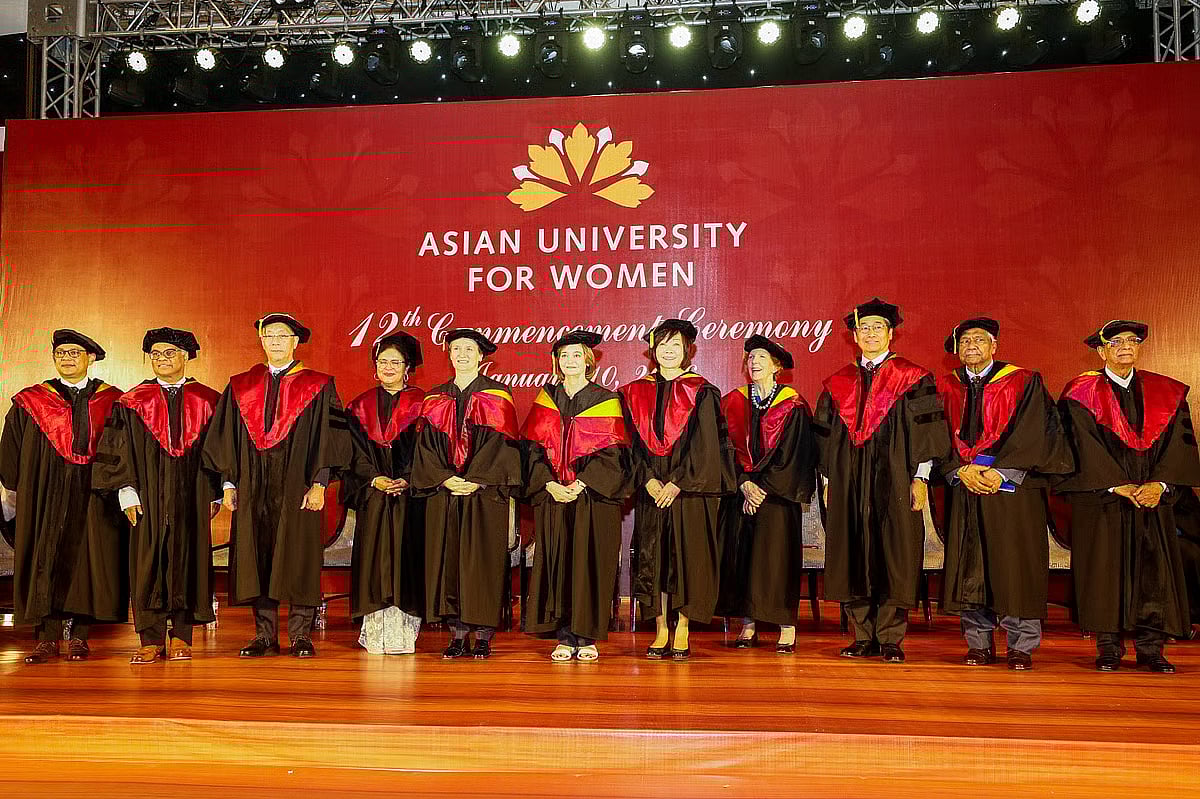
AUW 12th Convocation
No way out of major problems without search for truth, freedom to question: Oxford Vice Chancellor
Oxford University Vice-Chancellor Irene Tracey said that the world today has an urgent need for educated women. Without educated women, no sector—be it the economy, culture, or political stability—can truly succeed. Depriving women of the right to education causes society to lose enormous potential.
The Oxford vice chancellor made the remarks joining the 12th Convocation of the Asian University for women. Irene Tracey addressed several issues including women rights, climate change, diseases, discrimination, artificial intelligence, disinformation and false information.
Convocation speaker Vice-Chancellor Irene Tracey said that a just society cannot be built without an independent and autonomous university. She added that without the pursuit of truth and the freedom to question, major problems such as climate change and inequality cannot be solved.
The convocation was held today, Saturday, at the Radisson Blu Chattogram Bay View in Chattogram city. A total of 253 students received their certificates, while seven distinguished individuals were awarded honorary degrees for their contributions in various fields.
Addressing the students receiving the convocation, Oxford University vice chancellor Irene Tracey said, ““Dear students, when you look back, you will see that this degree is the foundation of your future life. You have not only acquired subject-based knowledge, but also learned how to learn and how to distinguish between truth and falsehood—skills that are essential in this age of fake news, misinformation and artificial intelligence,” she said.
Referring to the challenges faced by female students, neuroscientist Irene Tracey said EWU is a relatively new university, while Oxford is nearly a thousand years old. Yet the two institutions share similarities. She noted that the path for women at Oxford was not easy either, as women were allowed to earn degrees there only about 100 years ago. Today, however, those women are changing the world—from developing Covid vaccines to leading human rights movements.
At 11:00 am, distinguished guests and students participating in the convocation entered the auditorium. At the time, current female students of the university performed Rabindra Sangeet “Aguner Parashmoni Chhonwao Prane” and “Anandoloke Mangalaloke.” This was followed by the students performing prayer songs from different religions.
The main programme then began. EWU Chancellor Cherie Blair delivered the welcome address, telling the students, “With the development of artificial intelligence, the world of work may change rapidly in ways we cannot yet imagine. But the education you have received here is not limited to technical skills alone. It will shape you into thoughtful leaders and responsible agents of change.”
Referring to a future full of possibilities, Cherie Blair said those opportunities must be embraced with courage and ambition, while remaining grounded in reality. Poverty, inequality, disease and violence, she said, are still part of that reality. The responsibility of the students, to themselves, to their societies and to humanity as a whole, would be to ensure that innovation and scientific progress are placed at the service of social and economic justice. Whatever path they choose, she added, it must rest on a foundation of respect for human rights.
Explaining the current global situation, the AUW chancellor said, “We are living through a time that is undoubtedly difficult. Conflicts are unfolding within states and between states. Some make headlines, while others quietly devastate people’s lives. In responding to the human consequences of these crises, you must stand beside those affected with the fullest measure of your ability.”
At the ceremony, AUW vice chancellor Rubana Huq said that 51 of this year’s graduates came from Afghanistan, a country where women currently have virtually no access to education. “We hope that one day they will return home and lead their nation,” she said. Nine graduates came from Rohingya camps, places marked by a stark divide between need and deprivation. Seven garment factory workers also received their degrees. “At one point, these students thought their lives would be confined to sewing machines,” she added.
Referring to the wider global context, Rubana Huq said the world is going through an undoubtedly difficult time. Conflicts are unfolding within states and between states. Some reach the headlines, while others quietly shatter lives. She said that confronting the human consequences of these crises requires standing beside those affected with the fullest possible commitment.
Addressing the students, university founder Kamal Ahmad said, “You have the right to dream of a different world. Whatever risks you take, we will stand by you. You are our daughters.”
The Asian University for Women began its journey in 2008 with a distinctive vision of providing higher education to marginalised and disadvantaged women across Asia. It started with 127 students from six countries. At present, 2,000 students from 22 countries are studying at the university.
Addressing the students, university founder Kamal Ahmed said, “You have the right to dream of a different world. Whatever risks you take, we will stand by you. You are our daughters.”
The Asian University for Women began its journey in 2008 with a unique vision of providing higher education to marginalised and underprivileged women across Asia. It started with 127 students from six countries, and today 2,000 students from 22 countries are enrolled.
Seven distinguished individuals receive honorary degrees
At this year’s convocation, seven distinguished figures from Japan, the United Kingdom and Bangladesh were awarded honorary degrees by the university in recognition of their significant contributions to society.
Among them: Oxford University Vice-Chancellor Irene Tracey received a Doctor of Science and the Advancement of Humankind; University of Tokyo President Teru Fujiki was awarded a Doctor of Science; Japan’s former First Lady Akie Abe received a Doctor of Humane Letters; UK House of Lords member Janet Ann Royall was conferred a Doctor of Arts for Leadership and Educational Equity; Bangladesh’s former Education Minister M. Osman Faruk received a Doctor of Science in Educational Development; former Japanese Ambassador to Dhaka Ito Naoki was awarded a Doctor of Arts for the Advancement of Peace; and Matiur Rahman, editor and publisher of Prothom Alo, received a Doctor of Creative, Responsible and Courageous Journalism.
Tokyo University President Teru Fujiki, reflecting on his long-standing relationship with AUW, said, “I am proud to be associated with this extraordinary institution. The partnership between AUW and Tokyo University will only grow stronger in the future.”
Japan’s former First Lady Akie Abe, who has been connected with AUW since 2008, said at the convocation, “The world will expect a lot from AUW students. But the most important thing, to me, is to listen to your own inner voice. What is your heart saying? Value that voice, move forward with it, and work for the betterment of the world.”
Emotional after receiving her honorary degree, UK House of Lords member Janet Anne Royall said, “Tears are coming to my eyes. Honestly, receiving this honorary degree today is a tremendous honour for me. But even greater is the honour of having built a genuine, deep connection with this extraordinary university. From today onwards, I will consider myself a lifelong supporter of the university, a true ‘champion.’”
Former Principal of Somerville College, Oxford University, Janet Anne Royall said that education changes lives, transforms society, and reshapes nations and communities. “Education is a force through which real change can be brought to the world. In these divided times, it can serve as a bridge, bringing closer the growing gaps within society,” she added.
Former education minister Osman Faruk said, “When this university was established, many questioned why a separate institution of higher education exclusively for women was necessary. My answer was simple—once the university is fully operational, you will see the results for yourselves. Today, I believe those who once thought it unnecessary can now see its success and realise just how mistaken they were.”
Students delighted
The students attending the 12th convocation were visibly thrilled. They tossed their graduation caps into the air and posed for group photos. In between, Prothom Alo spoke with Narges Hussain, a student from Afghanistan who enrolled in the university’s Politics, Philosophy and Economics department in 2022. Narges told Prothom Alo, Alo that she is dedicating her degree to all women in Afghanistan, where access to education for women remains severely restricted.
Another student, Nuria Mohsini, had moved from Kabul, Afghanistan, to Quetta, Pakistan, many years ago, where her family still resides. She also enrolled at AUW in 2022. Nuria said that AUW is a highly diverse university, offering her the chance to study alongside students from different countries. She hopes to pursue a higher degree at Oxford University in the future.
In the final segment of the convocation, students from various countries showcased their cultural heritage through dance performances, after which the guests presented certificates to the graduates.