‘I saw Selina Parveen’s death up close’
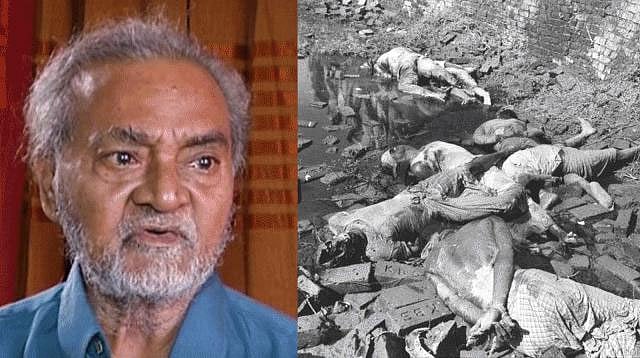
Delwar Hossain was 28 years old. He had finished his studies at Dhaka University and had joined Greenland Mercantile Company as chief accountant. When the liberation war began in March 1971, he left his house at Shantinagar in Dhaka and shifted to his village home in Comilla, near the border. He even went to India with his four brothers to train for the war under Maj. Salahuddin.
In May, Delwar returned to Dhaka, joined work and surreptitiously worked as a spy. Then on the morning of 14 December, members of the Al Badr force turned up at his house and took him away. He was taken to the Mohammedpur Physical Training College where he was tortured. He also witnessed the inhuman torture, and death, of Munier Chowdhury and Mofazzel Haider Chowdhury there.
Around one thousand people, including Delwar Hossain, were taken to the killing fields of Rayer Bazar at midnight. There he saw the monsters, Al Badr leaders Chowdhury Moinuddin and Ashrafuzzaman Khan. He saw Ashrafuzzaman dragging journalist Selina Parveen into the jaws of death.
Delwar Hossain smeared himself with the blood of others so that the enemies thought he had been shot dead. His throat was parched with thirst. The moment he got the chance, he jumped into the river Turag. The water was cold, but he swam on.
Today Delwar is an elderly man and still assailed by those frightful memories of 1971. He recalls the details of that horrific day:
“I lived in Shantinagar. It was the morning of 14 December 1971 and I was hungry. There was curfew in the city, but there was no food at home. I went out to get something to eat, but all the shops were closed. I returned home, wondering what to do. There was a knock on the door and in Urdu someone called out to open the door. It was a tin and bamboo-fenced house. I tried to peep through the fence, but two persons broke down the door and entered. They dragged me outside and were talking to someone they addressed as Ashrafuzzaman. He ordered them to search the other houses. They first took me to a Pakistani army officer who was among them. Then they placed me, blindfolded with hands tied, in a mud-smeared microbus. They took us to a building in an unknown destination and threw us into a room on the first floor.
“There were many wounded persons in the room. When they pushed me inside, I fell onto them. This was the hall room on the first floor of Mohammedpur Physical Training Centre. My wrists were tied so tight, I couldn’t help crying. I was thirsty. A boy there said, “If you cry so hard, they will kill you.”
“I asked the boy, “Who are you?”
“‘I am Tareq, the son of a sergeant at CMH,’ he replied.
“I asked him to untie me and he finally did so when I insisted. I pulled off the blindfold and looked out of the window. Men in army uniforms wandered around the grounds. I noticed the boy Tareq’s fingers were swollen and there were bloodstains on his head. They had beaten him with an iron rod. There were others in the hall room, huddled together. They were injured, some covered in blood, some with an eye gouged out, some with bayonet wounds. I blindfolded myself and tied my hands again, thinking of ways to escape.
“On 14 December I also saw Munier Chowdhury and Mofazzal Haider Chowdhury. They were shoved into the hall room at around seven in the evening. Munier Chowdhury was clad in a lungi and Panjabi. I was a student of Dhaka University and so I recognised them both. They were tortured there in the hall room and later, around eight at night, 10 to 12 armed persons entered the room. Then first asked Munier Chowdhury’s name and then asked him if he had written anything about Rabindranath. He replied in the affirmative.
“They then asked Mofazzal Haider Chowdhury’s name and also asked if he wrote on Rabindranath. He said he had. A member of the Badr force came up and said, ‘We don’t have much time. The Indian forces are bombing from the air.’
“I realised then that they would kill us and I began to pray. They were beating Munier Chowdhury and Mofazzal Haider Chowdhury with rods. Blood streamed down Munier Chowdhury’s face. He fell to the ground, reciting the kalmas. The Badr forces left the room then. I smeared myself with blood and kept my head down. After a while, I tried to look up, but was immediately hit on the head.
“I saw journalist Selina Parveen’s death up close. I was taken down at around 11 at night and placed in a bus again. There were 20 to 22 buses outside and around 1000 people were crowded into the buses. We were taken down at a point in Rayer Bazar and made to form groups of 15 to 20. A long rope was used to tie our left hands and we were led to the brick field. Anyone shouting out was shot dead. Those who remained quiet were knifed to death with bayonets. I felt it would be much more painful to be killed by a bayonet and decided to be shot dead. Right then I heard girls crying out too. A woman next to me was crying out, “You all are my fathers, my brothers. I have a small son. Let me go. I will leave Dhaka and go away.”
“Someone replied, ‘You had been taken to the Badr force’s headquarters but you persisted in writing.’
“The woman was screaming. As someone approached her, she cried out, ‘Ashraf bhai, they will kill me even though you are here!’ As another person went up to her, I managed to flee.
“I later learnt that the young woman was journalist Selina Parveen. After I managed to escape and return alive, Selina Parveen’s family showed me her photograph and I could identify her.
“When I escaped, I had first untied my hands, removed my blindfold and managed to pull the rope around my left wrist, scraping my hand badly. I ran to the marsh nearby, managed to get to the river and began to swim away. The Badr force men were looking for me, sweeping the torchlight all around and shooting. Allah protected me and I was not hit. It was around 3am then. When I reached the river bank on the other side, I still didn’t dare to climb out. I spent the entire night in the marsh.
“I later reached Basila and found freedom fighters. Many first thought that I was mad and crowded around me. Like delivering a speech, I related the events that had taken place. Later the villagers gave me cheera (flattened rice), panta bhat (water-soaked rice) and gourd. I think I never had a tastier meal in my life!”
Delwar Hossain returned to Dhaka on 17 December. The next day details of the events he had witnessed were published in Dainik Bangla and aired on BBC.
Delwar Hossain still suffers from the trauma. He said, “I couldn’t work properly, I had problems in my head. I would lose my temper, make mistakes. I still have problems. My wife Hafeza Begum taught at Tejgaon College and she would run the family. I have not been recognised as a freedom fighter. I really don’t mind that. What pains me is that Chowdhury Moinuddin and Ashrafuzzaman and still alive, hale and hearty.”
*This piece, originally published in Prothom Alo Bangla, has been rewritten in English by Ayesha Kabir.