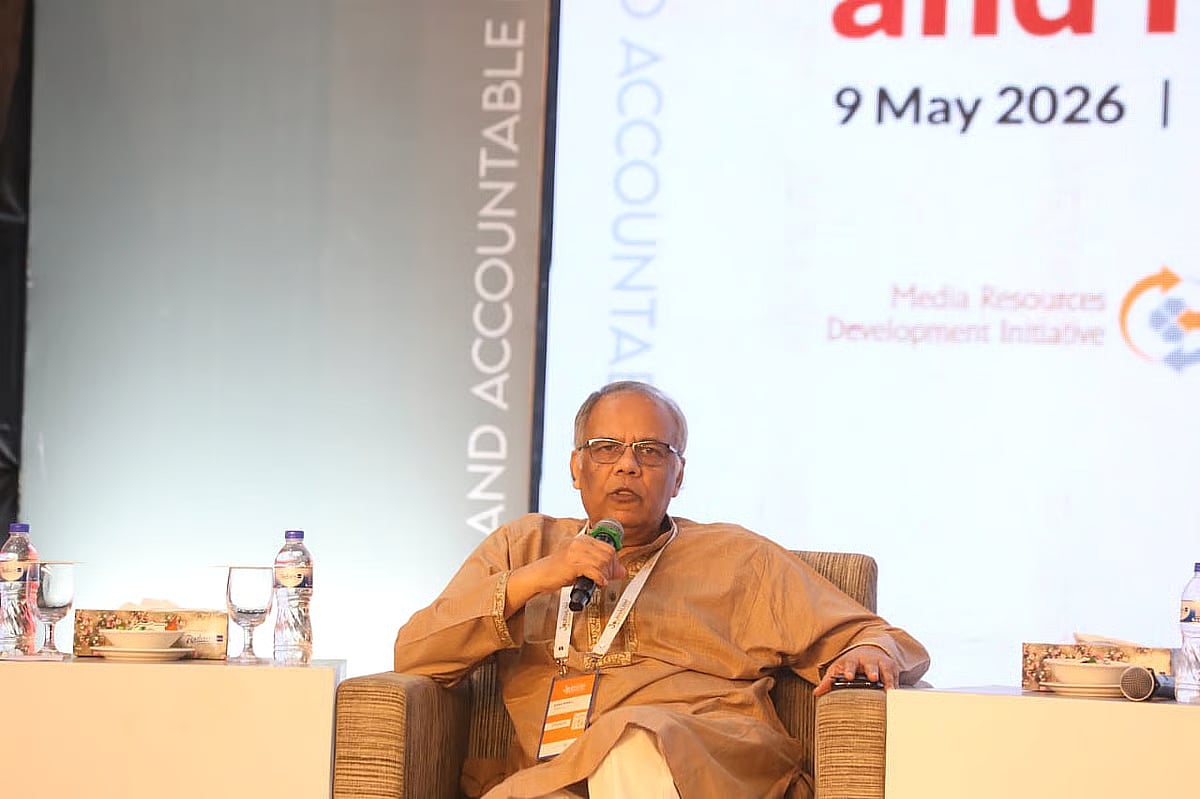
If political tolerance is lacking, the media cannot work freely either: Kamal Ahmed
Consulting editor of The Daily Star Kamal Ahmed has said that if a country lacks a democratic culture and political tolerance, the media cannot function independently. He said that the absence of respect for dissent and democratic practice in the state and society is also being reflected negatively in the media.
He made the remarks this morning, Saturday, in his opening speech at the final day’s morning session of the ‘Bangladesh Journalism Conference 2026’ at a hotel in the capital. The topic of the session was ‘Politico-Governance Ecosystem and Free Media’.
The session was moderated by Shakhawat Liton, executive editor of The Business Standard. The two-day international conference was organised by the Media Resources Development Initiative (MRDI).
Kamal Ahmed said that although a window of opportunity for change had emerged following the end of a long period of governance, still there remains uncertainty over how effectively it will be utilised.
He said, while the media is often described as the fourth estate, it is not an institution detached from society. Without democracy, tolerance and freedom of expression in society, the media cannot remain free either.
He added that the country is still not in a situation where people can express all sorts of opinions without fear.
As an example, he referred to the imprisonment of a person over the playing of 7 March speech and multiple cases being filed against a journalist in Khagrachhari on the same day. “What is happening across the country will be reflected in the media as well,” he said.
Kamal Ahmed noted that the tendency to ignore opposing views is deeply rooted in Bangladesh’s political culture. “We are seeing majority rule in the name of democracy, but dissenting voices are not being given adequate space,” he said, adding that this has affected the media as well.
He also identified the lack of democratic practice within the political parties themselves as a major crisis. Political parties that do not have democratic structures of their own fail to build democratic institutions once in power, he said. In this regard the media has also failed to exert enough pressure, he added.
The senior journalist also noted that political influence extends to media ownership structures, editorial leadership and decision-making processes. At the same time, he also highlighted issues of journalistic capacity, institutional weaknesses and a lack of courage.
Pointing out that various institutions in Bangladesh have gradually come under political influence, Kamal Ahmed said that although the Bangladesh Press Council is mandated to safeguard media freedom, it has not been able to play that role in practice.
He also alleged that the institution has failed to take an effective stand even in cases of attacks on newspapers.
Kamal Ahmed, who headed the Media Reform Commission formed during the previous interim government, also stressed the importance of financial independence to ensure media freedom.
“As long as the media cannot stand on a strong economic footing, true independence cannot be ensured,” he said. He further added, “The influence of black money is evident in both politics and the media.”
Speaking about possible solutions in his speech, Kamal Ahmed said that coordinated efforts and national consensus are needed to safeguard media freedom. However, he observed that there is a lack of sincerity in this regard too. “We are actually not able to agree among ourselves,” he added.
Other speakers at the discussion included editor of Pakistan’s Dawn Zaffar Abbas, executive director of Transparency International Bangladesh (TIB) Iftekharuzzaman, former BBC journalist Shakeel Anwar, and Samakal editor Shahed Mohammad Ali.