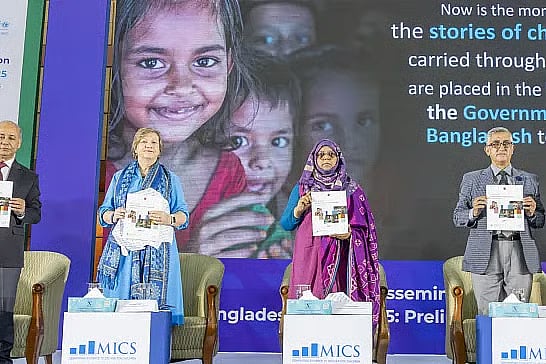
MES Survey
One in every two girls subjected to child marriage
Caesarean births have increased by 16 per cent.
Deliveries at health facilities have risen by 18 per cent.
The proportion of out-of-school children has increased by 2 per cent.
Child labour has risen by 2 per cent.
Use of contraceptives has declined by 5 per cent.
Mortality among children under five has decreased.
The rate of child marriage among girls under 18 has fallen from 60 per cent to 56 per cent, but the situation remains high, with one in every two girls in the country still subjected to child marriage. Compared to 2019, this rate has decreased by 4 per cent.
Institutional deliveries, meaning births at health facilities or hospitals, have increased. Alongside this, the rate of births by caesarean section (C-section) has also risen. Mortality among children from birth up to under five years of age has decreased. Child labour and the proportion of out-of-school children have risen.
The figures came up in the newly published Multiple Indicator Cluster Survey (MICS) report by the Bangladesh Bureau of Statistics (BBS) and UNICEF. The survey report was released today, Sunday, at the China–Bangladesh Friendship Conference Centre in Agargaon, Dhaka.
The report states that the survey was conducted in two phases from January to June this year, covering nearly 63,000 households. It included 172 indicators and 27 Sustainable Development Goal (SDG) indices, aligned with national priorities and global standards.
For the first time, the survey included tests for anaemia among pregnant women and children, as well as levels of heavy metal contamination including cadmium. The previous MICS report was published in 2019, and the new report also presents a comparative picture showing how much progress or decline has occurred since then.
The event was chaired by BBS director general Mohammad Mizanur Rahman. As special guests, Aleya Akter, Secretary of the Statistics and Information Management Division, attended, and UNICEF Bangladesh representative Rana Flowers was present as a distinguished guest.
Rana Flowers said that the rates of child marriage and child mortality demonstrate that progress is possible. Crises such as heavy metal contamination and child labour are depriving millions of children of their potential. Investment in child protection must be increased.
The welcome speech at the event was delivered by Mohammad Masud Rana Chowdhury. Emdadul Haque, the focal point officer of MICS, presented the main findings of the report. The open discussion session was conducted by BBS deputy director Md Alamgir Hossain.
The survey report provides two sets of data on child marriage. Before turning 18, 47 per cent of women aged 20–24 were married, whereas this rate was 51 per cent in the 2019 report. Meanwhile, the nationwide rate of child marriage among girls under 18 has stood at 56 per cent, which was previously 60 per cent.
The rate of childbirth among adolescent mothers has risen from 83 to 92 per thousand. Compared with 2019, caesarean (C-section) deliveries have increased by 16 per cent to nearly 52 per cent. Institutional deliveries at healthcare facilities or hospitals have increased by 18 per cent to 71 per cent.
Child labour has risen by more than 2 per cent to 9 per cent. The share of school-age children not attending secondary school has increased by 2 per cent to nearly 34 per cent. Use of contraceptives has dropped by 5 per cent to 58 per cent. The total fertility rate (TFR) has increased from 2.3 to 2.4.
While moderating the panel discussion at the event, former adviser to the caretaker government Hossain Zillur Rahman said that this MICS report is an important step towards open data. The data should be easily accessible so that it can be discussed on a wider scale. Two sets of data have come regarding child marriage. The question remains as to which one should be used in policymaking. The underlying stories behind why the rate is rising in some areas and falling in others should come out. The quality of the survey needs to be improved.
World Bank country director for Bangladesh and Bhutan Jean Pesme, WaterAid’s regional director for South Asia Khairul Islam, senior fellow at the Bangladesh Institute of Governance and Development Maheen Sultan, former secretary Md Sarwar Bari and Thaddeus David May, senior director of the nutrition research division at icddr,b, took part in the panel discussion.
The speakers emphasised reducing the disparity between urban and rural areas in the supply of safe water. They urged the government to strengthen monitoring to reduce the high rate of C-sections. Apart from this, four more panel discussions were held at the event.
The report said child mortality declined across all five age-specific groups under five. Among children under five, 33 out of every 1,000 live births die, down from the previous rate of 40 per 1,000.
The rate of stunted children fell to 24 per cent. However, the rate of wasted children rose by 3 per cent to about 13 per cent. The share of underweight children increased slightly to 23 per cent, while the rate of overweight children declined somewhat.
The rate of receiving four antenatal care visits stands at 43 per cent. The proportion of women who received at least one antenatal care visit has increased from 58 to nearly 76 per cent. However, the rate of receiving the full four quality visits remains low at just 43 per cent.
Among children under five, only 59 per cent have birth registration. As a result, many children are deprived of legal identity and access to services.
The new survey results show that 38 per cent of children aged 12–59 months and nearly 8 per cent of pregnant women have cadmium levels in their blood above safe limits. Dhaka (65 per cent) is the most affected area. Cadmium contamination poses a threat to children’s brain development, affecting all socioeconomic groups. More than half of the affected children belong to wealthy households, while 30 per cent belong to poor communities. Nearly half of drinking water sources and over 80 per cent of household water samples are contaminated with E. coli bacteria. The report highlights issues of safe water, sanitation, and the rising rate of school absenteeism among children.