‘No funds available’ for teachers’ retirement benefits, some die before receiving their dues
A middle-aged man was pacing around a floor of the Probashi Kallyan Bhaban in Dhaka’s Eskaton Garden area. His face looked gloomy. After introducing himself, he explained that his father-in-law had been a teacher at a Dakhil madrasa in Indurkani upazila of Pirojpur.
He retired in February 2023 and applied for retirement and welfare benefits in June that year. However, he died in April 2024 before receiving the money. The man had come to submit his father-in-law’s death certificate. He himself is also a teacher at an educational institution in the capital.
Speaking about the family’s need for the money, he said his late father-in-law had four daughters, while his mother-in-law is elderly. At one point, he entered the office of an official and broke down in tears.
This is not an isolated incident. Such circumstances have become the reality for thousands of MPO-listed non-government teachers and employees. Some spend months after retirement making repeated visits to offices, while others wait for years.
Some even die before receiving the money they are entitled to. After dedicating a lifetime to education, being forced to wait helplessly for their rightful dues in retirement has created deep frustration and resentment among teachers.
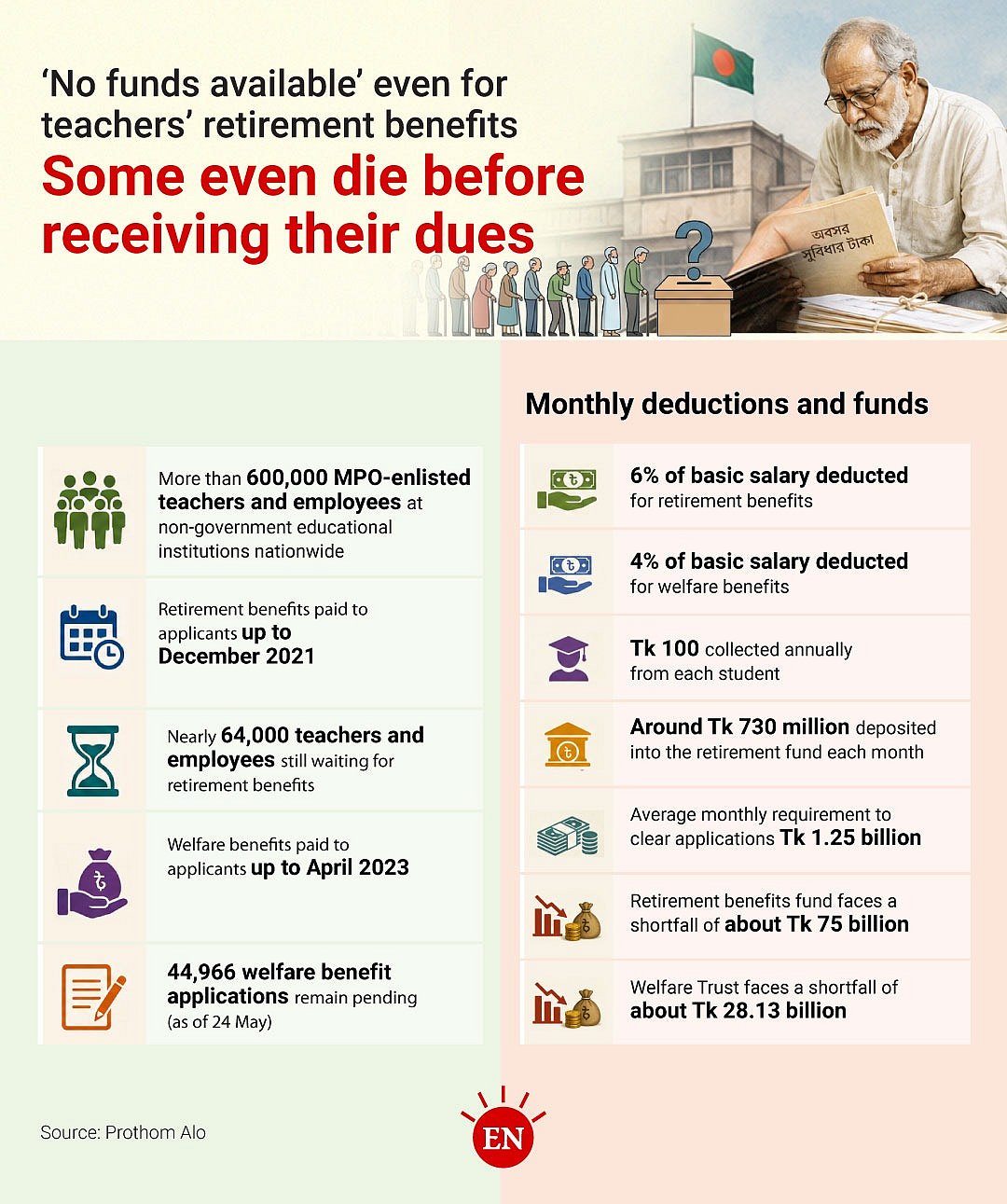
The waiting period is somewhat shorter for payments from the welfare trust, as the amounts involved are comparatively smaller. According to Trust sources, applicants who applied up to April 2023 have received their welfare benefits. However, as of 24 May, applications from 44,966 teachers and employees remained pending.
Governments change, teachers keep waiting
The Non-Government Teacher Employee Retirement Benefit Board and the Non-Government Teachers and Employee Welfare Trust have become places associated with the anguish of thousands of retired teachers and staff members.
Governments change and large projects are undertaken in various sectors, yet this problem faced by teachers remains unresolved. There are allegations that while spending is generous in other sectors, authorities repeatedly cite a lack of funds when it comes to paying teachers their legitimate dues.
People concerned believe that ensuring teachers receive their retirement and welfare benefits on time is the responsibility of the state. There is also a High Court directive requiring retirement benefits to be paid within six months. In reality, however, that directive is not being followed.
According to data from the retirement benefits board, teachers and employees who applied up to December 2021 have so far received their retirement benefits. Since then, around 64,000 teachers and employees have submitted applications but have yet to receive payment.
An official of the retirement benefits board told Prothom Alo that applications submitted up to May 2022 are currently being scrutinised. In addition, payments have remained suspended for a long period because of software-related problems.
The waiting period is somewhat shorter for payments from the welfare trust, as the amounts involved are comparatively smaller. According to Trust sources, applicants who applied up to April 2023 have received their welfare benefits. However, as of 24 May, applications from 44,966 teachers and employees remained pending.
Some spend months after retirement making repeated visits to offices, while others wait for years. Some even die before receiving the money they are entitled to. After dedicating a lifetime to education, being forced to wait helplessly for their rightful dues in retirement has created deep frustration and resentment among teachers.
Teachers left struggling to access retirement benefits
More than 600,000 teachers and employees at MPO-enlisted non-government educational institutions across the country are covered by retirement and welfare benefit schemes. These benefits are administered through two separate bodies.
Welfare payments are provided by the Non-Government Teachers and Employee Welfare Trust, while retirement benefits are paid by the Non-Government Teacher Employee Retirement Benefit Board.
Previously, both organisations operated from the BANBEIS building in the Nilkhet–Palashi area of the capital. They have recently been relocated to the Probashi Kallyan Bhaban in Eskaton Garden. The move has also drawn criticism, as office facilities for officials may have improved, but the suffering of retired teachers and employees has not eased.
For retirement benefits, six per cent of the basic salary of serving teachers and employees is deducted every month. A further four per cent is deducted for welfare benefits.
In addition, Tk 100 is collected annually from each student, of which Tk 70 goes towards retirement benefits and Tk 30 towards welfare benefits. The remaining funds are covered by government contributions and interest earned on deposited money.
In other words, teachers regularly contribute to these funds throughout their careers. Yet after retirement, they are unable to withdraw their own money on time.
For retirement benefits, six per cent of the basic salary of serving teachers and employees is deducted every month. A further four per cent is deducted for welfare benefits. In addition, Tk 100 is collected annually from each student, of which Tk 70 goes towards retirement benefits and Tk 30 towards welfare benefits. The remaining funds are covered by government contributions and interest earned on deposited money.
Massive funding shortfall
According to sources at the retirement benefits board, around Tk 730 million is deposited each month through the six per cent salary deductions. Interest from fixed deposits generates another Tk 30 million. However, the volume of applications received each month requires an average of Tk 1.25 billion in payments.
Based on the current backlog of applications, the shortfall in retirement benefits stands approximately at Tk 75 billion. The Welfare Trust faces a deficit of around Tk 28.13 billion.
During the tenure of the interim government, bonds worth Tk 22 billion were issued—Tk 20 billion for retirement benefits and Tk 2 billion for the Welfare Trust. However, returns from these bonds will be received only every six months and are expected to amount to Tk 1.5-1.6 billion.
Officials concerned say this is insufficient to resolve the financial crisis. They argue that the problem cannot be solved without direct government funding. The hardship could be eased if the government clears the accumulated deficit through a one-off allocation and then ensures dedicated funding in each fiscal year’s budget.
During the interim government period, the Ministry of Education sought an allocation of Tk 71.76 billion for the retirement benefits board and Tk 28.13 billion for the welfare trust. However, the Ministry of Finance did not approve the funds.
For long, neither the retirement benefits board nor the welfare trust had a full governing board. The failure to constitute these boards for months during the interim government period further deepened the crisis. However, after the new government assumed office, full boards were recently formed.
By virtue of their office, the secretary of the Secondary and Higher Education Division of the Ministry of Education serves as chairperson of both the retirement benefits board and the welfare trust. In practice, however, the two organisations are run by their respective secretaries.
When asked about the issue, the newly appointed secretary of the retirement benefits board, Md Mosharraf Hossain, told Prothom Alo that he had himself spent his entire career in teaching and would make every effort to help resolve the problem.