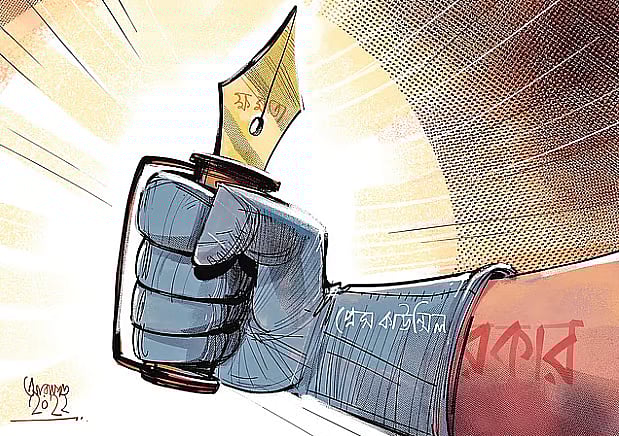
Even ten months after the Media Reform Commission submitted its report, none of its recommendations has been implemented. Now, at the very end of the interim government’s tenure, an initiative has been taken to form a National Media Commission.
Aiming to ensure media freedom and the protection of journalists, the Ministry of Information and Broadcasting has prepared a draft of the National Media Commission Ordinance, 2026.
The draft was published on the ministry’s website on Wednesday to solicit opinions. Only three days have been allotted for feedback, with the deadline set for 31 January. A day earlier, on Tuesday, a draft Broadcast Commission Ordinance was also published to establish a Broadcast Commission. This indicates that the ministry intends to form two separate commissions.
However, the Media Reform Commission formed by the interim government had recommended the establishment of a single, independent ‘Bangladesh Media Commission’, free from government control.
The proposal suggested integrating the existing Press Council for newspapers and news agencies with the previously proposed Broadcast Commission for broadcast and online media, creating a unified regulatory body. Instead, the Ministry of Information is now planning to form two separate commissions, the ‘National Media Commission’ and the ‘Broadcast Commission’.
Officials at the Ministry of Information and Broadcasting said the draft ordinance would be reviewed after receiving feedback, and a decision would then be taken on finalising it. With the national election scheduled for 12 February, just two weeks away, and a new government set to take office thereafter, questions have been raised about the haste in pushing ahead with two separate commissions while ignoring the reform commission’s recommendations.
The interim government, at the very last moment, is rushing to put together the National Media Ordinance in a patchwork manner.Kamal Ahmed, senior journalist and chairman of the Media Reform Commission
The Media Reform Commission submitted its report to the interim government in March last year. Its chair, senior journalist Kamal Ahmed, told Prothom Alo on Wednesday, “The interim government, at the very last moment, is rushing to put together the National Media Ordinance in a patchwork manner. There are doubts about whether the objective behind forming a media commission will actually be achieved.”
Kamal Ahmed added that if the existing Press Council remains unchanged, the proposed media commission’s jurisdiction and responsibilities would be largely the same. Overlapping mandates between two institutions would only deepen complications. In his view, it would be best to implement the Media Reform Commission’s recommendations exactly as proposed.
However, Information and Broadcasting Adviser Syeda Rizwana Hasan does not believe that forming two separate commissions would create additional problems. Speaking to Prothom Alo, she said that incorporating the Press Council into the National Media Commission would have been a major achievement, but that was not possible at this stage.
The adviser noted that the Media Reform Commission had recommended both a media commission and a law to protect journalists. The media commission, she said, would now also work on ensuring journalists’ protection, while the Broadcasting Commission would handle broadcast-related matters such as licence recommendations.
Syeda Rizwana Hasan added, “We will try to get both ordinances approved within the remaining tenure of the interim government. However, it may not be possible to actually form the commissions within this time.”
We will try to get both ordinances approved within the remaining tenure of the interim government. However, it may not be possible to actually form the commissions within this time.Syeda Rizwana Hasa, information and broadcasting adviser
How the commission will be formed under the draft
Once the ordinance comes into force, a commission titled the National Media Commission will be established, with a headquarters. If necessary, branch offices may be set up anywhere in the country with government approval.
The commission will be consisted of nine members, one chairperson and eight members. At least one member must be a woman and one must represent the small ethnic community or the indigenous community. Appointments will be made through a five-member selection committee, headed by an Appellate Division judge nominated by the Chief Justice.
For each position, the committee will recommend two candidates to the president. The nominees must have at least 20 years of practical knowledge and experience in media, journalism, law, technology, information or culture. More than one nominee from the same media outlet or from media organisations under the same ownership will not be allowed.
Under this process, the president will appoint the chairperson and eight members for a four-year term. Their rank, salaries and other benefits will be determined by the government. A quorum will require the presence of the chairperson and at least six members.
The commission must hold at least one meeting every two months. To ensure coordination, the chairpersons of the Press Council and the Press Institute of Bangladesh, or their nominated representatives, may be invited to commission meetings. Experts may also be included when necessary.
There are doubts about whether the objective behind forming a media commission will actually be achieved.Kamal Ahmed, senior journalist and chairman of the Media Reform Commission
Powers and functions of the commission
According to the draft ordinance, one of the commission’s core responsibilities will be to ensure the protection and freedom of media and journalism, uphold Article 39 of the Constitution, and formulate and enforce standards for self-regulation.
Article 39 of the Constitution guarantees freedom of thought and conscience, freedom of speech and expression, and freedom of the press.
In line with international norms, the commission will formulate codes of good practice, ethics and conduct to ensure transparency, professionalism, objectivity, impartiality and accountability among approved electronic, online and print media as well as journalists. It will also frame regulations on minimum qualifications and protection for journalists.
The draft states that regulations on journalism and journalists’ protection will include the right to access information, the right to investigate and publish reports in the public interest, the right to protect sources, the right to a safe working environment free from physical or mental pressure, fair recruitment conditions, appropriate remuneration and workplace justice.
All media outlets will be required to comply with the commission’s regulations to ensure journalists’ protection. The commission will make necessary recommendations to the government and law enforcement agencies to prevent threats, harassment and violence against media organisations and journalists, the draft mentions.
Recommending journalists’ pay and remuneration to the government will also fall within the commission’s remit. In dispute resolution, the commission will have the authority to order corrective measures, including compensation, to be taken by media outlets.