“I still carry that trauma”: 45 accounts of childhood sexual abuse shared on new platform in 24 hours
Most of the victims were between the ages of seven and 12 when the abuse occurred. Sixty-three per cent said they had been abused more than once, while 38 per cent said the abuse continued over an extended period—initially through force and later through threats.
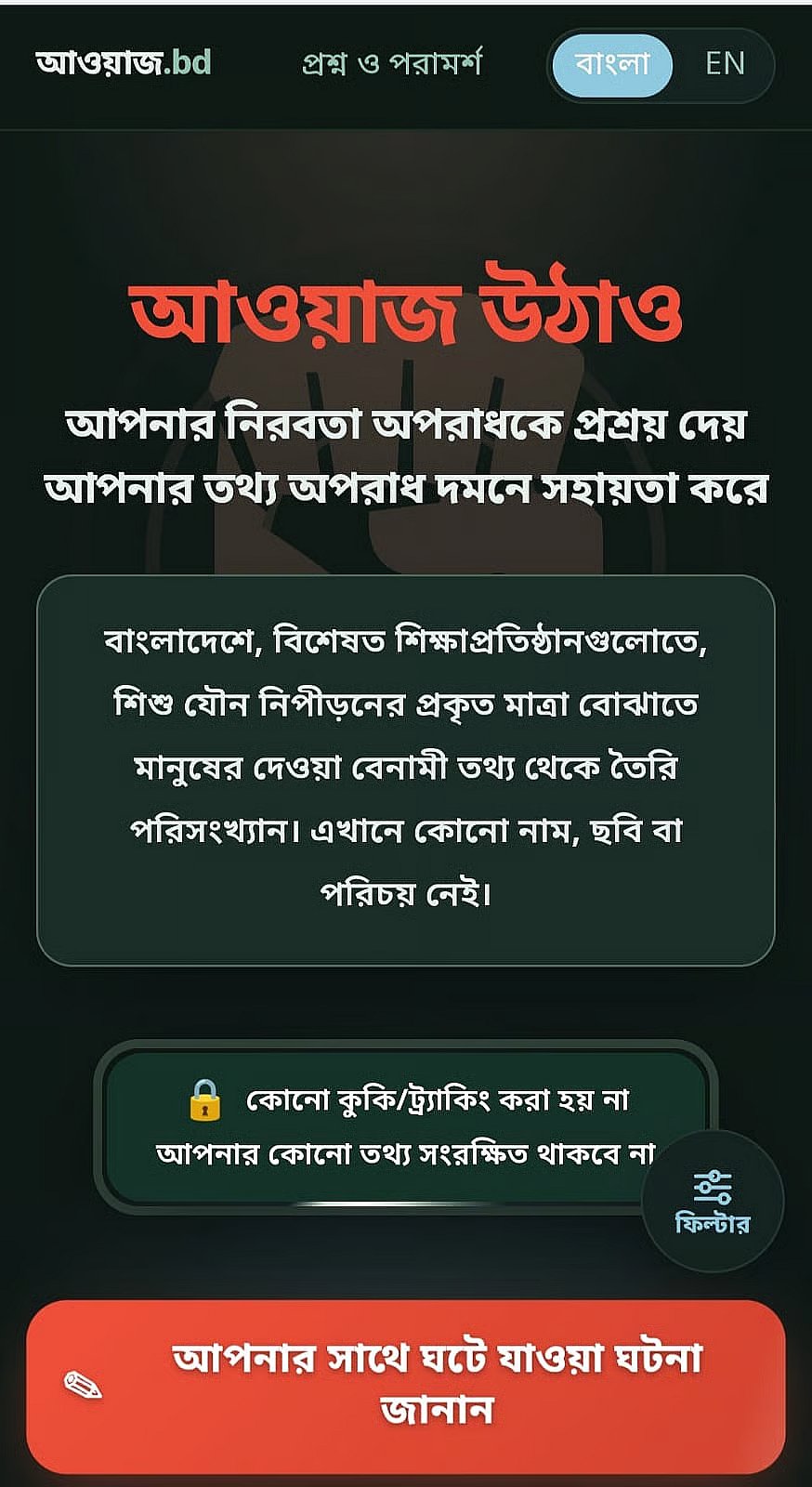
These findings have emerged from a new platform called awaz.bd. The platform has been created to document accounts of sexual abuse suffered during childhood. Within 24 hours of its launch at 4:00 pm on 7 September, 45 people had shared harrowing accounts of their experiences during childhood.
The platform was initially intended primarily to document cases of sexual abuse of boys. However, girls have also written about being sexually abused during their childhood.
Upon entering the platform, the words ‘Awaz Uthao’ (Raise Your Voice) appear on the screen, alongside the message: “Your silence encourages crime; your information helps combat crime.”
It also states that the statistics have been compiled from information submitted by people anonymously to help understand the true scale of child abuse in Bangladesh, particularly in educational institutions. No names, photographs or identifying information are included. No cookies or tracking are used, and none of the information submitted will be stored.
Why this platform
The platform was primarily developed by Rakibul Hasan, 27, and Salahuddin Jahangir, 42.
Rakibul Hasan graduated in international relations from Dhaka University and now works as an online entrepreneur. Salahuddin Jahangir is pursuing an MPhil at Islamic University in Kushtia and works for a private organisation.
Rakibul Hasan told Prothom Alo on Tuesday that they took the initiative to create such a platform after a number of cases of rape of boys, particularly at madrasahs, came to light.
He said they were inspired by the “Ghus” website. Just as the Ghus site generated a response among the public and reached policymakers within the government, the aim of the new platform was to ensure that cases of child abuse would similarly prompt the government to take notice, he said.
Among educational institutions, including religious institutions, 56 per cent of the reported cases occurred at Qawmi madrasahs and 19 per cent at schools. Alia madrasahs, mosques and universities were also mentioned.
“This is not a help centre or a legal assistance centre. It is an awareness platform,” Rakibul Hasan added.
Rakibul Hasan further said he had studied at a Qawmi madrasah and therefore had first-hand experience of madrasah culture.
“We want the government and madrasah boards to take active steps to stop sexual abuse of children in madrasahs. We want awaz.bd to create social pressure on the government to take action,” he said.
Describing the response since the platform was launched as unprecedented, Rakibul Hasan said they had initially intended to document only cases of abuse of boys at madrasahs.
However, people from all types of educational institutions, both men and women, had responded to the platform. Victims have shared their experiences of sexual abuse during childhood and offered advice to others on how to stay aware, he said.
More victims abused by relatives at home
One man shared an account of being abused during childhood, writing: “This happened to me many times in my life. Initially, my own cousin raped me in our own home. There were times when he did it every day. At first, I did not understand what was happening. Later, when I came to understand, I became involved in it myself. And to be honest, these things do not happen only in madrasahs. As far as I know, many people are currently involved in this heinous practice.”
There needs to be very close monitoring of such matters in all residential institutions. Why should innocent childhoods be ruined at the hands of such inhuman people? If a madrasah or school cannot ensure children’s complete safety, why should anyone have the courage to open one?One person wrote in the platform
A woman wrote about being sexually abused while she was in Class-V: “One of my maternal cousins used to come to our house to tutor me. He would sometimes play cricket with us in the courtyard or on the veranda... One day, when my mother was not at home, he took me to my room on the pretext of playing another game... Even now, I shudder whenever I remember these things...”
The platform has presented the 45 accounts statistically. Separate data have been provided for male and female victims, showing that 64 per cent of the victims were male.
Among boys, 32 per cent of the abuse was perpetrated by acquaintances, 26 per cent by trusted acquaintances, 16 per cent by close relatives and 10 per cent by more distant relatives. Among girls, 7 per cent of cases involved acquaintances, 14 per cent trusted acquaintances, 14 per cent close relatives and 43 per cent more distant relatives. Some cases also involved strangers and others.
One in five victims was abused by a family member while 56 per cent of the abuse occurred at home. Of these, 54 per cent took place in the victim’s own home, 19 per cent in the alleged perpetrator’s home and 15 per cent at the home of the victim’s relatives.
Alarming scale of abuse in educational institutions
One person wrote, “At the time, I studied at one of the country’s well-known Qawmi madrasahs. The room next to ours was where the older students lived. ...One day I had a very high fever. I was asleep. Suddenly, I realised that someone’s hand was inside my pyjamas. Then, out of fear, I opened my eyes slightly and saw that older student.”
“There needs to be very close monitoring of such matters in all residential institutions. Why should innocent childhoods be ruined at the hands of such inhuman people? If a madrasah or school cannot ensure children’s complete safety, why should anyone have the courage to open one?” the person added.
Another person wrote, “I studied at a kindergarten school in a village. The head teacher also tutored us privately. Several of us would stay at school at night so that we could do well in our studies. During that time, I was abused several times by an older student. I still carry that trauma today.”
According to the platform’s statistics, 36 per cent of respondents said they had been sexually abused at educational institutions.
We want the government and madrasah boards to take active steps to stop sexual abuse of children in madrasahs. We want awaz.bd to create social pressure on the government to take action.Rakibul Hasan, one of two developers of the site
Among educational institutions, including religious institutions, 56 per cent of the reported cases occurred at Qawmi madrasahs and 19 per cent at schools. Alia madrasahs, mosques and universities were also mentioned.
Some respondents wrote that being abused as children can lead victims to become abusers themselves.
One man wrote, “When I was growing up at my maternal grandparents’ home, a maternal cousin who lived nearby would sometimes take me into the woods and do bad things to me. When I grew a little older, a school friend would also do similar things whenever he got the opportunity. To be honest, it was so terrible, so horrifying, that it is beyond imagination! Later, after seeing what they did, I too became involved in such acts.”
Some respondents also stressed the need for parents to remain vigilant to protect children from abuse.
One woman wrote: “I feel sick to my stomach. A few animals have destroyed my life. ...My maternal cousin was the first. At my grandparents’ home, he did something to me under the pretext of playing and told me not to tell anyone. My parents would get very annoyed and angry when I did not want to visit relatives. If my parents had been a little more aware, my life would not have been plunged into darkness.”
‘Govt must act treating this a national crisis’
Laila Khandakar, convener of the organisation “Shishurai Shob”, told Prothom Alo that the nature of sexual abuse has a lasting impact on children.
Such experiences can interfere with their ability to lead normal lives as they grow older and can affect their relationships with their partners, she said.
“Children need to be taught about inappropriate and appropriate touch to ensure their safety at home, outside and in educational institutions. Arrangements must be made so that children can report abuse to their parents or teachers without fear. The prosecution of accused individuals must be ensured,” she said.
She said sexual abuse of children had reached an alarming level.
“The government must take the lead in preventive measures, treating this as a national crisis,” she said.