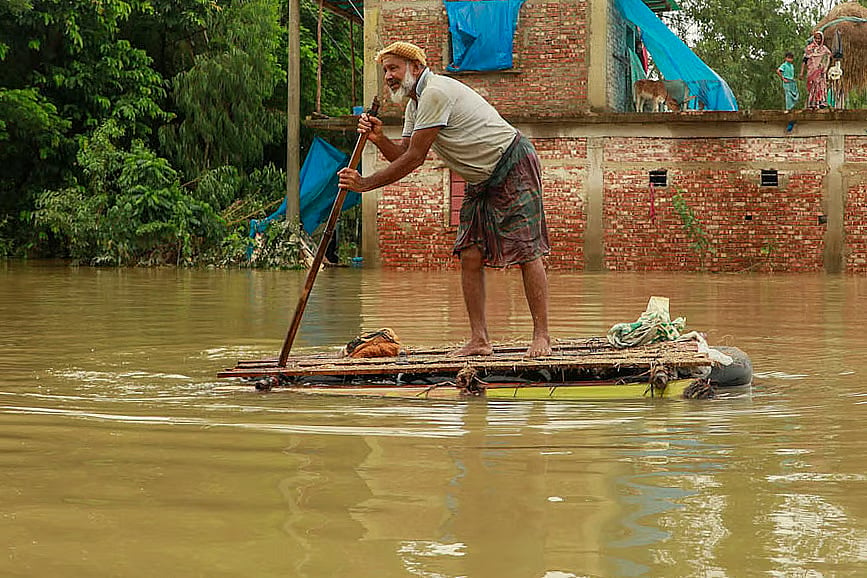
Flood situation: Battle to survive begins as water levels recede
“I spent my entire life working tirelessly to build that house. But it was completely destroyed in an instant. Now, with my son, daughter-in-law, and grandchildren, there are six of us with absolutely nowhere left to go. Everything is utterly ruined.”
These are the words of Rani Deb, a woman in her sixties. Her home is at Sughar village in Habiganj Sadar upazila. Her mud house was destroyed by the floods.
As the floodwaters began to recede, she and her family returned to their ruined homestead. However, having lost their only shelter, the family is now gripped by deep anxiety.
According to data from the Ministry of Disaster Management and Relief, 59 upazilas across Habiganj, Chittagong, Cox’s Bazar, Bandarban, Khagrachhari, Rangamati, and Moulvibazar have been inundated.
The true extent of the devastation is starting to become starkly apparent as the floodwaters recede in these regions. While residents have begun returning to their homes, they now face a gruelling new battle for survival.
The floods were triggered by several days of torrential rain and mountain runoff. The ministry’s report stated that as of 4:00 pm Monday, at least 54 people had lost their lives due to floods, mountain runoff, and landslides. The number of waterlogged families stands at 155,311, whilst the total number of affected individuals has reached 609,411.
According to ministry sources, 1,049 shelters have been opened for the flood victims in these areas. Currently, 38,422 people remain housed in these shelters.
The true extent of the devastation is starting to become starkly apparent as the floodwaters recede in these regions. While residents have begun returning to their homes, they now face a gruelling new battle for survival.
Meanwhile, the Flood Forecasting and Warning Centre (FFWC) has warned of potential flooding in nine more districts. These districts are Sylhet, Sunamganj, Mymensingh, Netrokona, Sherpur, Lalmonirhat, Nilphamari, Rangpur, and Kurigram.
The FFWC stated that these regions could be inundated within the next 24 to 48 hours.
Waters recede, exposing the scale of devastation
Although the floodwaters have subsided slightly, 75-year-old Nausha Miah from Katharia Union of Banshkhali, Chattogram, has not yet been able to return to his own home. For the past week, he has been staying at a relative’s house.
Speaking about the situation, he remarked, “The water is indeed receding, but you cannot simply stay at home immediately after returning. First, the house must dry out, and the mud has to be cleared. The roof and walls require repairs. Only then can we see how we might rebuild our lives.”
The plight of Nausha Miah is shared by hundreds of thousands of people across Chattogram, Cox’s Bazar, Rangamati, Khagrachhari, and Bandarban. In some areas, the water has receded; in others, it lingers. Nevertheless, a fresh struggle has begun for residents of these areas—repairing broken homes, clearing thick mud, salvaging ruined crops, and trying to return to normalcy.
Visiting various areas of Banshkhali in Chattogram yesterday, Monday, locals could be seen shovelling mud out of their homes. Some were removing ruined furniture. Many families reported that they were surviving solely on dry food.
Shaheen Akhter, from the Dongra area of Banshkhali, said, “What will we do? How will we rebuild our home? Where on earth will we find the money?”
Floodwaters have receded from parts of Satkania Sadar, Sonakania, Chadaha, Madarsha, Keochia, Kanchana, and Amilaish. The waters have also drained from all unions of Lohagara. However, many low-lying areas remain completely submerged.
There is still thick mud inside the house. It is impossible to live there without cleaning it first. Many of our household items have also been ruined.Jasim Uddin, a resident of Ujanipara, Bandarban
In Cox’s Bazar, floodwaters have started to drain from most parts of Chakaria, Pekua, Matamuhuri, Ramu, and Eidgaon upazilas. Consequently, residents are leaving the shelters to return to their homes.
Nasima Begum, a resident of the Gobindapur area in Chakaria, returned home yesterday after five days, only to find that her floor had collapsed. The entire house was choked with mud. She was seen desperately trying to clear the sludge to make the dwelling habitable again.
“Where will we lay our heads, we simply don’t know”
The Ministry of Disaster Management and Relief has announced that since 7 July, some 8,950 tonnes of rice and Tk 46 million have been allocated to deputy commissioners across 64 districts for humanitarian assistance. Specifically, Tk 17.5 million and 3,250 tonnes of rice have been distributed to the DCs of the seven flood-affected districts.
Nurul Amin, a resident of the Premashia area in Banshkhali, remarked that he had never witnessed such a disaster in his lifetime. He said, “My young children have been suffering for seven days. The water has gone down, but the house is in no condition to even light a cooking fire.”
Oh son, my house is gone; I couldn’t save a single thing. Where will we go, where will we stay, and where will we lay our heads? We simply do not know.Asha Khatun, a woman in her sixties from Paschim Kokdandi village, Banskhali, Chattogram
A certain Sadu Rashid, 55, a resident of the Banur Baper Bari area in Katharia Union in the same upazila, broke down in tears as he spoke. “I barely managed to support my family by sharecropping on someone else’s land. Now, the floodwaters have collapsed my mud house. The sheer worry of how I will construct a new home is constantly weighing on my mind.”
Almost all the dirt roads were seen submerged in Paschim Kokdandi village. Fields, ponds, and trees had merged into a single vast sheet of water. In some places, mud walls had collapsed entirely; in others, only the corrugated tin roofs of houses peeked above the water. Standing before their ruined homes, some residents searching for lost belongings, while others clearing the accumulated mud.
Standing in the water, holding the edge of her torn saree tightly, Asha Khatun pointed towards a spot where her house once stood. Now, there was nothing but murky water. Her mud house was gone. Her granary, rice stock, ducks, and chickens had all been swept away, and the fish from her pond had escaped into the floodwaters.
The woman, in her sixties, cried out, “Oh son, my house is gone; I couldn’t save a single thing. Where will we go, where will we stay, and where will we lay our heads? We simply do not know.”
Similar ruin across the hill districts
As the water levels began to fall in Rangamati, many residents started returning home from the shelters. However, 3,739 people still remain in 42 shelters across the district, with 1,646 families still marooned by floodwaters. Torrential rains have triggered 135 landslides across seven upazilas in the district.
In Bandarban’s Balaghata, Armypara, Islampur, and Ujanipara areas, residents were seen clearing mud from their homes. According to official figures, as many as 6,250 people in the district are still residing in shelters.
The water is indeed receding, but you cannot simply stay at home immediately after returning. First, the house must dry out, and the mud has to be cleared. The roof and walls require repairs. Only then can we see how we might rebuild our lives.75-year-old Nausha Miah from Katharia Union of Banshkhali, Chattogram
Jasim Uddin, a resident of Ujanipara, said, “There is still thick mud inside the house. It is impossible to live there without cleaning it first. Many of our household items have also been ruined.”
Speaking about the situation, disaster management expert Gawher Nayeem Wahra told Prothom Alo that these flood-affected people urgently require emergency relief.
“Local government institutions have effectively been non-functional for the past two years. Therefore, an all-party parliamentary committee should be formed immediately to assist the victims. Members of parliament from these regions must be sent to their respective constituencies to coordinate the rehabilitation process. If necessary, the parliamentary session should be adjourned to facilitate this,” he noted.
[Staff Correspondents in Chattogram, Cox’s Bazar, and Habiganj, alongside Correspondents in Bandarban, Rangamati, and Khagrachhari sent information to prepare the report.]