Dialogue
Fair elections not possible without political parties’ cooperation: CEC
Chief Election Commissioner (CEC) AMM Nasir Uddin sought the cooperation of political parties to conduct free and fair elections.
He said it would not be possible to hold a credible election without such cooperation.
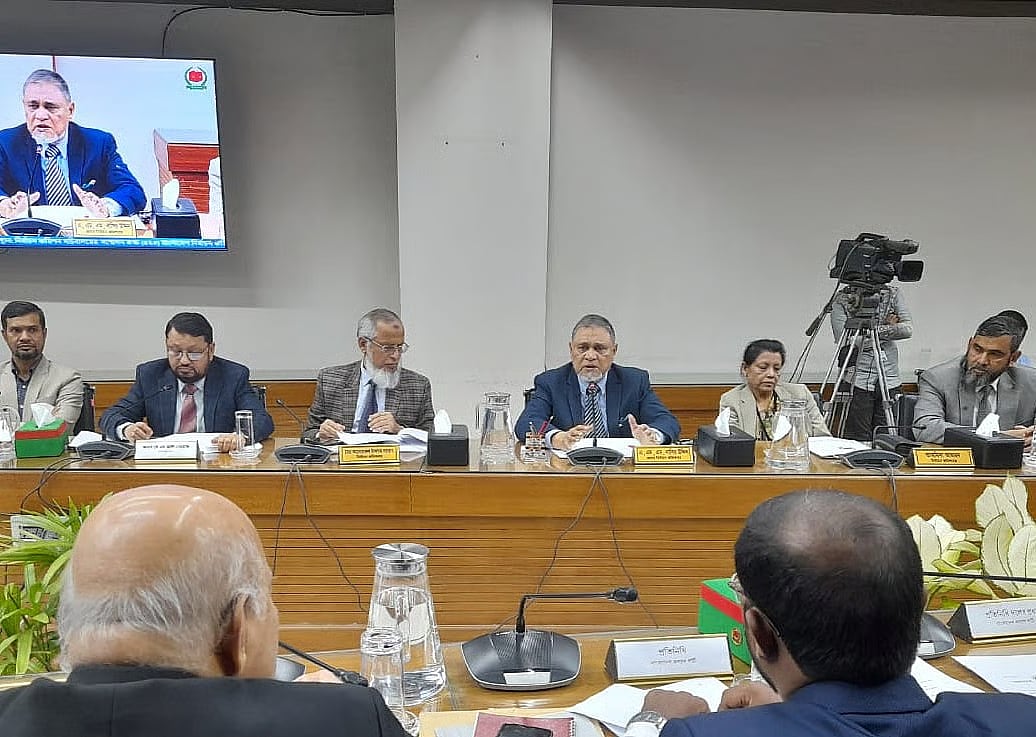
The CEC made these remarks during a dialogue with political parties as part of preparations for the 13th parliamentary election at the election commission office in Agargaon, Dhaka on Monday morning.
Leaders of Bangladesh Sanskritik Mukti Jote, Bangladesh National Awami Party, Bikalpo Dhara Bangladesh, Bangladesh Kallyan Party, and Bangladesh Muslim League (BML) participated in the first phase of the third day of dialogue. Although invited, the Bangladesh Labour Party did not attend.
Presenting the commission’s preparations for the parliamentary elections scheduled in February, CEC Nasir Uddin said at the start of the dialogue, "From our side, we will take all necessary preparations to create a free, fair, and smooth electoral environment. Our intention is absolutely clear, our commitment is clear. Whatever storms, cyclones, or obstacles come, we will take the necessary steps to ensure a smooth and credible environment."
Highlighting the importance of party cooperation on this matter, the CEC added, “If political parties do not cooperate or deliberately create problems, you will see that the possibility of holding the election turns into uncertainty.”
Urging parties to follow the electoral code of conduct, he said, “Problems may arise before polling day, on voting day, or afterwards. On the ground, these issues are visible during elections. To ensure that no problem arises in any of these three phases, the electoral code of conduct must be followed.”
Election commissioner Abul Fazal Muhammad Sanaullah said that, for the first time, the electoral code of conduct has been directly linked with the Representation of the People Order (RPO). As a result, any violation of the code of conduct will now be treated as a pre-election offence, and penalties, including cancellation of candidature, will apply.
He also stated that any form of election campaigning will remain prohibited in mosques, temples, pagodas, churches, government offices, and educational institutions.
Highlighting the voting of expatriates as a major challenge this time, Abul Fazal said, “The commission is attempting to implement this complex process in just nine months. The registration platform, Postal Vote BD, will be launched tomorrow (Tuesday) evening.”
He also mentioned that a monitoring cell has been formed to counter misinformation on social media, deepfakes, and misuse of artificial intelligence, with assistance from the United Nations.
Election commissioner Anwarul Islam stated that the current commission’s message is clear: no one will be allowed to violate the law, and the commission will not compromise on any matter. Vigilance teams, monitoring teams, law-and-order cells, electoral inquiry teams, and the commission’s own observers will keep round-the-cloak watch on the ground.
Anwarul Islam further said that if irregularities are observed, returning officers (ROs) may suspend or cancel voting in the entire constituency, and presiding officers may, if deemed necessary, annul the results of a polling centre.
Election commissioner Tahmida Ahmed sought everyone’s cooperation for free and fair elections, saying, “Even if the law-and-order situation is difficult, success is possible if the nation stands together, as demonstrated by the peaceful observance of Durga Puja.”
Objections over poster ban
During the dialogue, Bangladesh Kallyan Party chairman Syed Muhammad Ibrahim said that in today’s digital era, thanks to media and social media, identifying violations of the code of conduct is easy. Therefore, the focus should be on preventing or minimising such violations.
Referring to the limited authority of assistant returning officers, he added that in the digital era, people expect instant responses and action, so rapid decisions and measures are necessary.
Syed Muhammad Ibrahim praised the initiative for out-of-country voting (OCV) and postal ballots, and thanked the election commission for addressing the long-standing demand of over 4 million expatriates.
However, he urged special caution in the security and accounting of postal ballots, citing the current political distrust and lack of confidence in the country.
He also advised setting up a quick fact-checking and accurate information dissemination system to prevent the spread of false information during elections.
Bikalpo Dhara Bangladesh secretary general Major (retd) Abdul Mannan stated that if the candidature of a few candidates is cancelled for violating the code of conduct, it will create discipline among the rest.
He noted that in the past, there has been no precedent for cancelling the candidature of candidates from major parties, so the commission’s strict powers and enforcement must be ensured.
Regarding posters, Abdul Mannan said that major political parties do not need posters for campaigning, but smaller parties rely on them for recognition. Therefore, a realistic decision on posters is necessary.
He also raised questions about the presence of party agents at polling centres, stating that voting is possible without them because agents from major parties usually dominate polling centres, while agents from smaller parties are often denied access.
Bangladesh National Awami Party presidium member Abdur Rahman highlighted declining public confidence in elections and emphasised that a neutral, transparent, and violence-free election is the need of the hour, which will restore people’s trust.
Bangladesh Muslim League (BML) president Sheikh Zulfikar Bulbul Chowdhury stressed creating a level playing field for all parties and stopping the use of black money.
Speaking regarding the ban on posters, banners, leaflets, festoons, and PVC materials in the electoral code of conduct, he said this is inconsistent with reality.
Bangladesh Sanskritik Mukti Jote president Abu Layes Munna suggested structural reforms in the election commission, stating that a national council should be formed including presidents and general secretaries of all registered political parties to reform the commission’s rules and regulations.
He noted that if such a council existed, there would be no need for month-long dialogues.