‘July Fighters Council’ threatens nationwide highway blockade Sunday if demands ignored
The “July Fighters Council” has threatened to block highways across all districts on Sunday unless their main demands are clearly recognised and incorporated into the July Charter and implemented accordingly.
The demands include: formal state recognition of those killed in the 2024 mass uprising as martyrs, official recognition of the injured as July Fighters, a concrete rehabilitation framework for the families of the martyrs, and the provision of legal aid for the wounded.
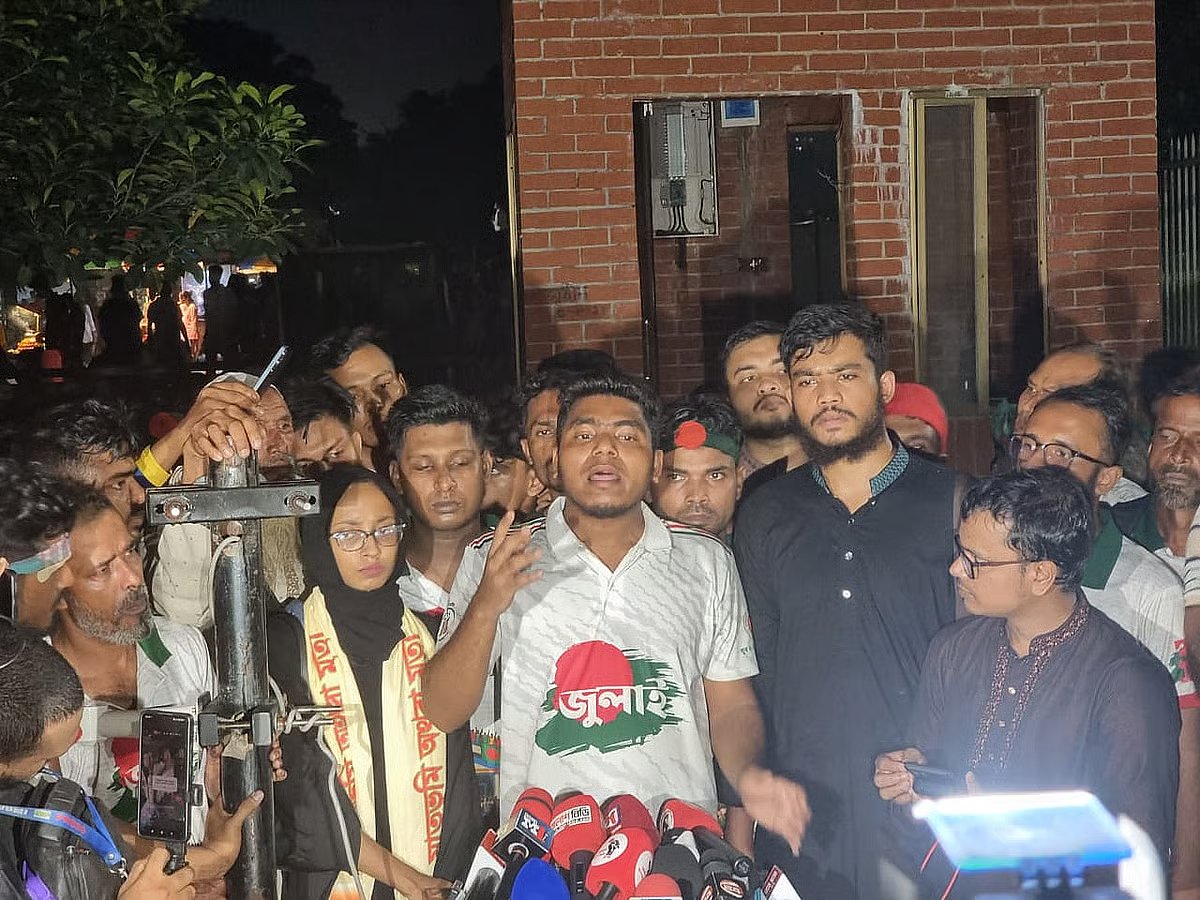
Masud Rana, convenor of the July Fighters Council, announced this at a press conference held at Gate No. 12 of the Jatiya Sangsad (National Parliament) on Friday evening.
Earlier in the day, he also demanded that those responsible for the police baton charge and tear gas attacks on July Fighters in and outside the parliament premises be brought to justice.
“We will not leave the streets until our demands are met. We will enforce blockades on highways in every district town from 2:00 pm to 5:00 pm on Sunday. We call upon ordinary citizens, especially those who took part in the July movement, to join us. This is not a partisan movement; it belongs to the people,” Masud Rana told the press conference.
Expressing anger at the government and the police, he said, “We took to the streets, risking our lives for this state and for a new dream of national freedom. The July Charter that was built upon our blood, should have contained due recognition of that sacrifice. Yet, the government has denied us that recognition. We shed our blood, we gave our lives, and now the state is betraying us.”
Masud Rana further stated that the group had engaged in discussions with the government and the National Consensus Commission for over a month. Injured protesters in every district had submitted demands to the local deputy commissioner’s offices. On 13 October, they marched from Shahbagh to the Secretariat to submit a memorandum, and copies of their demands were also delivered in writing to 14 ministries, the secretariat, the chief justice, and the chief election commissioner.
“We had hoped the government and the Consensus Commission would understand the justice of our demands,” said Masud Rana. “Law adviser Asif Nazrul himself reviewed our proposals. He objected to just one word, which we later amended. He assured us that he would work to include our demands in the July Charter. But when the Charter was finally published, we discovered that none of our demands had actually been incorporated.”
Condemning the police assault on their peaceful sit-in, Masud Rana said, “We were holding a peaceful demonstration at the parliament gate. Administrative officials spoke with us, and we assured them that our sit-in would continue only until 10:00 am and that there would be no disorder. Yet, without any attempt at dialogue or resolution, the police suddenly launched an attack.”
He continued, “Police began baton-charging on us from behind without warning. Before anyone could react, they fired tear gas shells. Those who fell to the ground were kicked and trampled with boots. The attack was so brutal, it was as if we were not human beings but animals. Over 100 of our members were newly injured and subjected to fresh torture.”
Masud Rana alleged that the police force still operates with the mindset cultivated under Sheikh Hasina’s regime.
Declaring that no new Bangladesh is possible without police reform, he said, “More than 120,000 members of the police were recruited during Hasina’s rule. Their DNA was tested to ensure they came from Awami League backgrounds. This force remains deeply partisan, immersed in a political culture that has not changed even after the July Revolution. Without reforming this institution, it is impossible to build a new Bangladesh.”