Renewable Energy
Limited efforts to expand solar power use in agriculture
The arrival of the boro rice season used to bring anxiety for Taijul Islam. Boro cultivation takes place during the dry season, when there is little or no rainwater available. Like most parts of the country, farmers in his area depend on groundwater for irrigation. Taizul lives in Dhitpur village of Bhaluka upazila in Mymensingh.
For him, the biggest challenge in irrigating his fields was availing diesel. Although a group of farmers jointly purchased a water pump, obtaining diesel, transporting it from town, storing it, and coping with constantly fluctuating prices proved difficult.
If irrigation was not provided on time, the soil in the fields would often crack. Speaking on a scorching afternoon in the Bengali month of Jyaishtha, Taijul said, “There’s no certainty about fuel prices. Sometimes they go up, sometimes down. If we couldn’t irrigate the paddy on time, the soil would crack open.”
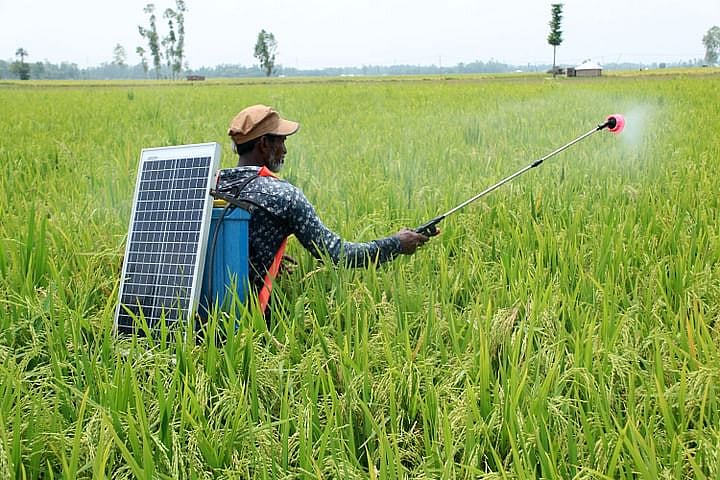
That dependence on diesel is beginning to change in Dhitpur. Water from the Sutia River, which flows beside the village, is now being pumped using solar energy to irrigate farmland. At least 70 farmers, including Taijul, are benefiting from the system.
The solar-powered irrigation pump is only one component of a broader initiative. Farmers are also being provided with a huller (rice milling machine), a solar dryer for drying paddy, and solar-powered threshing equipment. In addition, a small cold-storage facility capable of holding two tonnes of crops has been established, also powered by solar energy.
“There are many benefits in one place,” Taijul summed the initiatives up.
Another advantage is a solar-powered charging station for battery-operated auto-rickshaws, designed to facilitate the transportation of agricultural products.
Although irrigation services are fully operational, the other facilities have not yet become fully functional. The solar irrigation system was launched in 2022 by the Bangladesh Agricultural Development Corporation (BADC). The additional facilities are being jointly implemented by the Department of Farm Power and Machinery at Bangladesh Agricultural University and the United Kingdom’s Birmingham City University, with support from BADC.
Solar panels covering roughly 7 per cent of the area in Dhitpur generate about 17 kilowatts of electricity. Researchers say the system is comparatively affordable because it is built with locally available materials and is user-friendly for farmers and small entrepreneurs. Such technology can reduce post-harvest losses while increasing the use of renewable energy.
Asked about the impact on irrigation costs, local resident Rokonuzzaman said, “Previously, irrigation cost farmers around Tk 800 per katha of land. Now it costs about Tk 300. If the cultivated area is larger, the cost falls even further.”
The economic cost of that dependence is substantial. SREDA estimates that a typical diesel irrigation pump consumes around 1,200 liters of fuel annually. Altogether, the irrigation sector uses about 1.49 billion liters of diesel each year, equivalent to approximately 1.25 million tonnes. Importing that fuel costs around Tk 45.78 billion annually.
The Dhitpur project is a small but important example of the potential for renewable energy in Bangladesh’s agriculture sector. As concerns over climate change, fuel import costs, and dependence on fossil fuels continue to grow, solar-powered technologies are gradually expanding across agricultural and food systems in different parts of the country.
Although renewable energy still contributes only a small share of Bangladesh’s overall energy supply, initiatives involving solar-powered irrigation, food processing, storage, and transportation demonstrate its potential to transform rural economies. The experience of farmers such as Taijul Islam offers a glimpse of that transition.
Professor Chayan Kumar Saha of Bangladesh Agricultural University’s Department of Farm Power and Machinery told Prothom Alo that the initiative could serve as a model for the country. So far, the use of solar and renewable energy in agriculture has largely been confined to irrigation.
The Dhitpur centre expands that concept by integrating irrigation, rice threshing, and drying. This reduces dependence on diesel-powered machinery, lowers production costs, and supports sustainable agricultural development.
Irrigation still dependent on diesel
Irrigation is the largest energy-consuming activity in Bangladesh’s agricultural sector. Whether for boro rice, vegetables, maize, or other dry-season crops, irrigation is essential during the dry months. Most of this irrigation still depends on diesel and electricity.
According to data from the Sustainable and Renewable Energy Development Authority (SREDA), under the Ministry of Power, Energy and Mineral Resources, Bangladesh used 1.58 million irrigation machines during fiscal year 2018–19. Of these, 338,847 were electric pumps, while 1.24 million were diesel-powered. Together they irrigated more than 5.3 million hectares of farmland.
In other words, nearly 80 per cent of the country’s irrigation equipment remains diesel-dependent.
The economic cost of that dependence is substantial. SREDA estimates that a typical diesel irrigation pump consumes around 1,200 liters of fuel annually. Altogether, the irrigation sector uses about 1.49 billion liters of diesel each year, equivalent to approximately 1.25 million tonnes. Importing that fuel costs around Tk 45.78 billion annually.
Farmers bear these costs directly. When global oil prices rise, irrigation costs increase, production expenses climb, and food prices eventually follow. Renewable energy in agriculture is therefore not only an environmental issue but also a matter of food security and economic stability.
According to BADC, Bangladesh currently has 10,35,639 diesel-powered shallow tube wells, 737 deep tube wells, and 184,375 low-lift pumps.
During the 2025–26 fiscal year, operating more than 1.22 million irrigation machines required approximately 769,000 tonnes of diesel.
Previously, irrigation cost farmers around Tk 800 per katha of land. Now it costs about Tk 300. If the cultivated area is larger, the cost falls even further.Local resident Rokonuzzaman
Bangladesh possesses several renewable energy sources, including solar, wind, hydropower, biogas, and biomass such as cow dung, rice husks, straw, and jute sticks. However, solar energy dominates the sector. According to SREDA, 83 per cent of renewable electricity generation comes from solar power, contributing around 1,200 megawatts of capacity.
Institutions working in the sector
Renewable energy use in agriculture remains limited and is concentrated almost entirely in irrigation. Pilot projects such as the one in Bhaluka are operating in a few areas but have not yet been scaled up.
At least nine government and state-owned institutions are involved in promoting solar irrigation. They are: BADC, Barind Multipurpose Development Authority, Department of Agricultural Extension, Infrastructure Development Company Limited (IDCOL), Bangladesh Rice Research Institute (BRRI), Bangladesh Agricultural Research Institute (BARI), Bangladesh Rural Electrification Board (REB), Bangladesh Academy of Rural Development(BARD), and Rural Development Academy (RDA).
According to BADC, these organisations currently operate 5,139 solar-powered irrigation pumps, generating about 73 MWs of electricity.
Bangladesh has approximately 5.56 million hectares of irrigated land. Solar irrigation currently covers only about one per cent of that area. The overwhelming majority still depends on diesel pumps or grid-connected electric pumps.
Experts point out that solar power is particularly suitable for irrigation because water pumping is usually done during daylight hours—the same time solar panels generate the most electricity. Most parts of Bangladesh receive sufficient sunlight for nearly 300 days a year.
Beyond irrigation: toward a new rural economy
Discussions of solar energy often focus on electricity generation or rooftop panels. The Dhitpur project demonstrates that its applications in agriculture can be much broader.
One of the greatest challenges after crop production is processing, storage, and transportation. Studies by the Ministry of Agriculture indicate that a significant portion of fruits and vegetables is lost after harvesting due to inadequate storage facilities, lack of drying systems, and insufficient electricity for small-scale processing.
The Dhitpur initiative seeks to address these challenges collectively. Solar power is being used not only for irrigation but also for drying, threshing, storage, and transportation. Small solar-powered cold-storage facilities are also being established in districts such as Dinajpur and Jhenaidah.
Researchers at Bangladesh Agricultural University argue that a truly renewable agricultural sector must extend beyond irrigation and encompass the entire value chain—from farm to market.
A study by the International Water Management Institute (IWMI) reveals that solar irrigation pumps are slashing Bangladeshi farmers’ costs by 20–30 per cent, heavily reducing reliance on imported diesel which currently powers 80 per cent of the nation’s 1.6 million pumps. Through grid-integration and smart policy design, these solar models are also generating supplemental income for local service providers.
Jayanta Bhattacharya, Associate Scientist, IWMI stated that in the second phase of the SoLAR project is pairing solar irrigation with Alternate Wetting and Drying (AWD) techniques to incentivize water conservation.
According to him, this strategic bundling aims to maximise “crop per drop” while drastically cutting methane emissions from paddy fields.
Ultimately, experts view the initiative as a vital blueprint for securing the country’s long-term food and water security.
IDCOL’s experience
The state-owned Infrastructure Development Company Limited (IDCOL) has played the leading role in expanding solar irrigation in Bangladesh.
According to the organisation, its solar irrigation programme was launched to provide irrigation in off-grid rural areas, reduce diesel consumption, and lower farmers’ costs. The objective was not only to promote renewable energy but also to shield agriculture from fluctuations in imported fuel prices.
IDCOL estimates that installing a solar pump for irrigating 15–20 bighas of land costs roughly Tk 1.2 million. A system capable of irrigating around 120 bighas costs Tk 6–7 million. These costs include the land required for solar panel installation.
IDCOL’s model is based on partnerships. It provides loans covering 35 per cent of project costs, while the remainder must be financed through bank guarantees and contributions from farmers. In addition, IDCOL offers a grant covering 50 per cent of installation costs. Without such support, solar irrigation would be beyond the reach of most farmers.
However, progress has been slower than initially envisioned. In 2011, IDCOL announced a target of installing 18,750 solar pumps nationwide by 2016. After multiple revisions, it now aims to convert 10,000 diesel pumps to solar power by 2030.
Officials say declining international financing has slowed implementation. Unlike government agencies that receive annual budget allocations, IDCOL relies heavily on external funding.
Nazmul Haque Faisal, Executive Vice President for Corporate Affairs, said the organisation is seeking financing from global climate funds and the World Bank.
Economic benefits
According to Prothom Alo’s Chuadanga correspondent Shah Alam, diesel shortages during the recent boro season forced thousands of farmers in the district to wait in long queues at fuel stations. Many suffered lower-than-expected yields because of inadequate irrigation.
Farmers in Sarishadanga–Kobikhali village of Mominpur union, however, were largely unaffected thanks to solar irrigation.
Farmer Rezaul Karim said that before solar irrigation was introduced in 2018, irrigation cost nearly Tk 8,000 per bigha using diesel-powered pumps. Today, solar irrigation costs between Tk 2,500 and Tk 3,000 per bigha, saving roughly Tk 5,000.
In four upazilas of Chuadanga district, an NGO ,Wave Foundation has installed 54 solar irrigation pumps with support from IDCOL. Each pump serves about 60 farmers and irrigates around 180 bighas of land.
According to Wave Foundation’s renewable energy project coordinator Kitab Ali, three of the projects now supply 25,000–30,000 units of electricity annually to the national grid.
ADB’s roadmap suggests that large-scale deployment of solar irrigation pumps could save several hundred thousand tonnes of diesel each year, reducing both fuel import costs and pressure on foreign currency reserves.
Environmental significance
Bangladesh is among the countries most vulnerable to climate change, despite contributing very little to global greenhouse gas emissions.
According to the Asian Development Bank’s 2023 report, Road Map to Scale Up Solar Irrigation Pumps in Bangladesh (2023–2031), widespread adoption of solar irrigation could reduce diesel consumption by nearly one million tonnes annually and prevent approximately three million tonnes of carbon dioxide-equivalent greenhouse gas emissions each year.
Why is progress slow?
ADB projects mention that by 2030, Bangladesh could install around 45,000 solar irrigation pumps. This would avoid approximately 900,000 tonnes of carbon dioxide-equivalent emissions annually, add nearly 1,000 MWs of solar capacity to the national energy system, and save about US$377 million in fuel costs each year—equivalent to roughly Tk 46.33 billion at current prices.
Yet progress remains slow. The main obstacles include high installation costs, limited financing, and scarcity of suitable land for solar panels.
Another challenge is that much of the electricity generated remains unused. Irrigation is required for only about five months of the year. For the remaining months, many farmers are uncertain how to use the surplus electricity.
As a result, integrating solar irrigation systems with the national grid is increasingly viewed as a priority.
Dipal Chandra Barua, founder of Bright Green Energy Foundation, argues that connecting solar pumps to the grid would enable low-cost electricity generation and improve economic viability.
He also advocates low-interest loans for solar irrigation and related initiatives.
According to Barua, Bangladesh’s banking sector has more than 10,000 branches. If each branch financed just five solar-energy customers, the resulting savings and expansion could be substantial.
Hope for a new era
As afternoon sunlight softens over the solar panels in Dhitpur, water continues flowing from the Sutia River into nearby fields. Farmers stand beside the system calculating their irrigation schedules.
Terms such as renewable energy, carbon emissions, and energy transition may not mean much to Taijul Islam. What he understands is simple: where he once waited for diesel deliveries, sunlight now powers the irrigation of his land.
Bangladesh’s agriculture sector still relies heavily on diesel, consuming fuel worth tens of billions of taka every year to deliver water to fields. That reality will not change overnight. But in villages like Dhitpur, the first steps toward a different future are already visible.