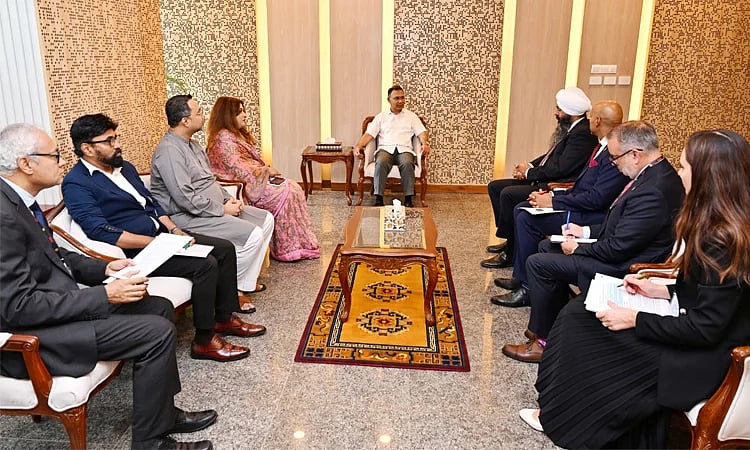
PM seeks Canadian cooperation in energy, health and agriculture
Prime Minister Tarique Rahman today, Monday sought Canadian cooperation in education, health, energy and agriculture, alongside food security, technical education and climate financing, to strengthen bilateral ties and expand development cooperation.
He made the call when a delegation led by Canada's Secretary of State for International Development Randeep Sarai paid a courtesy call on him at the Prime Minister's Office at the Secretariat here, said PM's Deputy Press Secretary Shahadat Shadhin.
During the meeting, the two sides discussed strengthening bilateral relations, expanding economic cooperation and exploring new avenues for strategic partnership, alongside the Rohingya crisis and other development priorities.
The Prime Minister said Bangladesh looked forward to cooperation from friendly countries like Canada in key sectors, including health and education.
On energy, the Canadian side expressed interest in supporting Bangladesh's energy supply, particularly in oil and liquefied natural gas (LNG).
In health and skills development, Canada expressed interest in expanding cooperation in technical and vocational education and training, including nursing education. The Canadian side also indicated interest in supporting nursing training institutions and developing skilled nurses, building on its existing activities in the sector.
In agriculture, the discussions covered cooperation in pulses and oilseeds, food security and data-driven agricultural planning. The Canadian side also briefed the prime minister on its ongoing activities through the International Maize and Wheat Improvement Center (CIMMYT).
Tarique Rahman outlined the government's plan to introduce Farmer Cards to provide farmers with fertilisers, seeds and other essential agricultural inputs, saying, "The initiative would also help build a comprehensive database of farmers, enabling better agricultural planning and more effective delivery of government support."
On the Rohingya crisis, the Prime Minister said Bangladesh was hosting around 1.3 million Rohingyas and that their prolonged presence was putting considerable pressure on the country's economy and environment.
"While humanitarian assistance to the Rohingyas is important, their safe, voluntary and dignified repatriation is the only sustainable solution to the crisis. The crisis originated in Myanmar, and its solution also lies in Myanmar," the premier said.
Canada's Secretary of State for International Development agreed on the importance of peaceful, safe and dignified return of the Rohingyas.
The meeting also discussed renewable energy, canal excavation, tree plantation and climate financing.
Sarai said Canada was interested in providing C$13 billion in climate financing globally over the next five years, noting that Bangladesh could benefit from the initiative.
Canada also expressed interest in supporting feasibility studies for development projects in Bangladesh.
The discussions also covered the government's Family Card initiative and poverty reduction. Referring to World Bank estimates, the prime minister said better-targeted social assistance, including through the Family Card, could help lift an additional 28.5 lakhs people out of poverty.
He stressed the importance of promoting economic self-reliance through income generation and employment opportunities alongside social protection programmes.
Sarai praised the contributions of Bangladeshis and Canadians of Bangladeshi origin living in Canada, highlighting their initiative, skills and positive outlook, noting that two Canadians of Bangladeshi origin were serving as members of the Canadian Parliament.
At the end of the meeting, Sarai invited the Prime Minister to visit Canada.
State Minister for Foreign Affairs Shama Obaed Islam, Prime Minister's Adviser on Education, Expatriates' Welfare and Overseas Employment Mahdi Amin, Press Secretary AAM Saleh Shibly and other relevant officials were present.
Canadian High Commissioner to Bangladesh Ajit Singh and other senior Canadian officials also attended the meeting.