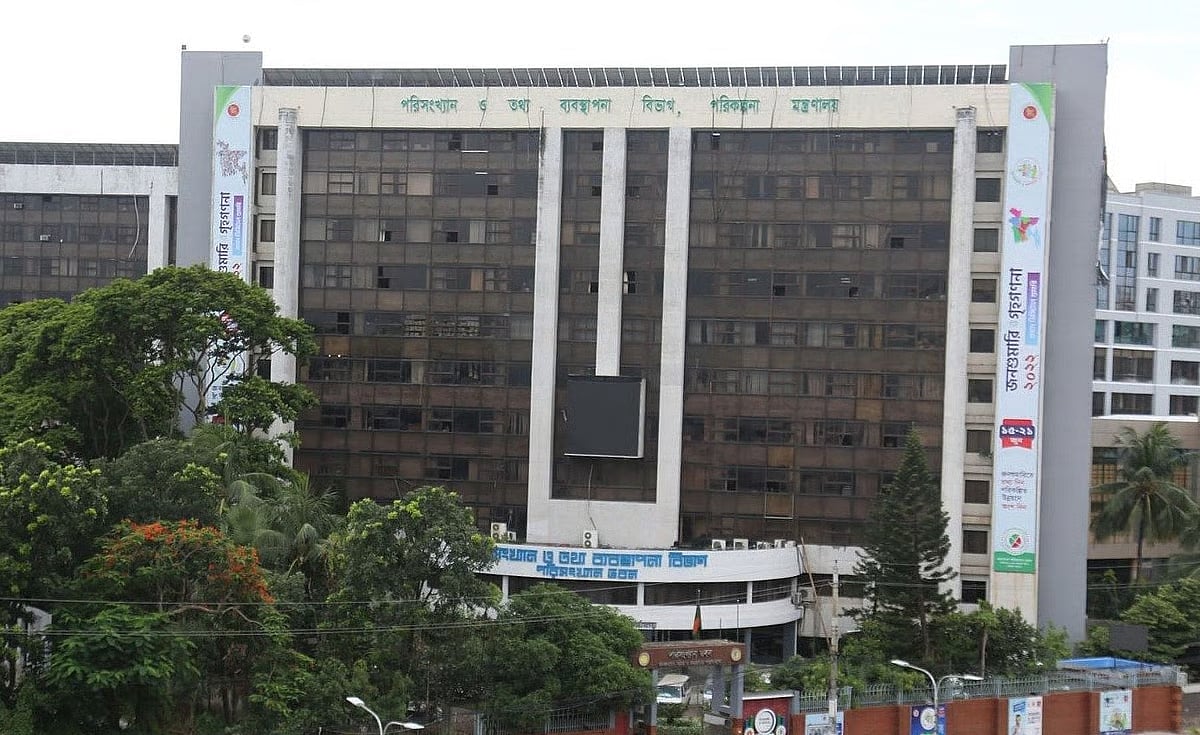
BBS: Minister’s approval not required to release data, will manipulation end?
From now on, government statistical reports will no longer require approval from the Minister for Planning before being made public. The Director General of the Bangladesh Bureau of Statistics (BBS) will be able to release such reports independently.
Planning adviser professor Wahiduddin Mahmud hopes this move will close the door to manipulation of statistics. However, economist Selim Raihan believes that unless the BBS is allowed to function independently, the risk of political influence will remain.
The Ministry of Planning has recently issued a policy on “preparation, publication and preservation of statistics”. Work on drafting regulations in line with this policy is now at the final stage. The interim government intends to place the regulations before the advisory council for approval during its remaining tenure.
Professor Wahiduddin Mahmud believes the decision will reduce delays in publishing statistical reports.
Speaking to Prothom Alo, he said the process would take less time; accurate and reliable data would emerge, and political interference would be eliminated.
The planning adviser added that the relevant regulations would be approved soon.
Economists and experts say that allegations of data manipulation against ministers of ruling parties have been persistent. They point to a tendency to inflate GDP growth figures and understate inflation.
They believe that removing the requirement to submit survey and census reports to the minister will reduce political interference and allow the public access to accurate data from surveys and censuses.
The credibility of BBS statistics has long been questioned. Economists allege that successive governments have tailored statistics to suit political interests, such as exaggerating growth figures and concealing the true (higher) inflation rate.
The BBS operates under the Ministry of Planning. Under the Statistics Act of 2013, the bureau is responsible for conducting the population census, agricultural census, fisheries and livestock censuses, as well as other surveys and censuses. It is also responsible for publishing data on GDP growth, the Consumer Price Index and other indicators. The government appoints the BBS director general, who holds the rank of an additional secretary.
Until now, it had been customary to obtain approval from the planning minister before publishing any survey or census data. This practice has been abolished under the new policy. From now on, inflation data, GDP growth figures, economic census results and labour force survey data may be released directly by the BBS director general. This effectively reduces the powers of the planning minister.
The BBS currently has six divisions: agriculture; census; demography and health; industry; national accounts; and computer division. Surveys and censuses are conducted through these divisions.
The policy states that the BBS will form “division-based technical advisory committees” comprising experts to ensure the preparation, publication and preservation of accurate, reliable and timely statistics.
For any agriculture-based survey or census, the BBS will form a 14-member technical committee chaired by the director general. The committee will include representatives from other government agencies as well as BRAC, the Bangladesh Agricultural Research Council, Sher-e-Bangla Agricultural University, the Bangladesh Institute of Development Studies (BIDS), and Bangladesh Agricultural University.
During the term of AHM Mustafa Kamal as planning minister (2014–2018), allegations of manipulation of BBS data were particularly widespread.
All agricultural crop production data, surveys and census results will be reviewed by this committee, after which the BBS director general will publish the statistics in line with the committee’s recommendations. These reports will no longer require submission to the planning minister prior to publication.
The credibility of BBS statistics has long been questioned. Economists allege that successive governments have tailored statistics to suit political interests, such as exaggerating growth figures and concealing the true (higher) inflation rate.
Allegations of statistical manipulation are longstanding but became more pronounced during the tenure of the previous Awami League government. Economists claim that ministers themselves were most involved in manipulating data during that period.
During the term of AHM Mustafa Kamal as planning minister (2014–2018), allegations of manipulation of BBS data were particularly widespread. It is alleged that when BBS officials presented preliminary GDP growth estimates to Mustafa Kamal, he would instruct them to raise the figures further.
The BBS typically published inflation data on a monthly basis. However, in 2017, then planning minister AHM Mustafa Kamal suddenly decided to release inflation data quarterly instead. At the time, inflation was rising. When inflation later declined, the practice of monthly publication was reinstated.
Towards the end of the Awami League government, which was toppled by a student–public uprising, the publication of inflation data reportedly required clearance from the Prime Minister’s Office. Inflation figures were released only after being shown to the then prime minister at ECNEC meetings. Such political interference severely eroded public trust in BBS data.
Towards the end of the Awami League government, which was toppled by a student–public uprising, the publication of inflation data reportedly required clearance from the Prime Minister’s Office. Inflation figures were released only after being shown to the then prime minister at ECNEC meetings. Such political interference severely eroded public trust in BBS data.
The policy also states that a 13-member technical advisory committee will be formed for conducting the population census, chaired by the BBS director general.
Members will include representatives from the Population Sciences Department of Dhaka University, the Statistical Research and Training Institute, icddr,b, the Population Council, and the National Institute of Population Research and Training (NIPORT).
This committee will analyse data and provide recommendations, following which the DG will publish the report.
Similarly, technical committees will be formed as follows: 13 members for the demography and health division; 14 members for the industry and labour division; 17 members for the national accounts division; and 16 members for the computer division.
Professor Mohammad Moinul Islam of Dhaka University’s Department of Population Sciences welcomed the interim government’s move.
He told Prothom Alo that when statistical reports go to a minister, the process becomes time-consuming and entangled in bureaucratic complications, delaying publication. Moreover, if results are unfavourable, ministers may dislike them, raising concerns about manipulation.
Professor Moinul Islam further said that if survey and census results no longer go to the planning minister, political interference will be eliminated, the process will be faster, and the objectivity of surveys will be ensured.
However, Selim Raihan, executive director of the private research organisation SANEM (South Asian Network on Economic Modelling), told Prothom Alo that although the policy states on paper that political interference will not occur, what happens behind the scenes remains unknown.
He warned that unless the BBS is allowed to operate independently, the risk of political influence will continue.