RMG sector
Wage board vote fixes minimum wage at Tk 17,000
Wage board was formed on 1 Nov; first meeting held on 4 Nov
At the second meeting, on 9 Nov, workers proposed minimum wage of Tk 32,000
At the third meeting, on 23 Nov, employers proposed a minimum wage of Tk 15,700
On 24 Nov, both the employers’ and workers’ sides revised their proposals several times
Following negotiations, the employers’ side proposed Tk 17,000, while the workers’ side proposed Tk 18,000, yesterday
The minimum monthly wage for workers in the readymade garment (RMG) sector has been fixed at Tk 17,000, which is a 36 per cent increase, or Tk 4,500 more than the current minimum wage of Tk 12,500.
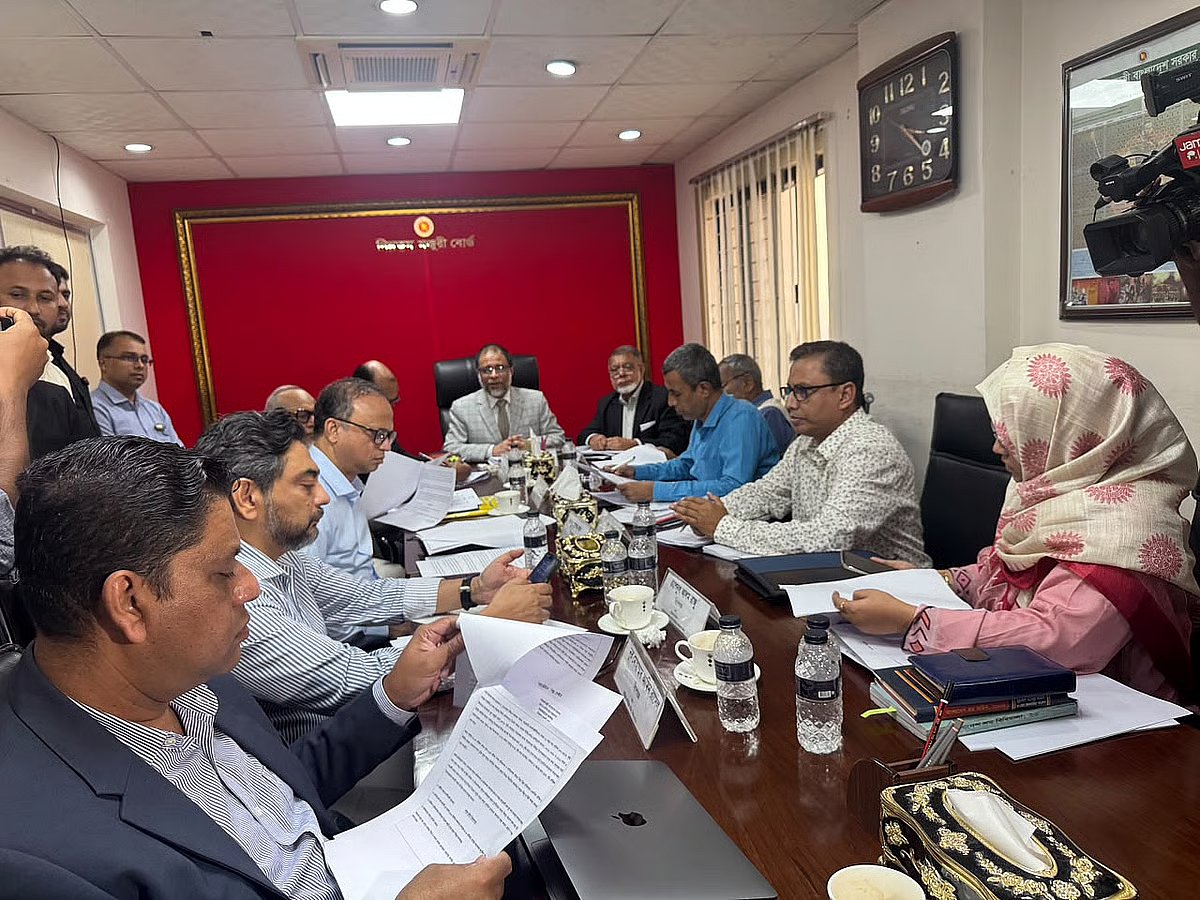
During a meeting of the Minimum Wage Board on Tuesday, employers submitted a revised proposal of Tk 17,000 while workers proposed Tk 18,000. At that stage, Board Chairman Syed Azad Subhani decided to put the matter to a vote at the Minimum Wage Board office.
Six board members cast their votes: the two workers’ representatives voted in favour of Tk 18,000, while the remaining four members voted for Tk 17,000—ultimately settling the minimum wage at Tk 17,000.
Employers’ representative ABM Shamsuzzaman and workers’ representative Babul Akhter confirmed the decision to Prothom Alo at around 2:15 am. Although the Wage Board Chairman was scheduled to brief journalists on the outcome, he had not done so as of 2:40 am on Wednesday.
According to sources, wages have been finalised at Tk 17,000 for the minimum or Grade-4 level; Tk 19,200 for Grade-3; Tk 20,000 for Grade-2; and Tk 21,500 for Grade-1.
The fourth meeting of the Wage Board concluded at around 1:30 am on Wednesday, after which several board members confirmed the figures. The new wage structure for garment workers will take effect from 1 December.
Chaired by Board Chairman Syed Azad Subhani, the fourth day’s meeting began at 3:15 pm on Tuesday at the Minimum Wage Board office in Segunbagicha, Dhaka.
Two votes were cast in favour of the workers’ proposal, while the employers’ proposal received four votes.
Participants included neutral member Mosleh Uddin Ahmed, employers’ representative ABM Shamsuddin, workers’ representative Babul Akhter, permanent workers’ member Anwar Hossain, and permanent employers’ representative Asif Ayub.
Additionally, BGMEA (Bangladesh Garment Manufacturers and Exporters Association) President Mahmud Hasan Khan and Additional Senior Secretary Noor Mohammad Amin attended as experts from the employers’ side, while General Secretary of the Bangladesh Free Garment Workers Union Federation Rashedul Alam joined as an expert for the workers’ side.
During negotiations, employers raised their wage offer in four stages from Tk 15,700 to Tk 17,000, while workers lowered their demand in four steps from Tk 22,000 to Tk 19,000.
When employers stood firm on their offer, workers submitted revised demands first of Tk 18,500 and subsequently Tk 18,000. With both sides refusing to budge further, the Board Chairman called for a vote shortly after 1:00 am.
Earlier, at the third Wage Board meeting on Monday, employers had tabled their initial minimum wage offer of Tk 15,000, prompting workers to revise their demand to Tk 25,000. Employers then raised their offer to Tk 15,500, while workers scaled back their demand from Tk 32,000 to Tk 22,000. Employers concluded Monday’s session with a final offer of Tk 15,700, which failed to satisfy workers, ending the meeting at 8:30 pm without a resolution. At the second board meeting on 9 November, workers had initially demanded a minimum wage of Tk 32,000.
Speaking to journalists at 4:45 pm yesterday after more than an hour of deliberations, Chairman Syed Azad Subhani said, “During the discussions, I spoke separately at times with the employers’ side and at times with the workers’ side, and even created opportunities for employers and workers to hold separate talks between themselves.”
Mahdi Amin added that alongside fulfilling workers’ legitimate rights and expectations, it is vital to protect the country’s largest export sector, maintain industrial stability, and ensure harmonious worker-employer relations for long-term employment and export growth.
He noted that in Monday’s session, workers had demanded minimum wages of Tk 35,000 for Grade-1, Tk 30,000 for Grade-2, Tk 27,000 for Grade-3, and Tk 22,000 for Grade-4, against employer proposals of Tk 18,828 for Grade-1, Tk 17,887 for Grade-2, Tk 16,996 for Grade-3, and Tk 15,700 for Grade-4.
As on the previous day, leaders and activists of various labour organisations demonstrated outside the Wage Board office from noon until evening yesterday, chanting slogans demanding a minimum wage of Tk 30,000 or Tk 32,000.
Meanwhile, the government expressed hope that a consensus-based, acceptable wage would safeguard both workers’ basic living standards and the industry’s capacity.
Speaking to Prothom Alo last night prior to the conclusion of the meeting, Prime Minister’s Labour and Employment Adviser Mahdi Amin said, “We hope that based on consensus among all parties on the Wage Board, a fair, rational wage aligned with workers’ living needs will be fixed. Hopefully this will be done taking into account inflation, workers’ living costs, industrial capacity, wages in other sectors, and the wage structures of competing countries in the international market.”
Mahdi Amin added that alongside fulfilling workers’ legitimate rights and expectations, it is vital to protect the country’s largest export sector, maintain industrial stability, and ensure harmonious worker-employer relations for long-term employment and export growth.
During the discussions, I spoke separately at times with the employers’ side and at times with the workers’ side, and even created opportunities for employers and workers to hold separate talks between themselves.Wage Board Chairman Syed Azad Subhani
Industry sources noted that in the early 1990s, the minimum wage for RMG workers stood at Tk 627, rising by 48 per cent to Tk 930 in 1994. Over the subsequent three decades, the minimum wage increased by Tk 11,570, with the last revision in 2023 raising it by 56 per cent to Tk 12,500.
Worker protests
Workers staged demonstrations at several points along the Dhaka-Tangail and Dhaka-Mymensingh highways in Gazipur yesterday as well, leading to intermittent chases and counter-chases with law enforcement agencies.
Police fired tear gas shells and sound grenades in places to disperse demonstrators, while a police box was vandalised and set on fire in the Gazipura area on the Dhaka-Mymensingh highway.
According to Industrial Police, authorities declared holidays at 70 factories across Gazipur’s Bhogra Bypass, Chowrasta, and Konabari areas due to labour unrest, while 32 factories remain closed indefinitely.
Traffic came to a halt after workers from several factories blockaded the Dhaka-Mymensingh highway at Memberbari in Gazipur Sadar upazila, while demonstrations and blockades also took place from morning in Mouchak and Telirchala, sparking clashes as police moved to restore order.
Around 11:45 am, workers blocked the Dhaka-Mymensingh highway at Bhogra Bypass and Chowrasta, halting vehicular movement. During the protests, demonstrators vandalised a police box situated in the middle of the highway at Gazipura and set fire to its furniture and nearby firewood on the road.
Officer-in-Charge of Tongi west police station Arifur Rahman said protesters dragged chairs and tables out of the police box and torched them on the highway before authorities brought the blaze under control and chased protesters off the road.
Meanwhile, Ashulia Industrial Police reported attempts to create disorder at factories which are operational in some areas of Savar and Ashulia on Tuesday. At that time, factory gates were vandalised with brickbats before law enforcement dispersed the crowds through use of force in phases.
Superintendent of Police of Ashulia Industrial Police-1 Mohammad Mominul Islam Bhuiyan stated on Tuesday evening that managements declared holidays at 24 factories across Ashulia at various points during the day, workers observed work stoppages at seven factories, and 20 factories remain closed under Section 13(1) of the Bangladesh Labour Act amid the ongoing unrest.