Commemorating 16 July 2024
My 12 hours with Abu Sayed
On the afternoon of 16 July 2024, many students who had been critically injured by police firing during the anti-discrimination student movement were admitted to Rangpur Medical College Hospital. As soon as I heard the news, three of my colleagues and I rushed to the hospital.
The moment we entered the emergency department, we saw the body of Abu Sayed lying on a stretcher. He was a final-year undergraduate student in the Department of English at Begum Rokeya University and one of the coordinators of the quota reform movement. His home was in Pirganj Upazila of Rangpur.
Several students stood beside his body, crying inconsolably. Everyone was in tears. Many embraced us and broke down in grief.
The students placed Abu Sayed’s body on a stretcher and began carrying it toward the university campus. However, the police blocked them on the way and brought the body back to the hospital.
Around 50 other injured students had also been admitted that day, and we began visiting them one by one. During this time, Zahir Raihan, a reporter from Prothom Alo in Dhaka, arrived at the hospital. I learned that he had been in Lalmonirhat working on a special report when the newspaper’s headquarters instructed him to come to Rangpur to cover Abu Sayed’s killing.
By then, the other university teachers had already left. As far as I knew, I was the only teacher still there. I could not bring myself to leave until someone from Abu Sayed’s family came to receive his body. So I waited for his father.
Toward the end of the afternoon, his brother Ramzan, his brother-in-law, and several other relatives arrived from Pirganj. A little later, a few teachers from the Department of English came, followed by four or five more faculty members from the university.
Because of police delays and various bureaucratic maneuvers by the local administration, it was almost midnight before the authorities finally released the body. Around 20 government vehicles accompanied the hearse.
It was already deep into the night. Yet when I realised that no one from the university was accompanying Abu Sayed’s body to his village, I felt that my responsibility as a teacher could not end there.
I kept thinking of his parents, who had sent their son to the university with so many hopes and dreams. The university had failed to return him to them alive. It simply could not be right for no one from the university to accompany him on his final journey.
So I decided to go. A few of Abu Sayed’s relatives and eight to ten students involved in the movement traveled with us. Many people warned me that something bad could happen if I went. Some feared that I would be branded as anti-government.
But all I could see was that my student had been killed.
I said, "When a student dies, there is nothing left to being a teacher."
We reached Abu Sayed’s home around 2:00 am.
His mother’s heart-wrenching cries, his father’s vacant, stone-like stare, and the desperate words of his younger sister as she clutched my hand are moments I will never forget.
She cried out in the local dialect, “Sir, if only my brother hadn’t wanted a government job... If only someone had told the police not to shoot him... My brother would still be alive. He wanted to become a BCS officer.”
After Abu Sayed’s body was washed in preparation for burial, I finally returned to my home in Rangpur. By then, people were already coming back from the Fajr prayer.
Even amid such extraordinary circumstances, Prothom Alo showed remarkable determination in reporting Abu Sayed’s death. Throughout the day, journalists from its Dhaka office repeatedly called for updates. The newspaper’s Rangpur correspondent, Ariful Haque Ruzu, also filed several reports.
During the clashes, Prothom Alo photojournalist Mainul Islam had been forced to hide in a wooded area behind the women’s residence hall to save his life. The situation outside was so dangerous that he could not leave his hiding place. The Vice-Chancellor’s residence had been set on fire, and the entire campus was gripped by fear.
Ariful Haque Ruzu kept calling me, saying, “Mainul has a heart condition. He has undergone open-heart surgery. Please help get him out through the rear gate of the hall.”
When I contacted the provost and assistant provost of the women’s hall, they advised that he remain where he was because trying to leave would be even more dangerous. They said they would inform us when conditions became safer.
Later, I learned that Ruzu had arranged for water, dry food, and medicine to be passed over the wall separating the women’s hall from Carmichael College so that Mainul could survive while in hiding.
When we finally set out with Abu Sayed’s body at midnight, Zahir Raihan and Prothom Alo’s regional manager Imran Ali followed the hearse all the way to Babanpur village in Pirganj on a motorcycle. There we met another Prothom Alo journalist, Altaf Hossain, who also stayed through the entire night.
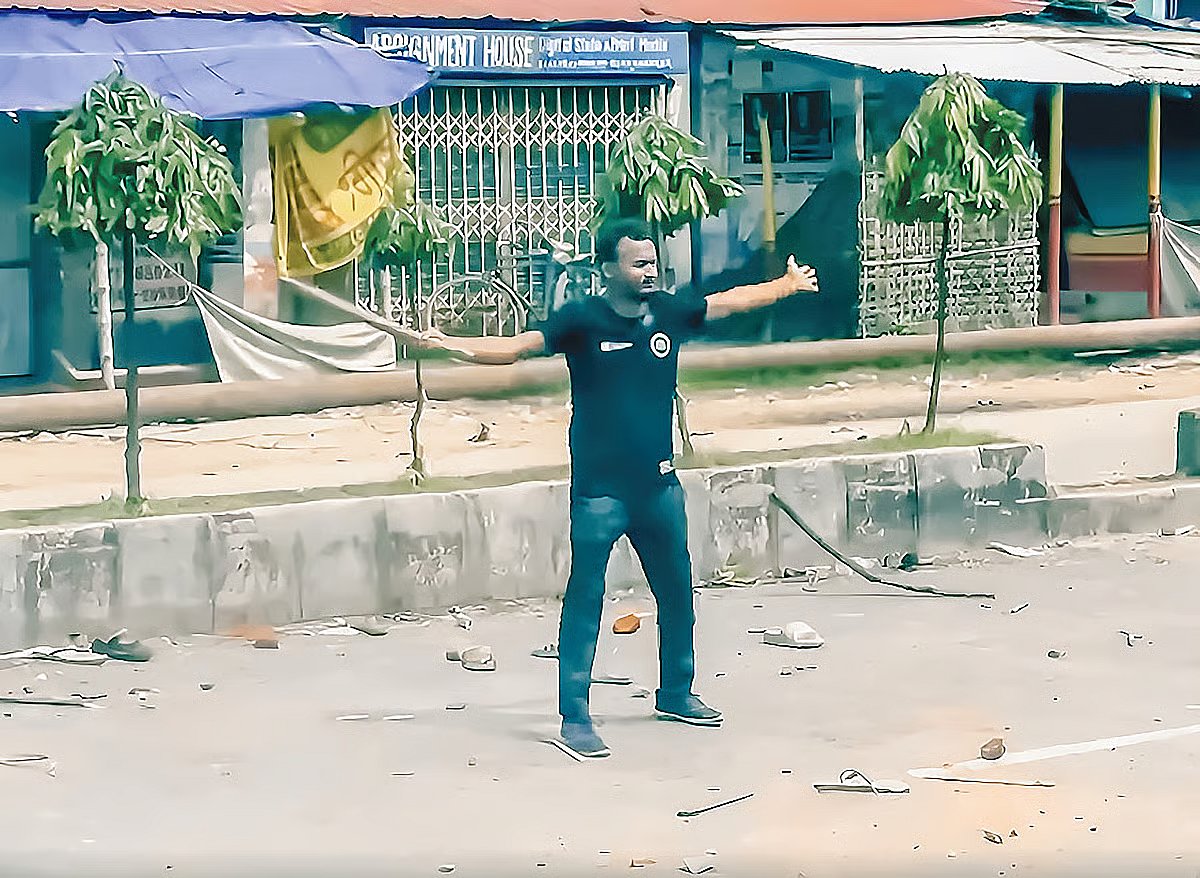
The following day, Prothom Alo devoted its front page to Abu Sayed. Its lead story featured the now-iconic photograph of him standing with his arms spread wide and chest bared in defiance just before he was shot. The newspaper published four photographs in total.
In the right-hand column, it also carried a report based on a Facebook post Abu Sayed had written, quoting the words, “Sir! I desperately need you at this moment, Sir!”
He had written those words the day before his death while remembering the martyred teacher Shamsuzzoha. Drawing on that post, the newspaper published a separate story.
Using a Facebook post that I had written about Abu Sayed while returning from his village that night, Prothom Alo’s then Joint Editor Sohrab Hassan also wrote a column the following day.
Abu Sayed’s sacrifice became a defining moment in Bangladesh’s history. His death played a crucial role in changing the course of the nation.
Private television channels Jamuna TV and NTV broadcast the footage showing the moment he was shot.
During the 12 hours that I remained with Abu Sayed’s body, I did not see any media organisation other than Prothom Alo carrying out such sustained reporting on the ground.
Abu Sayed gave his life resisting an authoritarian government and in the hope of building a just, people-centered Bangladesh free from discrimination. The interim government has not yet fully realised that aspiration.
We can only hope that the incumbent government will rise above individuals, political parties, and regional divisions, and become a government truly committed to equality and the welfare of all citizens.
* Tuhin Wadud is Professor of Bangla at Begum Rokeya University and Director of the river conservation organisation Riverine People. He can be reached at wadudtuhin@gmail.com