6 things to know about UNSC visit to Rohingya camps
After the influx of more than 700,000 Rohingya Muslims into Bangladesh due to persecution by the Myanmar forces since 25 August 2017, there is large scale criticism that the United Nations has failed to protect the Rohingya people or to take tough measures to compel Myanmar to comply with international human rights laws and rules.
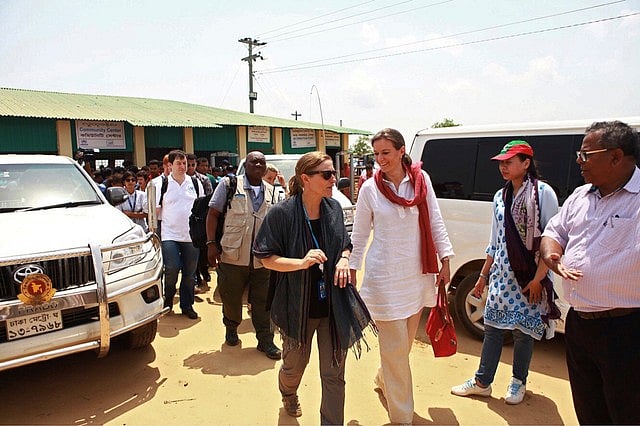
Against this backdrop, a delegation of UN Security Council is visiting Rohingya camps in Bangladesh. The UNSC envoys began the four-day visit to Bangladesh on Saturday, to be followed by visit to Myanmar.
Here are six key facts one should know about the UNSC visit to the Rohingya camps.
26 diplomats from 15 countries are in the delegation
The delegates include envoys of five permanent members -- China, France, Russian Federation, the United Kingdom, and the United States -- and 10 non-permanent members -- Bolivia, Côte d’Ivoire, Equatorial Guinea, Ethiopia, Kazakhstan, Kuwait, the Netherlands, Peru, Poland and Sweden -- elected for two-year terms by the General Assembly.
Rohingyas present 14 conditions for repatriation
A Rohingya leader named Dil Mohammad was quoted by news agency AFP as saying that they would present the delegation with 14 conditions. Prothom Alo obtained a list of demands that include keeping security forces in Arakan (Rakhine) before repatriation, restoring nationality with Rohingya ethnicity, involving Bangladesh, EU, UNHCR, OIC, HRW, USA, other international community and the Rohingya with Rohingya repatriation agreement and process, rehabilitating Rohingyas in their own land, own village and own house compound in Rakhine, compensatation to Rohingyas' losses and returning confiscated land, allowing international media, rights groups and humanitarian aid groups in Rakhine freely, releasing Rohingya prisoners without any exception, no accusation of Rohingya in any past events, taking action againast the criminal in the ICC court, allowing government staff among the Rohingya refugees to continue their job and taking no action against them.
Delegation to visit Rakhine
The UN Security Council visit is expected to include a meeting with prime minister Sheikh Hasina and Myanmar's de facto leader Aung San Suu Kyi. They will also have a helicopter flight over Rakhine to see the remains of villages torched during the violence.
The visit not about "naming and shaming"
Kuwait's ambassador Mansour al-Otaibi said that the visit was not about "naming and shaming" Myanmar, but that "the message will be very clear for them: the international community is following the situation and has great interest in resolving it."
"We have to push to see how we can speed up the process of the implementation of the bilateral agreement between Bangladesh and Myanmar," the Kuwait's UN ambassador added.
Read more : UNSC team hears of rapes, murders from Rohingyas
"We care because we are here, but the United Nations is not limited to the Security Council," deputy Russian UN ambassador Dmitry Polyanskiy was quoted as saying by Reuters. "The threat of raising this issue in the Security Council shouldn't be used as a leverage for the Myanmar government to cooperate."
Britain's UN ambassador Karen Pierce said all council members believed the Rohingya issue was "one of the most significant human rights cases that we have ever faced in the last decade and that something needs to be done" to avoid it causing instability in Bangladesh and Myanmar.
"How one goes about that, the prominence that one gives to the individual government, particularly the Burmese government, tends to be what divides the council and that's the old sovereignty versus human rights debate," she said.
HRW for referring Rohingya crisis to the ICC
On Friday, Human Rights Watch called for Myanmar's Rohingya crisis to be referred to the International Criminal Court.
"The lack of a UN Security Council resolution has left the Myanmar government convinced that it has literally gotten away with mass murder," HRW executive director Kenneth Roth told reporters in Yangon.
Read more : UNSC team rules out sanction on Myanmar
Rohingyas stage protests
AFP reported that hundreds of Rohingyas at Kutupalong camp staged a protest ahead of the visit, holding banners demanding the restoration of their rights in Myanmar. The police dispersed the protesters peacefully.
"We want restoration of our citizenship under Rohingya ethnicity. We want security and return of our confiscated land and properties," said Rohingya leader Mohibullah was quoted as saying.
Read more : UNSC team visits Kutupalong Rohingya camp