Prothom Alo roundtable
Another govt exists inside interim govt: Debapriya Bhattacharya
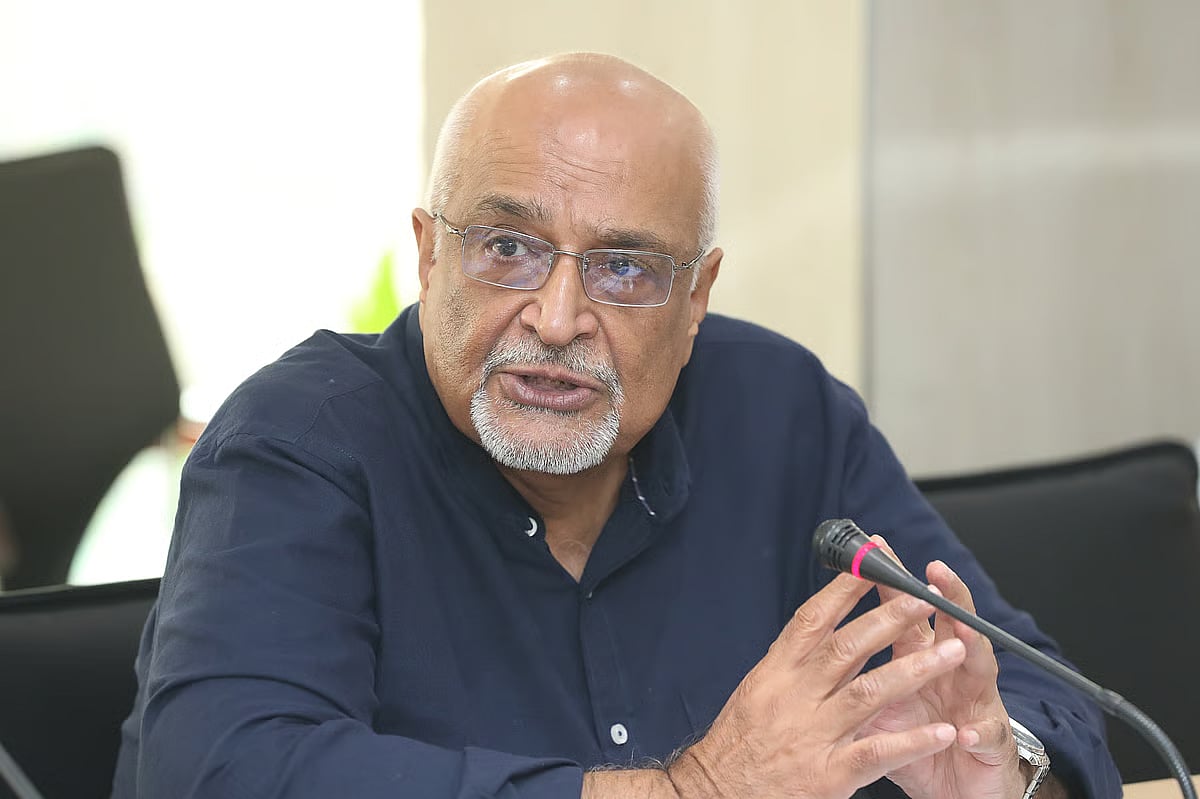
Debapriya Bhattacharya, a distinguished fellow at the private research organisation Centre for Policy Dialogue (CPD), has said there is another government inside the incumbent interim government.
He said, “The question regarding the neutrality of the government, especially from the perspective of party allegiance, has become very important now. Because it has somewhat been clear now that, in fact, there is another government inside those who we officially see as the government. It is an open secret. The government must prove its neutrality now.”
Debapriya Bhattacharya made these remarks while addressing a roundtable at the Prothom Alo office in Karwan Bazar, Dhaka on Wednesday. Prothom Alo organised the roundtable titled ‘July mass uprising: One year experience and future’.
A one-minute silence was observed at the beginning of the event to mourn the victims of the air force fighter jet crash into the Milestone School campus in Uttara.
He said, “We brought a new government to power in the spirit of anti-discrimination, but they could not reflect the spirit of anti-discrimination in economic management and reform process. The government maintains no clear moral stance.”
“The government is mulling economic expansion and standing for the weak communities on the basis of the universal human rights, but they are yet to take measures to identify that weak community to stand beside them. Since there is a possibility of reform, this did not even cover the manufacturing entrepreneur class let alone the poor class,” he added.
Debapriya Bhattacharya said that two fundamental questions have now come to the fore. One is the issue of an interim government—meaning it has a beginning and, it must also end after a clearly defined and limited period. It is time to bring this point forward: that this is not an eternal government, but an interim one. If it is indeed an interim government, then two questions, which are unsettling everyone—at least unsettling him—must be addressed. The first is the government’s neutrality. The neutrality of the interim government has now come to the fore as a major issue.
When the issue of a government’s neutrality is spoken of, it does not refer to the fundamental ideological neutrality, because a government will stand with marginalised people. A crisis has arisen in this regard because disadvantaged communities are feeling even more vulnerable and endangered. Much like during the regime of an authoritarian government, women, religious minorities, ethnic minorities—let alone people with gender diversity—are being pushed to the margins. This has become another concern, he added.
Debapriya further said the question of the government's neutrality has now become especially important from the perspective of party allegiance.
"This issue has gained importance because it has become fairly clear that the people we formally see as the government are not the only ones running it; there is another government within it. It is an open secret now that there is another government within government," he added.
Debapriya said the core power within the government is now so influential that the formal government cannot always act even within its desired jurisdiction.
So the need to reestablish the government's neutrality has become urgent, the CPD distinguished pointed out.
Raising a question on whether the interim government can even hold a fair election, Debapriya Bhattacharya said, “A real election is essential—not an election based on compromises, backroom deals, or seat-sharing, where people will live in peace after casting vote, as well the days after election. This leads to the second major concern: maintaining peace and security during the election. We have understood very well that this cannot be achieved through just administrative power or existing law enforcement agencies. This will not be possible without a significant role for the military. I simply understand the military would need to be deployed for three to four months and must begin by recovering illegal arms. Similarly, the military may need to work jointly with the local administration in other ways.”
In that case, the military will require a little more direct and active role going beyond the traditional roles of ‘in aid to civil administration’ or as a ‘striking force’, Debapriya said adding, the relationship between the government and the military has become a cause for public concern. As a result, the government’s neutrality and capability are now the two biggest questions.
“Since this is an interim government, the government should now prepare a desk-clearing list. If the honourable chief adviser delivers a speech to the nation, I expect that he will clarify how he intends to conclude his role. The chief adviser should clearly outline which reform initiatives he plans to complete, and where he expects to contribute or participate,” he added.
Debapriya further said that reform is an ongoing process. Political leaders must now present their election manifestos. Civil society, media, and entrepreneurs should engage in discussion or even protest on those manifestos, if necessary. The country will remain, the people will remain, but governments will come and go. With that mindset, the nation must move from this current transitional phase to the next stage.
“I feel it was more important to focus on the next year’s exit strategy —what it should be and what is needed to make it happen, rather than reviewing the past year,” he added.
Writer and thinker Farhad Mazhar; Hossain Zillur Rahman, executive chairman of Power and Participation Research Centre (PPRC); Anu Muhammad, member of Ganatantrik Odhikar Committee and former professor of Jahangirnagar University; senior Supreme Court lawyer Sara Hossain; writer and researcher Altaf Parvez; professor Saeed Ferdous; filmmaker Kamar Ahmad Saimon; writer and political analyst Zahed Ur Rahman; writer and researcher Maha Mirza; and research specialist at Press Institute of Bangladesh Sahul Ahmed, among others, participated in the event.