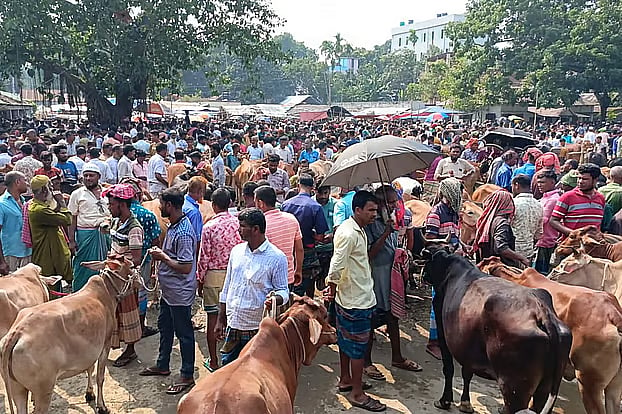
Higher livestock prices lead to decline in Eid sacrifices
For years, a farming family in Wazirpur upazila of Barishal used to offer animal sacrifice during Eid-ul-Azha. But for the past three years, they have stopped doing so.
Speaking to Prothom Alo on condition of anonymity, the head of the family said that a single share in a sacrificial animal now costs around Tk 20,000. In his village, he said, animal sacrifice is now mostly performed by families with relatives abroad, businesspeople and government employees. Farmers can no longer afford it.
Government statistics also show that while the prices of livestock and meat are rising, the number of sacrifices is declining. Analysts say the cost of offering sacrifice has gone beyond the reach of low-income families.
The Covid-19 pandemic in 2020, the high inflation that began in 2022 and continued afterward, and the current economic slowdown have all placed people under financial strain. In many cases, people who used to offer sacrifice in the past no longer do so.
Many who once sacrificed an entire animal now participate through shared arrangements. At the same time, there remains a section of society for whom money is not a constraint.
Professor AHM Saiful Islam, chairman of the Department of Agricultural Economics at Bangladesh Agricultural University, told Prothom Alo that the ability to offer animal sacrifice is closely tied to people’s economic capacity. He said the economic situation this year is roughly similar to last year, with some indicators even worsening. As a result, the number of sacrifices this year may decline compared to last year.
Prices continue to rise
According to the Department of Agricultural Marketing, the average price of beef in 2014 was Tk 275 per kilogram. Prices have continued to rise since then. One major reason was the disruption of a key source of cattle in 2015, when India instructed its border guards in April that year to completely stop cattle from entering Bangladesh.
After Indian cattle imports stopped, numerous cattle farms were established across Bangladesh. Domestic supply of cattle and beef increased, but not enough to stabilise the market. As a result, meat prices have continued to climb.
According to data from the state-run Trading Corporation of Bangladesh (TCB), beef in Dhaka currently sells for Tk 780 to Tk 850 per kg. During the same period last year, the price remained within Tk 780.
Prices of goat and mutton have also increased. Consumers now have to spend Tk 1,200 to Tk 1,300 per kg of mutton, which is Tk 50 to Tk 100 higher than a year ago.
Number of sacrifices declining
An analysis of data from the Department of Livestock Services covering the last nine years (2017–2025) shows that animal sacrifice tends to decline during periods of political instability, economic crisis or pandemics. In more stable times, the number generally increases.
The number of sacrificial animals had been rising steadily since 2017. In 2019, the figure reached 10.6 million. Since then, the country has not witnessed sacrifices on that scale again.
The Covid-19 pandemic emerged in 2020, bringing not only a health crisis but also an economic one. Many people lost income, while others lost jobs entirely. Eid-ul-Azha that year was held on 1 June, and compared to the previous year, 1.164 million fewer animals were sacrificed.
Amid the pandemic, the Russia-Ukraine war began in February 2022, creating further negative impacts on Bangladesh’s economy. After conditions partially stabilised, nearly 10 million animals were sacrificed during Eid-ul-Azha in 2023. The number rose slightly in 2024. However, under the interim government last year, the number of sacrificed animals fell to 9.136 million during Eid-ul-Azha 2025.
Acting Director General of the Department of Livestock Services, Md Shahzaman Khan, told Prothom Alo that the number of sacrifices depends on people’s economic condition. He said people may not have been financially well-off last year, but this year there is an elected government, which could result in a higher number of sacrifices.
Questions over claims of surplus livestock
According to the Department of Livestock Services, the number of sacrificial animals stood at 12.9 million in 2024. Last year, in 2025, the figure fell to 12.4 million. This year, it has declined further to 12.3 million.
Among them, the number of cattle and buffaloes suitable for sacrifice this year stands at 5,695,878 — around 93,000 more than last year. The decline has mainly occurred in goats and sheep, with their number decreasing by 206,000 compared to last year. A total of 6,632,307 goats and sheep have been prepared for sacrifice this year.
Despite these figures, the Department of Livestock Services claims that the number of sacrificial animals exceeds expected demand this year and that there may be a surplus of 2.227 million animals.
The department says it compiles the figures through its own officials. Data is collected from upazila livestock offices, where each office has eight to nine staff members. Field-level livestock officials say the farms are registered with them and that the data they provide is accurate.
However, experts have questioned these estimates. They argue that if there truly were a surplus of livestock, prices would not be so high. In normal market conditions, adequate supply leads to lower prices — something seen with most agricultural products.
Professor AHM Saiful Islam told Prothom Alo that there are legitimate questions about the accuracy of official estimates on the supply and demand of sacrificial animals. He said that if the figures are accurate, some animals may remain unsold because many farmers may refuse to sell if they cannot recover production costs. Others may sell simply to recover costs without making a profit, leaving them vulnerable to losses.
No other agency independently verifies the livestock figures. However, the continued rise in cattle and beef prices suggests supply is still inadequate.