1st year of interim govt
Health sector: Work on paper, no improvement in service
There has not been any fundamental change in the health sector so far. Top officials of the health ministry are saying the reform has just started. However, health sector analysts feel that although some significant work has been done on paper, there has been no real improvement in health services.
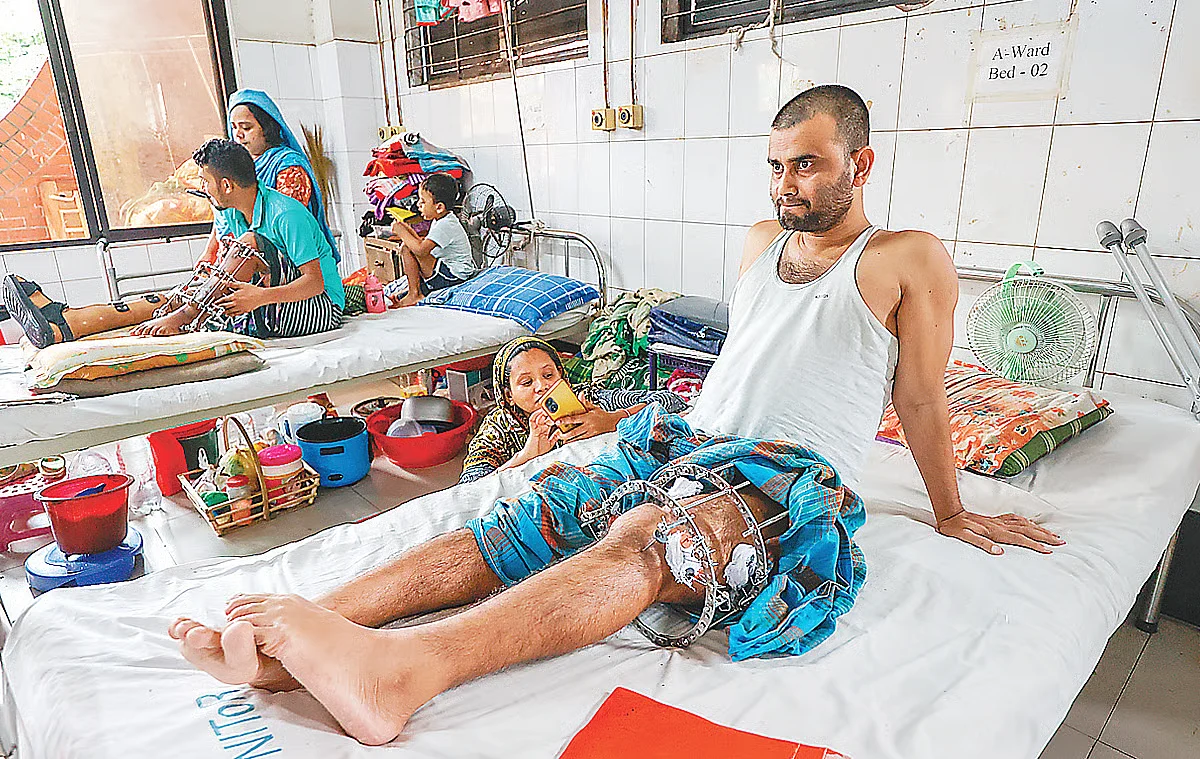
Treatment of persons who were injured during the July uprising came up as the prime task of the health ministry in the last one year under the rule of the interim government. In an interview with Prothom Alo in the last week of August last year, health adviser Nurjahan Begum said treatment of injured persons from the July uprising would be at the top of his priority list.
Speaking to Prothom Alo last Friday, the health adviser said, “I have tried my best to ensure proper treatment for the injured persons. There was no lack of sincerity.”
There were already various allegations against pro-Awami League physicians and officials in directorates and institutions under the health ministry. So it was a big challenge for the health ministry to replace those officials with competent candidates after regime change.
The first major blow came while appointing the director general of the Directorate General of Health Services (DGHS). The ministry appointed the then line director at the Department of Non-communicable Disease Control Programme, Robed Amin as the director general of the DGHS.
However, the appointment sparked huge backlash from pro-BNP (Bangladesh Nationalist Party) and pro-Jamaat physicians. They opposed the appointment and had besieged the DGHS for a month. Robed Amin never got the chance to take over. It became imperative for the ministry to retract the decision, which unravelled the weakness of the ministry. Later, child specialist professor Md Abu Jafar was appointed as the director general (DG) of the DGHS.
Speaking to Prothom Alo, DGHS DG Md Abu Jafar, “The 16-year-rule of the Awami League left DGHS in massive and deep disorder. The rule of law was greatly ignored. To restore order was a great challenge. Around 8,000 physicians were transferred in the last one year. Efforts have been made to address deprivation, and the efforts are continuing. Order has been established in postings and promotions. This is a major achievement.”
Complications of the interim period
The current government has limited scope to take up or implement any major projects. There are allegations that some bureaucrats and physicians in government service are not cooperating with the government. Some donors are also delaying their promised assistance.
Professor Syed Abdul Hamid of the Institute of Health Economics at Dhaka University told Prothom Alo, "The interim government should take on the necessary tasks that political governments avoid for fear of losing popularity. For example, increasing the allocation for the health sector and shutting down substandard medical colleges. As there is no parliament now, there is no opportunity to pass laws. However, this can be done through the issuance of ordinances."
However, many, including Syed Abdul Hamid, consider the formation of the health sector reform commission and its report to be significant progress. Over the past three months, at least five seminars organised by the civil society group Shushasthyer Bangladesh, the Institute of Health Economics at Dhaka University, and the Power and Participation Research Centre (PPRC) have seen public health experts and health economists share their views on how the recommendations could be implemented.
For instance, they suggested that three laws—on the establishment and operation of private hospitals and clinics, health protection, and the protection of service providers—could be issued in the form of ordinances. These are necessary but have not been enacted.
Problems prevail as before
Public health experts had long been calling for increased allocations to the health sector. Many had hoped that the interim government would raise the allocation, but in reality, it did not happen. In the current fiscal, only 5 per cent of the national budget has been allocated to the health sector. For two decades, the allocation has remained roughly at 5 per cent or close to it. The interim government could not break out of this fixed pattern.
The patient load and problems in hospitals remain the same as before. At a press briefing organised by the health ministry on 7 August, Professor Md Sayedur Rahman, special assistant to the chief adviser, said that around 15,000 people across the country are still forced to receive treatment lying on hospital floors every day. Without initiatives backed by a special political commitment to resolve the crisis, thousands of patients will still be lying on hospital floors even after 10 years.
Many people seeking treatment are turned away, while others go to private hospitals at a higher cost, due to equipment in government hospitals being out of order or unused. At the National Institute of Cancer Research and Hospital, all faulty equipment has not been fully repaired and brought back into operation even after a year. The same situation is seen at Dhaka Medical College Hospital, with similar examples found outside the capital as well.
An senior official at the Ministry of Health told Prothom Alo on condition of anonymity that on 9 August, an election was held with much fanfare for the Bangladesh Doctors’ Association (DAB), a group aligned with the BNP. A faction of this same DAB had, in June–July, engaged in irregularities and corruption in appointing 65 physicians to the children’s hospital. In the past, the pro-Awami League physicians’ group Swadhinata Chikitshak Parishad (Swachip) dominated the health sector; now the influence of physicians aligned with two other political parties—the BNP-backed DAB and the Jamaat-supported National Doctors’ Forum (NDF)—is evident.
Neither the political parties have taken any initiative to end this politicisation in the service sector, nor has the interim government shown the will to do so over the past year.
The Ministry of Health has scrapped the Health Sector Programme, saying it had been run according to donor agencies’ priorities. Now, the government will design and implement plans based on national priorities. However, due to the cancellation of the programme, many employees have gone without pay for nearly a year.
Conflict has arisen
The health sector reform commission’s report included some recommendations related to the pharmaceutical industry. Following these, the health ministry has taken some reform initiatives. For instance, the ministry has formed at least four committees related to pharmaceuticals without including representatives from drug companies. The ministry stated that this was done to avoid conflicts of interest and to follow the guidelines of the World Health Organization. Additionally, the ministry is imposing restrictions on the movement of drug company representatives within hospitals.
Such initiatives have caused some differences of opinion between the health ministry and the Bangladesh Association of Pharmaceutical Industries (BAPI). At a meeting with journalists last week, owners of pharmaceutical companies said the government is pushing the pharmaceutical industry into risk. On these matters, the industry owners have also met with BNP’s secretary general Mirza Fakhrul Islam Alamgir.
What the ministry has done
Health ministry sources said a total of 13,811 people injured during the July–August mass uprising have so far been listed by the ministry. After verification, the official gazette recorded the number at 12,041.
Of them, 78 have been sent to Thailand, Singapore, Russia and Turkey for advanced treatment. In addition, 26 specialist physicians from Singapore, Nepal, France, the United States, China, the United Kingdom and Thailand have come to Bangladesh to provide treatment to the injured.
A total of 7,363 injured individuals have been issued health cards, entitling them to free treatment for life in government hospitals.
Over the past year, new principals have been appointed to 23 of the country’s 37 public medical colleges, and new vice-principals to 17. Furthermore, 15 institutes and hospitals have received new directors.
A decision has been made to create supernumerary posts and promote 7,000 physicians, a move set to be implemented very soon.
Promotions to the rank of professor have begun in 86 disciplines for 800 physicians. Recruitment processes have also been initiated for 3,500 new physicians and 3,500 new nurses.
Reforms underway and planned
The Health Sector Reform Commission’s report contains short- and medium-term recommendations.
Senior ministry officials say that based on these recommendations, the ministry’s own experience, and consultations with public health experts, they have identified 10 core problems in the health sector. Addressing these would amount to a genuine reform.
The issues are: the current health system is disconnected from merit, knowledge and competence; it is over-centralised; primary healthcare is neglected in favour of specialised services; there is a lack of transparency and a strong culture of impunity; the workforce suffers from low motivation and morale; there is a crisis of mindset and vision; ethical standards are in decline, with deep conflicts in the sector; there is excessive dependency on others; leadership is weak; and the sector operates under budgetary shortfalls and without proper planning.
The ministry has abolished all forms of quotas in medical education and established an accreditation council to regulate quality.
The relevant department in the ministry’s education wing reports that both public and private medical colleges are being assessed. Based on the evaluation, seat numbers are likely to be reduced in the next academic year.
The process of decentralising the powers of the ministry and its directorates has begun. Officials at the divisional and district levels now have full authority to make decisions on transfers and appointments locally.
To improve efficiency and reduce corruption, all procurement in the health sector is now required to go through the e-GP (electronic government procurement) system.
The ministry has taken steps to strengthen Essential Drugs Company Limited (EDCL), sole state-owned drug manufacturer. In the past year, 700 additional staff have been laid off. The company has started producing intravenous saline, and drugs previously costing more than Tk 700 are now being sold for under Tk 400 by EDCL.
Other initiatives include updating the list of essential medicines and taking further measures on drug production, pricing and marketing.
There are plans to extend medical students’ internships to 18 months, including six months of mandatory rural service. The ministry also plans to establish a Women’s Health Institute in Khulna, an Elderly Health Institute in Chattogram, and a fully fledged ‘Health City’ in Rangpur.
Speaking about the steps, Professor Md Sayedur Rahman, Special Assistant to the Chief Adviser, told Prothom Alo, “We believe that health should be placed at the centre of the government’s development agenda. And, at the centre of health should be medicine.”