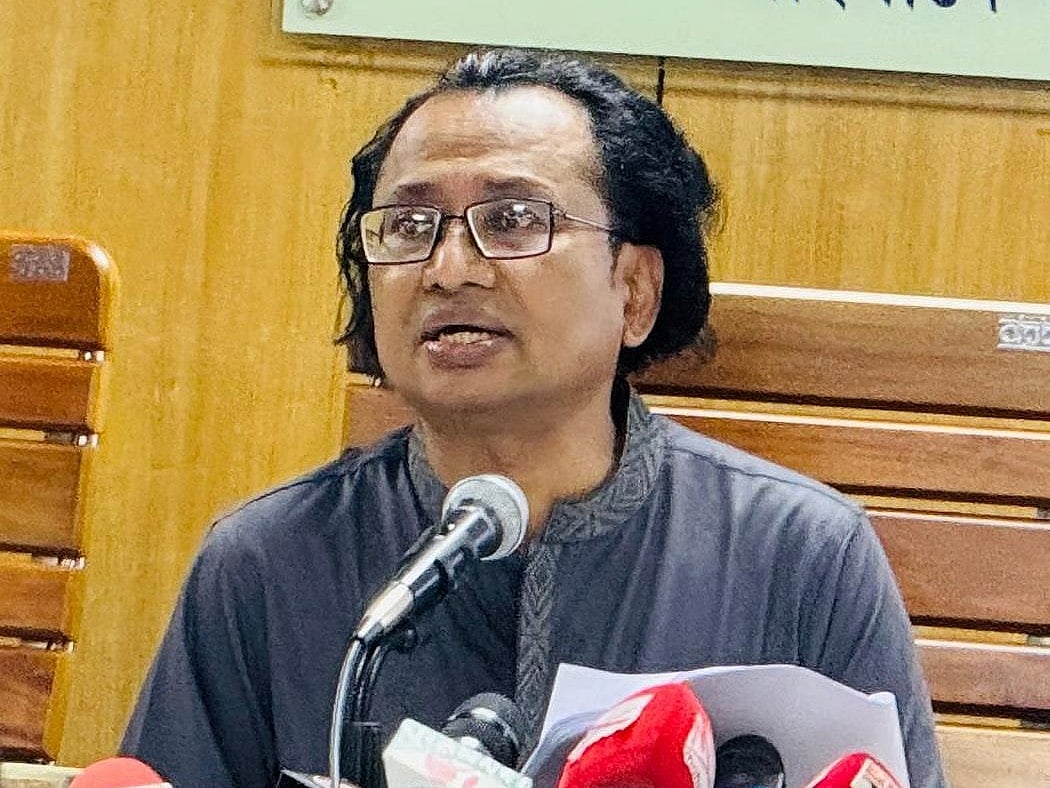
Returning from Delhi was an ‘instant protest’: PM’s information adviser
Prime minister’s Information and Broadcasting Adviser Zahed Ur Rahman has described his decision to return to Bangladesh from India after being kept waiting for nearly two and a half hours at Indira Gandhi International Airport as an “instant protest”.
He also characterised the incident against him as harassment by Indian authorities.
Bangladesh had informed India’s Ministry of External Affairs at least two days in advance about prime minister’s Information Adviser Zahed Ur Rahman’s visit to New Delhi.
Nevertheless, upon his arrival at IGI Airport on Sunday, he was made to wait for nearly two and a half hours and was initially denied entry into India. Although permission to enter was later granted following intervention at a higher level, he declined the offer and returned to Dhaka.
Speaking at a regular press briefing at the Secretariat on Tuesday, Zahed Ur Rahman said he felt an immediate response was necessary because he had travelled not as an individual but as a representative of the Bangladeshi state.
“I did not go there as an individual. I went as a representative of this government and this state. Therefore, after what happened to me there, I felt that an instant protest from our side was necessary,” he told newspersons.
“That is why I decided to return. Although, as you have seen in media reports, at one stage they [the Indian authorities] tried very hard to ensure that I entered the country and attended my scheduled engagements, I chose not to do so.”
‘A signature response was necessary’
The adviser said that, as a member of the government and an adviser to the prime minister, he believed the state needed to leave a clear “signature” in response to what he described as an “unwanted situation”.
“I felt there should be a signature response from the government. As an immediate reaction to this incident, I took that step on behalf of the state and the government,” he said.
He stressed that the decision was not intended to trigger a cycle of retaliatory actions or further negative developments between the two countries.
“I felt a message needed to go out both inside and outside the country that this is not Sheikh Hasina’s government. This is a government with a mandate from the people,” he said.
Despite the incident, Zahed Ur Rahman expressed hope that it would not adversely affect future engagement between Bangladesh and India.
‘I’ll certainly visit India again’
Responding to a question on whether he would accept a future invitation from India, the adviser replied in the affirmative.
“Certainly, I will. Let me make this very clear: if I receive an appropriate invitation, I will certainly go there,” he said.
“I want to engage with India logically and rationally. Whenever one speaks of engaging with India, some people assume that one is about to sell out the country. This government will never build relations with India by compromising Bangladesh’s interests.”
“We always place Bangladesh first. Therefore, we want engagement with India. There is significant scope for advancing trade, commerce and many other areas on the basis of equality and mutual respect.”
Bangladesh lodged formal protest
The incident prompted Bangladesh’s Ministry of Foreign Affairs to summon India’s acting high commissioner in Dhaka on Monday.
During the meeting, Bangladeshi officials expressed strong dissatisfaction and described the events at Delhi airport as unfortunate and unacceptable.
Indian media reports have claimed that Zahed Ur Rahman’s name appeared on a watchlist during immigration screening, resulting in questioning and several hours of delay.
What happened at Delhi airport
According to officials familiar with the matter, Zahed Ur Rahman arrived at Indira Gandhi International Airport in New Delhi shortly after 5:00 pm on Sunday on an Air India flight from Dhaka.
He was received by Bangladesh High Commissioner to India Riaz Hamidullah, who accompanied him to the immigration counter.
At one stage, the high commissioner noticed that the immigration officer was closely examining the adviser’s details on a computer screen but was not providing any explanation.
After approximately 15 minutes, the high commissioner asked whether there was any problem. The officer reportedly remained silent.
A short while later, the officer asked questions regarding Zahed Ur Rahman’s birthplace and whether he had previously visited India. The officer then left the counter and returned after some time to collect fingerprints and conduct an iris scan.
Subsequently, the adviser was told to sit in a waiting area because “it would take some time”.
As the delay continued, Bangladesh’s high commissioner contacted officials at India’s Ministry of External Affairs and held several conversations with them by telephone.
Eventually, Indian authorities informed the Bangladeshi side that immigration records showed Zahed Ur Rahman as being listed under a barred or watchlist category.
Following what Bangladeshi officials regarded as a humiliating situation, the adviser communicated with senior political authorities in Dhaka and decided to return home.
Officials from the Bangladesh High Commission then requested the return of his passport from Indian immigration authorities.
At that point, Indian officials reportedly informed them that clearance had been granted and that Zahed Ur Rahman was free to enter India.
However, he declined the offer and proceeded with his decision to return to Dhaka.
The incident unfolded in the presence of passengers from Bangladesh and several other countries who were passing through immigration at the time.