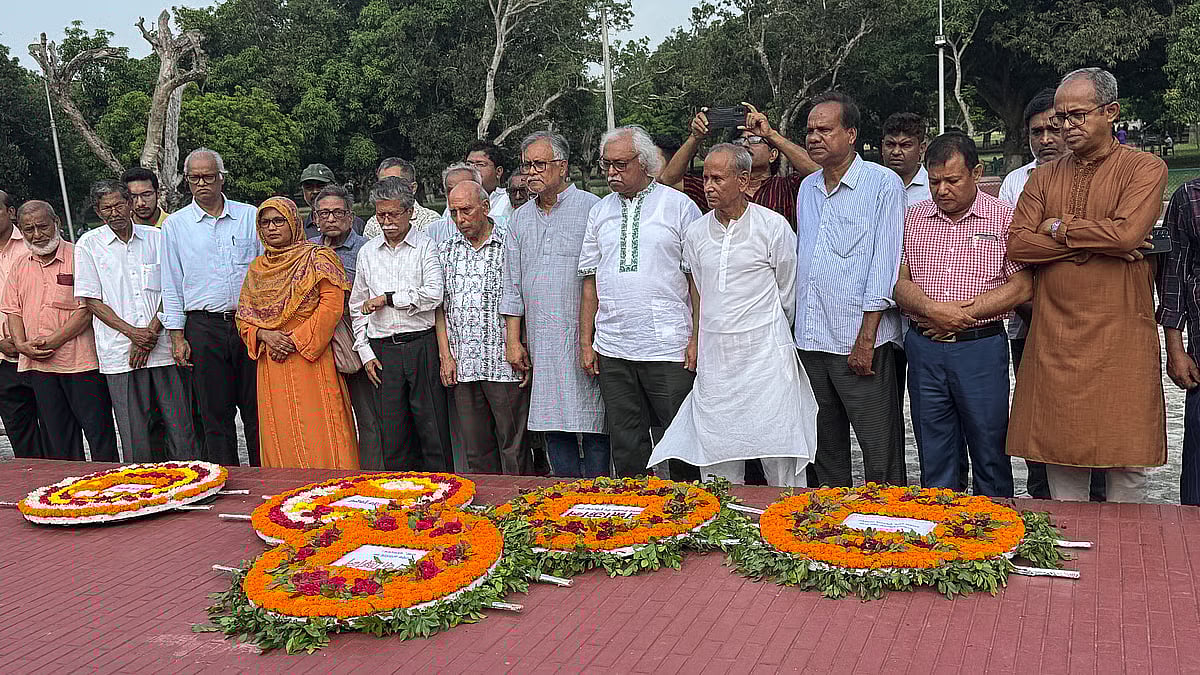
Civil society pays tribute at Mujibnagar, calls for proper observance of all days related to Liberation War
Representatives of civil society paid tribute to the martyrs of the Liberation War at the Mujibnagar Memorial Complex on Friday, marking the historic Mujibnagar Day.
Journalists, political leaders, and prominent citizens placed wreaths at the memorial in the afternoon, honouring the valiant sons of the soil. However, they expressed deep dissatisfaction and frustration over the absence of any official state programme to observe the occasion this year.
Following the tribute, freedom fighter, journalist, and writer Abu Sayeed Khan criticised what he described as a lack of respect for the spirit of the Liberation War.
“Those who came to power invoking the ideals of 1971 cannot ignore its memory. This is unacceptable,” he said, urging the government to recognise its responsibilities and ensure proper observance of such a national day in the future.
He also demanded the immediate restoration of damaged sculptures at the Mujibnagar Liberation War Memorial Complex and called for exemplary punishment for those responsible for the vandalism. “All days associated with the Liberation War must be observed with due state honour,” he added.
Responding to a query, Shamsul Huda, Executive Director of the Association for Land Reform and Development (ALRD), remarked that the term “provisional government” was largely a construct of contemporary media. “In reality, it was the first constitutional government of Bangladesh, led by Bangabandhu Sheikh Mujibur Rahman,” he said, referring to the leadership that guided the Liberation War.
He strongly condemned the vandalism at the memorial complex and announced plans to formally raise the matter with the government through a press conference in Dhaka.
Among others present were Ruhin Hossain Prince, former general secretary of the Communist Party of Bangladesh (CPB), and Rajekuzzaman Ratan, assistant general secretary of the Bangladesher Samajtantrik Dal (BASAD), along with members of various organisations.
Earlier in the day, at around 9:00 am, members of the Mujibnagar Upazila Freedom Fighters’ and Freedom Fighters’ Children Command also paid homage at the memorial.
Among those present were freedom fighters Haji Ahsan Ali Khan and retired Captain Abdul Malek, along with Freedom Fighters’ Children Command upazila unit president Mokhlesur Rahman and general secretary Khairul Islam and others.
The date of 17 April 1971 remains a defining moment in Bangladesh’s history. On that day, at Baidyanathtala—later named Mujibnagar—the first government of independent Bangladesh formally took oath.
Although the day is typically marked by state programmes each year, no government programme was observed this time, prompting renewed calls for greater institutional respect for the nation’s Liberation War heritage.