Suits under ICT act double in six months
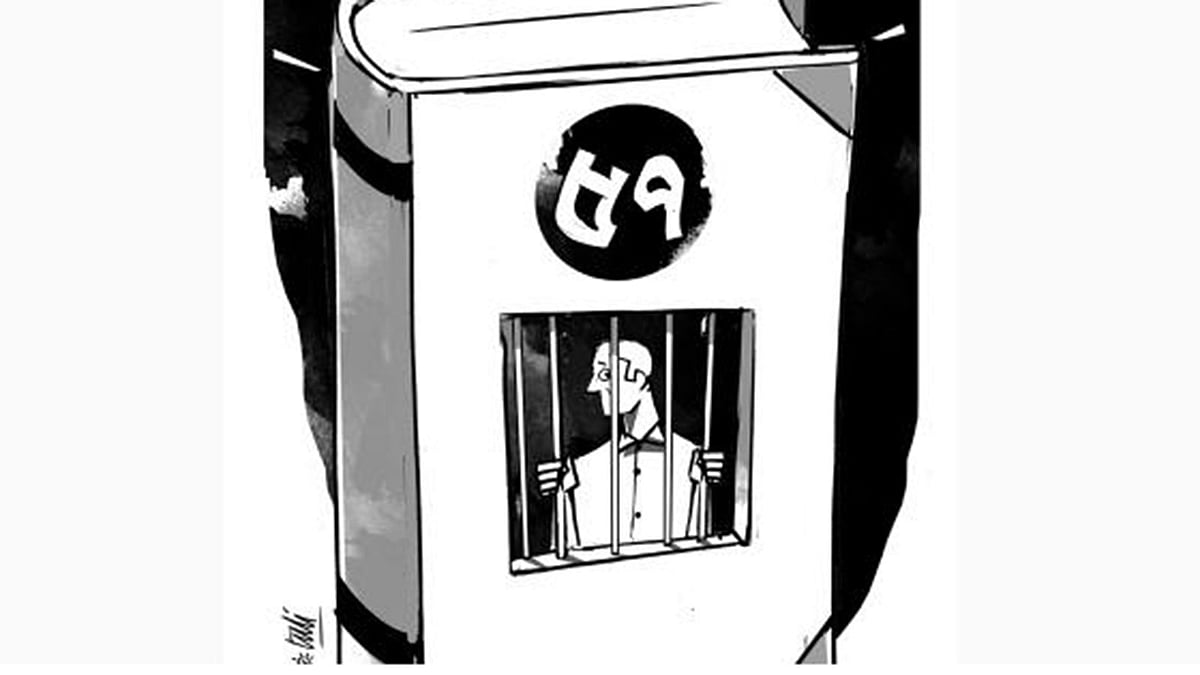
The rate of suing people, mostly professionals, by powerful quarters under a controversial provision of the Information and Communications Technology (ICT) Act has doubled this year.
As many as 19 journalists have been implicated in cases filed under article 57 of the act since January. Eleven of these cases were filed by persons close to members of parliament (MPs) and ministers.
The number of cases filed under ICT act was 42 in January and this rose to 79 in June, according to statistics available with the police headquarters.
In the six months, a total of 391 cases were recorded and 785 people accused, of whom 313 were arrested.
Ninety three more cases were filed, under the Pornography Control Act and 85 more under the Anti-terrorism Act during the period.
“Most of the cases recorded at the thana level are filed under the section 57 of ICT act,” a police officer told Prothom Alo, seeking anonymity, adding that the matter has been conveyed to the police headquarters.
The latest case is Abdul Latif Morol, a journalist hailed from Khulna, who was arrested on Tuesday after he had been implicated in a case filed under section 57.
He has been sued allegedly for defaming state minister for fisheries and livestock Narayon Chandra Chanda by posting news of the death of a goat on Facebook. A local journalist, Subrato Fowzdar, is the plaintiff of the case.
When asked, information commissioner M Golam Rahman said, "I am personally in favour of scraping this section. This act was formulated to ensure that the people safely use the information technology. But the lawmakers out of whim made it non-bailable. As it is harsh, this act is being misused as well."
There are criticisms that section 57 curbs freedom of expression as enshrined in article 39 of the constitution. Thus, people from different strata and professions are being harrassed by it.
Although information minister Hasanul Haq Inu has taken his position in favour of retaining this act, the law minister, Anisul Huq, said a new law styled Digital Security Act will be enacted soon and the current problem will be resolve then.
Officials say the provision contained in section 57 will be inserted in the section 19 of the proposed Digital Security Act. In its draft, reduction in punishment and making the case bailable have been proposed.
The information minister declined to talk about statements on the section made in parliament and in the cabinet meeting as well as on reactions coming from different sections of the society.
Bangladesh’s ICT act was formulated in the light of India’s Information Technology Act. Section 66 of the Indian Act is similar to section 57 of ICT act, Bangladesh. However, the Supreme Court of India scrapped the provision.
Why more cases, harassment
Section 57 of the ICT (Amendment) Act, 2013 says if any person deliberately publishes any material in electronic form that causes to deteriorate law and order, to prejudice the image of the state or person or causes to hurt religious belief, the offender will be punished for a maximum of 14 years and minimum of 7 years imprisonment. It also suggests that the crime is non-bailable.
Human rights activists and lawyers said the terms regarded as offences in the section 57 are not clearly defined.
In the amendment to the ICT act in 2013, the crimes committed under the section have been made congnizable and non-bailable. Punishment has been made stringent, and it is being misused, they said.
The words, which are not properly defined in the section 57, are: false and indecent, unethical and dishonest, defamation, deterioration in law and order, tarnishing image of the state and person, hurting the religious sentiment and causing incitement of the organisation.
Former chairman of National Human Rights Commission Mizanur Rahman said each word in the law needs to be explained. “The weaknesses of this law should be addressed soon; otherwise scope will remain for violation of rights,” he added.
The police do not need to show warrant for arrest from the court while detaining someone under this act. According to the ICT Act, 2006, there was no specific timeframe of the minimum punishment. Earlier, if someone was defamed, the court could have fixed the extent of defamation, and punished accordingly. But after the amendment to this act, if offence against anybody is proved, he or she has to face seven years in jail.
Deputy inspector general of police Mohammad Mohsin said the police take measures in view of importance of any case. “The same is followed while dealing with the cases under section 57 of ICT act,” he mentioned.
The cases under section 57 mainly implicated journalists, students and teachers of colleges and universities, lawyers, opposition political leaders, fishermen and workers, suggests an analysis of 50 such cases.
And the plaintiffs in these cases are those who are close to MPs and ministers, teachers of colleges and universities, the police and also journalist.
Allegations have it that the cases were filed to take personal revenge, to evict members of minority community from their homes or to harass someone.
Some cases under section 57
Brahmanbaria’s Rasraj Das is one of the victims of this section. He was arrested on charge of hurting religious sentiment on 29 October last year. A rumour in this regard triggered attack on the Hindu minority and vandalism of their houses. Later, the police Bureau of Investigation investigated the incident and conducted forensic test on handset, memory card, and SIM card over spreading the rumour on Facebook.
The probe team found no evidence that Rasraj committed any offence. However, Rasraj had to spend three months in jail.
Upon getting bail, Rasraj returned to his occupation -- fishing -- but the incident still haunts him. Speaking to Prothom Alo on Tuesday Rasraj Das said, “I just can sign my name. I used to catch fishes with my brother at Balinga Bill (a water body). I have no knowledge of facebook.”
On 13 July this year, another case was filed against a professor of the mass communication and journalism department at Dhaka University, Fahmidul Haque, under the section 57. Another professor of the department, Abul Mansur Ahmed, sued Fahmidul for posting a comment on facebook over delay in publication of results of a Master’s programme.
Also, registrar of Rajshahi University Mohammad Entazul Haque sued the university’s teacher Kazi Zahidur Rahman under the ICT act.
Zahidur, now freed on bail, said on 9 September last year, he posted a comment on his facebook page over recruitment at the ICT centre of the university. He alleged that the university did not investigate into the matter and instead, the authorities sued him under section 57.
In the past year, a student of Islamic University, Kushtia, was sued under section 57 for sharing his satirical comment on political leaders with his friends on social communication site Imo.
Journalists suffocated
Prabir Shikdar was the first journalist victim of this law. He went to police station to file a general diary (GD) alleging that an influential minister and two of his associates were threatening him.
As the police did not receive the GD, he posted the copy of the GD on facebook. The police, later, picked him up from his house and sued him.
In the face of widespread criticism, he was granted bail after spending a day in police custody for quizzing.
In 2016, Amnesty International mentioned 35 cases in its report on rights situation in Bangladesh. Four of the cases were filed against journalists.
The number of the cases against journalists filed in the first seven months of this year has stood at 19. Such cases were filed not only for publishing news stories in the mainstream media but also for sharing news items on certain matters on the social media sites.
A senior staff reporter of daily ‘Shakaler Khabar’, Ajmal Haque, was sued for sharing a news item that reads a Tk 300 million was pocketed showing fake bill without implementing the project. A lecturer of Pirojpur Rustam Ali College, Farukh Hossain, filed the case. Two more persons were sued under section 57 for showing empathy to Ajmal through facebook posts.
Editor and publisher of the local daily ‘Habiganj Samachar’ Golam Mostafa returned home on 26 after spending 18 days in jail. He was sued for publishing a news item titled ‘MP Abdul Majid Khan won’t be nominated for next national polls’.
Golam Mostafa said, “I never think of something like this. An OC (officer in charge) took me to the police station at 1:30am. When I reached there, I heard that a certain person is forcing the OC over phone for implicating me in a case. Finally, a case was filed at 8:00am in the morning. I’ve suffered 18 days in jail.”
Acting editor of the newspaper Rassel Chowdhury and managing editor Niranjan Saha were also sued over the matter.
Those sued under the section include Rajshahi University correspondent of the daily ‘Alokito Bangladesh’ Mustafiz on 1 March this year, editor of Narayanganj-based newspaper ‘Juger Chinta’ Morsalin Babla on 25 March, correspondent of the daily ‘Banik Barta’ in Kushtia Hasan Ali on 30 March, staff reporter of ‘Kushtia Darpan’ Aslam Ali on 30 March, Munshiganj correspondent of ‘My TV’ Sheikh Md Ratan on 14 April, executive director of Natunsomoy.com Ahmed Rajib on 1 May, Dahamina correspondent of ‘Asian Age’ Nipun Chandra Das and upazila correspondent of the ‘Daily Janata’ Sanjay Banarjee on 16 May, senior correspondent of ‘BDNews.com’ Golam Mojtaba on 13 June, Chittagong bureau chief of the ‘Daily Samakal’ Taufikul Islam on 22 June, ‘Jamuna TV’s Nazrul Hossain on 3 July, senior staff reporter of ‘Shakaler Khabar’ Ajmal Haque on 6 July, Habiganj correspondent of the daily ‘Prothom Alo’ Md Shahjahan in separate two cases on 16 May and 9 July.
Alokito Bangladesh’s Rajshahi University correspondent Mustafiz said, “Readers are most interested in political news items on the university. I used to send 7-8 news stories over political matters. After the case, I try to avoid the issue.”
The Daily Samakal publisher, AK Azad, said if anyone is humiliated through a news item, he/she can protest at it through due process. “The aggrieved person can even go to the Press Council for remedy,” he pointed out. He regretted that journalists, editors and publishers are being harassed through section 57. “I think this provision is an obstacle to free press.”
*This report, originally published in Prothom Alo print edition, has been rewritten in English by Rabiul Islam and Toriqul Islam.