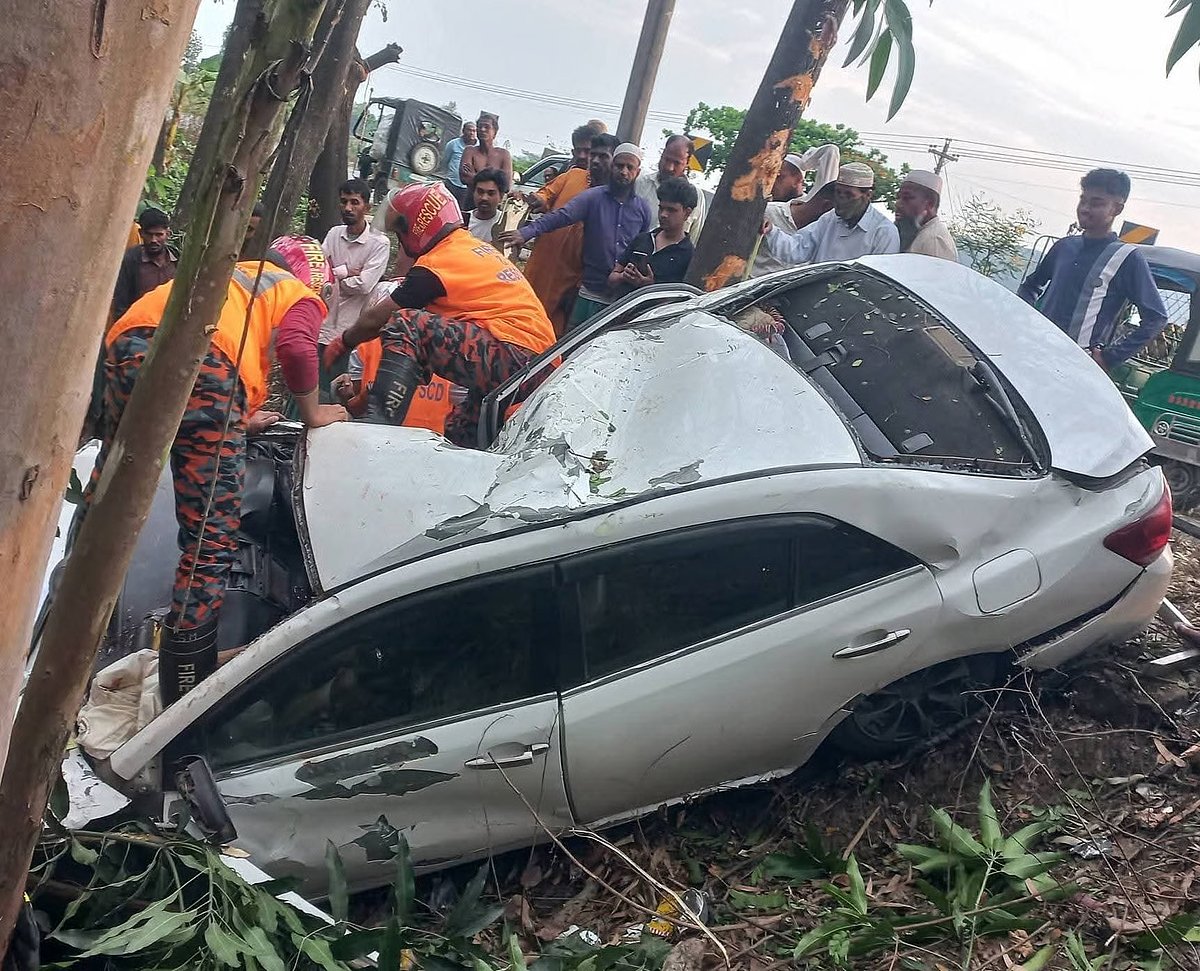
Road accidents kill an average of 20 people daily during Eid travel: Road Safety Foundation
A total of 298 people, including 46 women and 67 children, were killed in 373 road accidents across the country during the 15 days before and after this year’s holy Eid-ul-Fitr, averaging 20 deaths per day, with the highest number of accidents occurring in the Chattogram division.
This grim scenario comes from the Road Safety Foundation’s ‘Road Accidents During Eid Travel’ report, released to the media on Thursday. The report covered data from 14 March to 28 March, compiled from nine national daily newspapers, 17 national and regional online news portals, electronic media, and the Foundation’s own sources.
According to the Foundation, during last year’s Eid-ul-Fitr travel, an average of 22 people was killed per day. In that 11-day Eid travel period, 249 people died in 257 road accidents.
The Foundation reported that during this year’s Eid travel, 116 motorcyclists and passengers, 41 bus passengers, 13 truck-pickup passengers, 20 private car-microbus passengers, 50 three-wheeler passengers (easy bikes, CNG, auto-rickshaw, auto van), 9 passengers of locally made vehicles (Nachiman, Bhatbhati, Mahindra, tom-tom), and 2 cyclists were killed, while more than 2,000 people were injured.
According to the Road Safety Foundation’s observations and analysis, of these accidents, 115 (30.83 per cent) occurred on national highways, 161 (43.16 per cent) on regional roads, 48 (12.86 per cent) on rural roads, 42 (11.26 per cent) in urban areas, and 7 (1.87 per cent) at ferry ghats and other locations. Time-wise, 6.16 per cent of accidents occurred at dawn, 24.39 per cent in the morning, 23.05 per cent at noon, 17.96 per cent in the afternoon, 8.04 per cent in the evening, and 20.37 per cent at night.
The highest number of accidents and fatalities occurred in the Chattogram division, accounting for 24.93 per cent of accidents and 24.83 per cent of deaths, followed by the Dhaka division with 17.42 per cent of accidents and 24.16 per cent of deaths.
Earlier, on 30 March, according to figures released by the Bangladesh Passenger Welfare Association, there were 377 accidents on roads, railways, and waterways during this Eid-ul-Fitr, resulting in 394 deaths and 1,288 injuries. Of these, 346 accidents on roads alone caused 351 deaths.
10 reasons behind accidents
The Road Safety Foundation identified 10 main causes of road accidents: faulty vehicles, reckless speed, driver incompetence and physical-mental illness, lack of fixed wages and working hours, slow-moving vehicles on highways, reckless riding by youth, public ignorance or violation of traffic laws, weak traffic management, capacity shortfalls in the Bangladesh Road Transport Authority (BRTA), and extortion in the public transport sector.
The Foundation stated that to ensure a normal and safe Eid travel, a sustainable and coordinated transport plan of at least three years is needed, including railway renovation and expansion to increase train services and shift road passengers to rail, improving waterways to be user-friendly, expanding BRTA routes and increasing buses, planning staggered holidays for garment workers, and arranging regional transport for them. Implementing these measures would ensure smooth and safe travel during future Eid holidays.
Saidur Rahman, Executive Director of the Road Safety Foundation, told Prothom Alo that a safe road system can be established through timely policy-making, technological and infrastructural improvements, and awareness and education programs for road users, though strong political will from the government is essential.
12 recommendations
The ‘Road Accidents During Eid Travel’ report also included 12 recommendations:
Reorganise the National Road Safety Council (NRSC) and place BRTA, BRTC, and DTC under its authority, granting the council power to formulate laws, rules, and regulations.
Ensure institutional transparency and accountability through structural reform of BRTA, BRTC, and DTC, appointing experts to top positions in their respective fields.
Make the use of modern safety technology mandatory in vehicles.
Withdraw expired vehicles from roads.
Introduce company-based modern bus services in Dhaka through route rationalisation.
Increase the number of BRTC buses and improve transport services to enhance government transport capacity.
Expand institutional initiatives to train skilled drivers, ensuring their wages, working hours, and health care.
Construct service roads on all highways for slow-moving small vehicles and design safe roads.
Appoint gatekeepers at all railway crossings.
Allocate budget in the national budget to raise awareness and skills of road users.
Enhance the knowledge and skills of administration cadre officers on road safety, as they play a key role in governance and policy implementation.
Integrate road, rail, and waterways into a unified Ministry of Communications under a sustainable transport strategy.