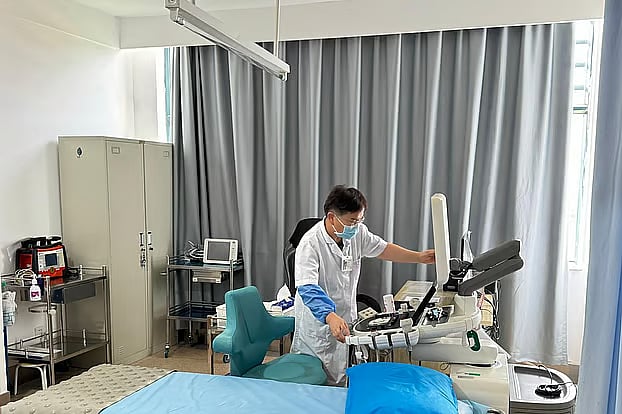
China offers advanced treatment opportunities, food and language are barriers
Omar Faruk Rashedi from Jashore had a younger brother who suffered from a spinal disease. Failing to get proper treatment in Bangladesh, Faruk learned through a service centre in Dhaka that good treatment was available at Kunming Tongren Hospital in China. After examinations there, the hospital authorities advised surgery.
Once admitted, his brother underwent surgery and recovered. The treatment took about 10 days to complete. The cost seemed lower to Faruk compared with advanced private hospitals in Dhaka.
Although satisfied with the medical services and the sincerity of the hospital staff, he considered the language barrier to be a major challenge.
“It’s not easy to find an interpreter, and even if you do, it’s costly,” he said.
For the first session, one has to pay 500 yuan (about Tk 9,000), and then 200 to 300 yuan per hour thereafter. This expense must be borne personally. There is also a lack of suitable food for Bangladeshis, and prices are high.
On 8 August, while visiting Tongren Hospital in Kunming, the capital of Yunnan Province, he suggested that Bangladeshi students studying in China could be engaged as interpreters.
Not only Kunming Tongren, but many hospitals across China offer modern medical facilities and high-quality services. However, Bangladeshi patients face problems with language and food. Hospitals have said they are taking initiatives to address this issue, with plans to expand restaurants and interpreter services catering to Bangladeshi patients. Some measures have already been put in place.
On 7–8 August, a delegation of journalists from Bangladesh visited various hospitals in Kunming at the invitation of the Chinese government, marking 50 years of China–Bangladesh diplomatic relations.
At Kunming Tongren Hospital, a variety of medical services are available. Hospital Vice President Shen Ling stated that the hospital has more than 100 medical specialists and 37 clinical departments, along with internationally standard diagnostic and laboratory equipment.
On 8 August, journalists visited Kunming Eye Hospital. CEO Zeng Min said that although it is a private hospital, the level of service is equal to that of government hospitals. The physicians treating foreign patients are experienced, and there is no need for Bangladeshi patients to worry about language issues.
On 7 August, journalists also toured the First Affiliated Hospital of Kunming Medical University, a government hospital where advanced treatment for almost all diseases is available, with a well-maintained environment. The Provincial Health Commission and hospital authorities shared various information about their services.
Arifin Islam, a Bangladeshi physician pursuing his PhD there, said that all staff in the international division can speak English. If needed, Bangladeshi patients are also provided support from local Bangladeshi students or interpreters.
Accommodation is also not a problem. Inpatients stay at the hospital, while outpatients can stay at nearby hotels. Kunming also has Muslim restaurants, including one inside the hospital itself. In addition, Bangladeshi, Indian, and Pakistani restaurants are available from which patients can order food. He added that the cost of treatment is lower compared to Thailand.
That language is indeed a major challenge for treatment in China became clearer on 9 August, while returning home through Kunming Airport. Sagor Hossain, a young man from Chattogram, said he had brought his mother, a cancer patient, for treatment.
Although the cost was somewhat higher, the quality of care was excellent. However, language remained a problem. Since he had a Chinese friend, he received significant help. One major issue, he said, was that medical reports are not provided in English. This creates difficulties, as physicians in Bangladesh or elsewhere cannot read them later.
On 8 August, at a press conference in a local hotel in Kunming, Mohammad Abul Kalam Azad Majumder, Deputy Press Secretary to the Chief Adviser, and Mohammad Khaled, Bangladesh’s Consul General in Kunming, shared various information regarding medical services for Bangladeshi citizens in China.
Azad Majumder said that initially, the Chinese government opened three major hospitals in Kunming, and later another specialised hospital, to Bangladeshi patients. Last May, the Chinese government announced that all its government and private hospitals would be open to Bangladeshis.
He added that initiatives have been taken to introduce direct flights between Kunming and Chattogram, as well as multiple flights on the Dhaka–Kunming route.