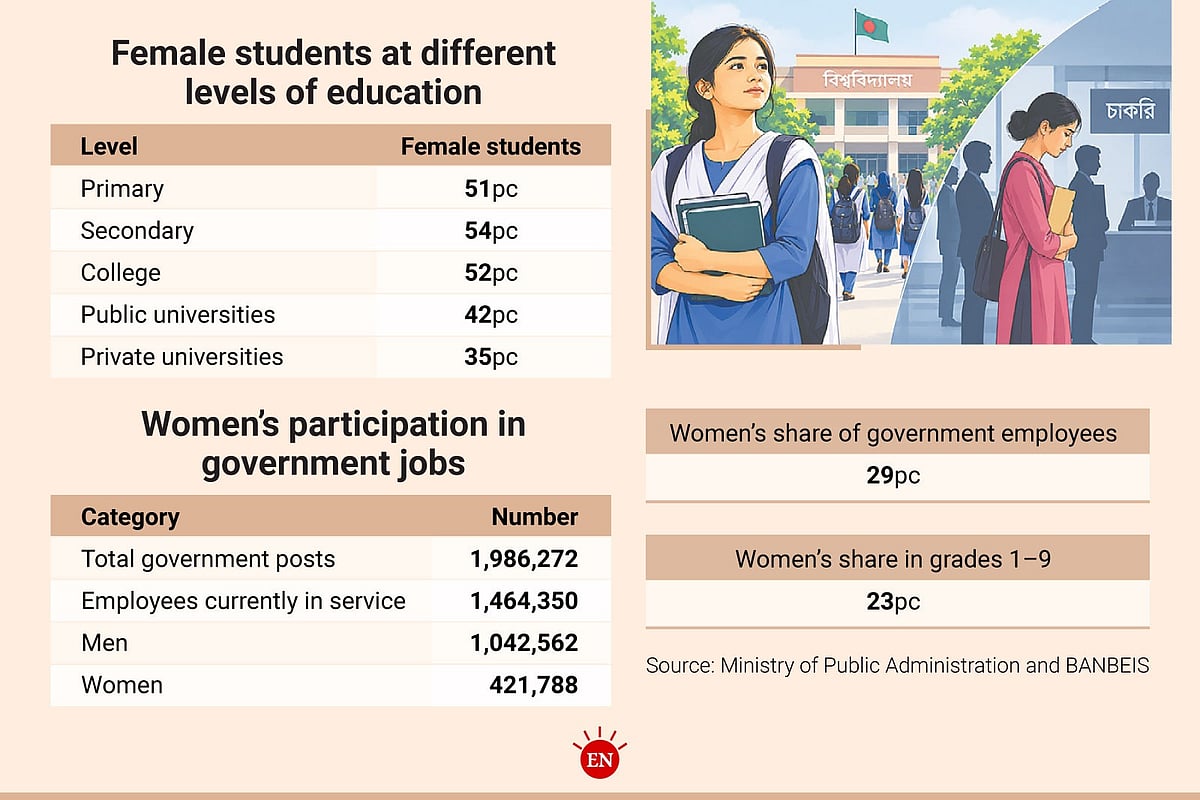
Girls outnumber boys at the primary, secondary and college levels. The picture changes, however, at university level. Excluding colleges affiliated with the National University, women account for less than 40 per cent of students at public and private universities.
Women’s participation in government employment after completing their education also remains below expectations, at less than 30 per cent. In other words, the progress girls make in the lower levels of education does not continue at the same pace in higher education and working life.
Education experts say girls’ participation in education has increased compared with the past. Greater awareness among families and guardians, expanded access to education and various government policy initiatives have contributed to this progress.
However, girls face a range of practical challenges when moving from secondary school or college to university and subsequently entering the workforce. Living away from home for higher education, a shortage of adequate accommodation, limited safe transport, family finances and marriage can all influence decisions about continuing their studies.
However, detailed research is needed to determine the extent to which each factor contributes to lower female participation at universities and to identify the necessary measures.
Similar considerations may influence women’s decisions about employment, particularly when jobs involve transfers, postings in remote areas, and concerns about safe accommodation and transport, as well as balancing family responsibilities.
These barriers do not affect all women equally. Nor should it be assumed that women’s underrepresentation in government jobs is attributable solely to family decisions or transfer policies.
Education experts say the progress girls have made in schools and colleges must be carried forward by ensuring equal opportunities in higher education and employment. This requires identifying the barriers that prevent women from pursuing higher education while also creating more women-friendly workplaces.
Setbacks in higher education
According to the Bangladesh Education Statistics 2025, published by the Bangladesh Bureau of Educational Information and Statistics (BANBEIS), girls account for 51.2 per cent of primary-level students and 54.67 per cent of secondary-level students. Their share at the college level is around 52 per cent. At the higher secondary level, girls make up 54.39 per cent of students in school-and-college institutions and 53 per cent in higher secondary colleges.
Bangladesh achieved numerical parity between boys and girls in primary and secondary education well before 2015 under the Millennium Development Goals (MDGs). Girls’ participation increased further in subsequent years, but questions remain about whether that progress has continued into the later stages of higher education.
BANBEIS collects data each year on various aspects of educational institutions, including teachers, students and infrastructure, and publishes education statistics. According to its latest figures, public and private universities and the Open University together have more than 1.11 million students. Women account for 39.34 per cent of them.
Excluding colleges affiliated with the National University, the country’s 56 public universities had slightly more than 700,000 students, around 42 per cent of whom were women. Private universities had approximately 400,000 students, with women accounting for around 35 per cent. Female participation is therefore lower at private universities than at public ones.
The figures vary from one university to another. Women make up around 42 per cent of the more than 36,000 students at the University of Dhaka. At Jahangirnagar University, the proportion is around 49 per cent. Women’s participation is also relatively high at some medical and agricultural institutions. They account for around 55 per cent of students at Gazipur Agricultural University and more than 50 per cent at Bangladesh Medical University.
A gender gap in working life
Alongside women’s lower participation at university level, their representation in government employment also remains limited. According to the Statistics of Government Employees 2025, published by the Ministry of Public Administration, the country has 1,986,272 government posts. Of these, 1,464,350 are occupied, leaving approximately 525,000 vacant.
Of the government employees currently in service, 1,042,562 are men and 421,788 are women. Women therefore account for approximately 28.8 per cent of government employees, while men make up more than 71 per cent.
Women’s representation is even lower in senior positions. Of the 1,103 officials serving in Grade 1, only 162 are women, accounting for around 14.7 per cent. There are 206,973 officials in Grades 1–9, of whom 46,925 are women, or approximately 22.7 per cent.
c Large numbers of women work in the private sector, particularly in the garment industry and other sectors.
Action needed
Asked for her views on the overall situation, former caretaker government adviser Rasheda K Chowdhury told Prothom Alo that financial assistance, safe accommodation and transport should be provided to help girls enter university. The reasons they fall behind must also be identified and addressed.
She said equal opportunities must be ensured in recruitment and promotion in government jobs, while workplaces should be made more women-friendly. Creating opportunities for women to balance family and professional responsibilities would make it easier for them to enter the workforce and remain in employment.