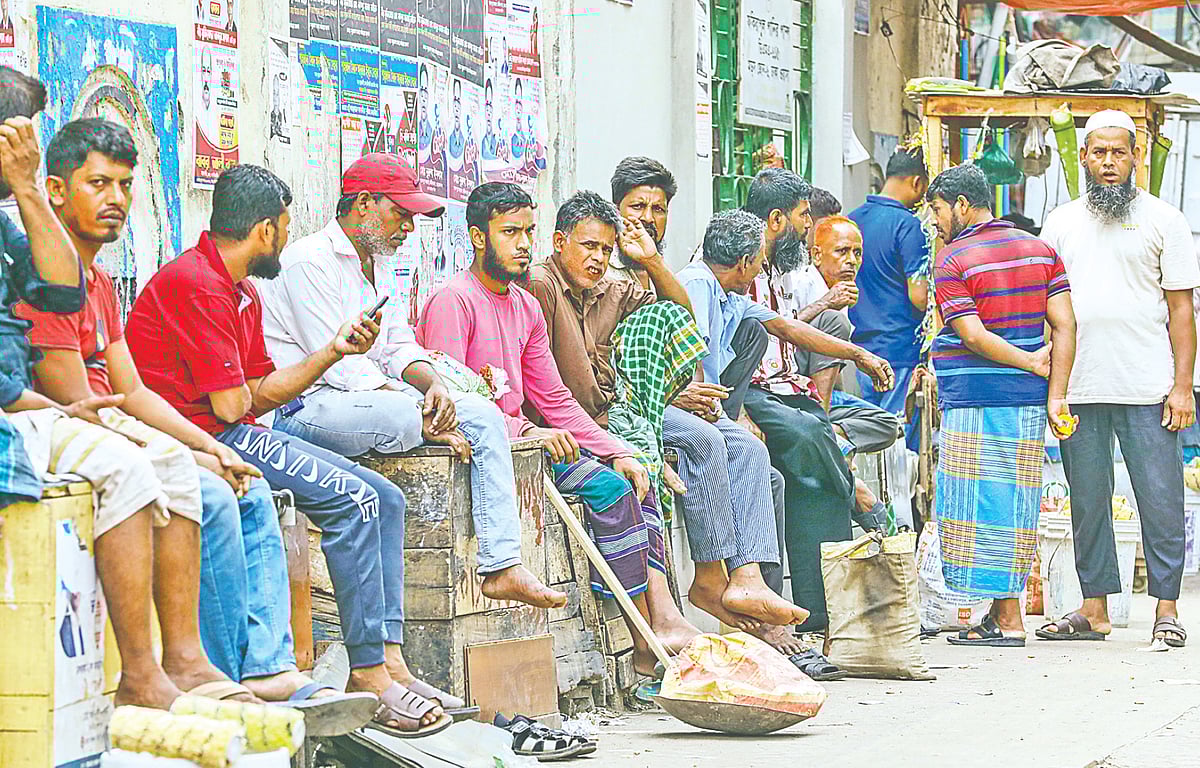
Working-class people's frantic search for jobs
Standing on the footpath beside the Fakirapool water tank road, Mohammad Suman waits in search of work. Wearing a black T-shirt over a lungi, with a towel draped over his left shoulder, he has not been hired for the past three days.
Every morning around 6:30, he comes here from Keraniganj. He waits until noon and then returns home. After midday, work is rarely available. Disheartened, he heads back.
Speaking with Suman yesterday, Saturday at 9:00 am, he said life is extremely difficult. He has a family of five—his wife and three children. Monthly expenses range between Taka 16,000 and Taka 18,000. He works as a day labourer, earning Taka 800 per day. However, the later he finds work—especially after 10:00 am—the lower the wage becomes.
Since independence, this labour market has developed on the footpath beside the Fakirapool water tank. Now, 300 to 400 people come here daily to sell their labor.
Among them are various types of construction workers—carpenters, masons, sanitary workers, painters and their assistants—as well as general laborers, van drivers, and people from many other occupations.
Conversations with many of them reveal that work has declined for everyone. From skilled craftsmen to day laborers, all are facing financial hardship. Most reported being unemployed three to four days a week; some go without work for more than a week at a stretch.
Suman’s village home is in Baliganj of Tongibari, Munshiganj. Although he has relatives there, he does not have his own house. He came to Keraniganj as a teenager and is now 45 years old. He has worked as a day laborer all his life. At one point, he tried something different but ran into trouble.
With some savings and a loan of Taka 115,000 from a cooperative, he bought a battery-powered auto-rickshaw in 2022. Unfortunately, within a year, the battery failed. Various problems followed.
With no other option, he sold it for Taka 70,000 and returned to day labor. Using his wife’s savings and loans from relatives, he repaid the cooperative loan, though he still has about Taka 40,000 in debt.
Suman said his work has declined over the past two years. Now, he gets work for at most 15 days a month, and even then, he does not always receive full wages. As a result, his monthly income rarely exceeds Taka 10,000 to Taka 12,000. His wife works as a domestic worker in Keraniganj, earning about Taka 4,000 a month. Together, they somehow manage to run the household.
Liton Mia from Jamalpur works as a tile mason. He has been in the Fakirapool area of Dhaka for 17 years. With the decline in work, supporting his family has become difficult. Last year, he was forced to send his wife and two children back to the village. Now he lives in a shared mess.
Depending on his work, he sends money to his wife weekly or every 10–12 days via mobile banking. Even then, it is not enough. His monthly expenses in Dhaka range from Taka 8,000 to Taka 10,000. A single meal at a roadside restaurant costs at least Taka 100; even a simple meal of lentils and vegetables costs around Taka 70.
Liton said his daily wage is Taka 1,200. However, construction work has slowed since the fall of the government. Contracting work had almost stopped. Work for tile, paint, and sanitary workers largely depends on contractors. He hopes the situation will improve after the election, but contracting work has yet to resume.
Expressing frustration, Liton said the new government faced a major shock at the outset due to the Iran war. Prices of goods continue to rise daily, while their incomes are not increasing—in fact, they are decreasing further. “How long can this go on?” he asked.
The situation is similar for carpenter Jasim Biswas from Krishnakathi village in Bakerganj. He was sitting on a van on the footpath. Nearby were carpenter Md Shah Alam, mason Abul Kalam of Cumilla, and his helper Ramzan Sheikh, along with several others.
Jasim Biswas said that until yesterday, Saturday, he had earned only Taka 8,000 this month. There is hardly any work now for carpenters. He lives in a shared mess in Shantinagar, while his wife and two children stay in the village. He owns only a homestead there, with no farmland. Asked how he is managing, he replied, “God is keeping us going.”
Rickshaw-van drivers are also facing a downturn in work. Md Ashraful from Pirgacha in Rangpur said they mostly transport goods for printing presses and wholesale markets in the Fakirapool area. There is also work related to house moves at the end and beginning of the month.
Recently, however, one reason for reduced work is the growing number of auto-rickshaw vans. Auto-van drivers have lowered fares significantly. Trips that used to cost Taka 500 are now being done by auto-vans for Taka 250–300.
Spending over an hour in the Fakirapool area in the morning, it was seen that more than a hundred people were waiting for work. This is their daily reality. They arrive at dawn and wait in hope. Time passes—some find work, others return disappointed.