People's stories
‘We have to live very carefully’
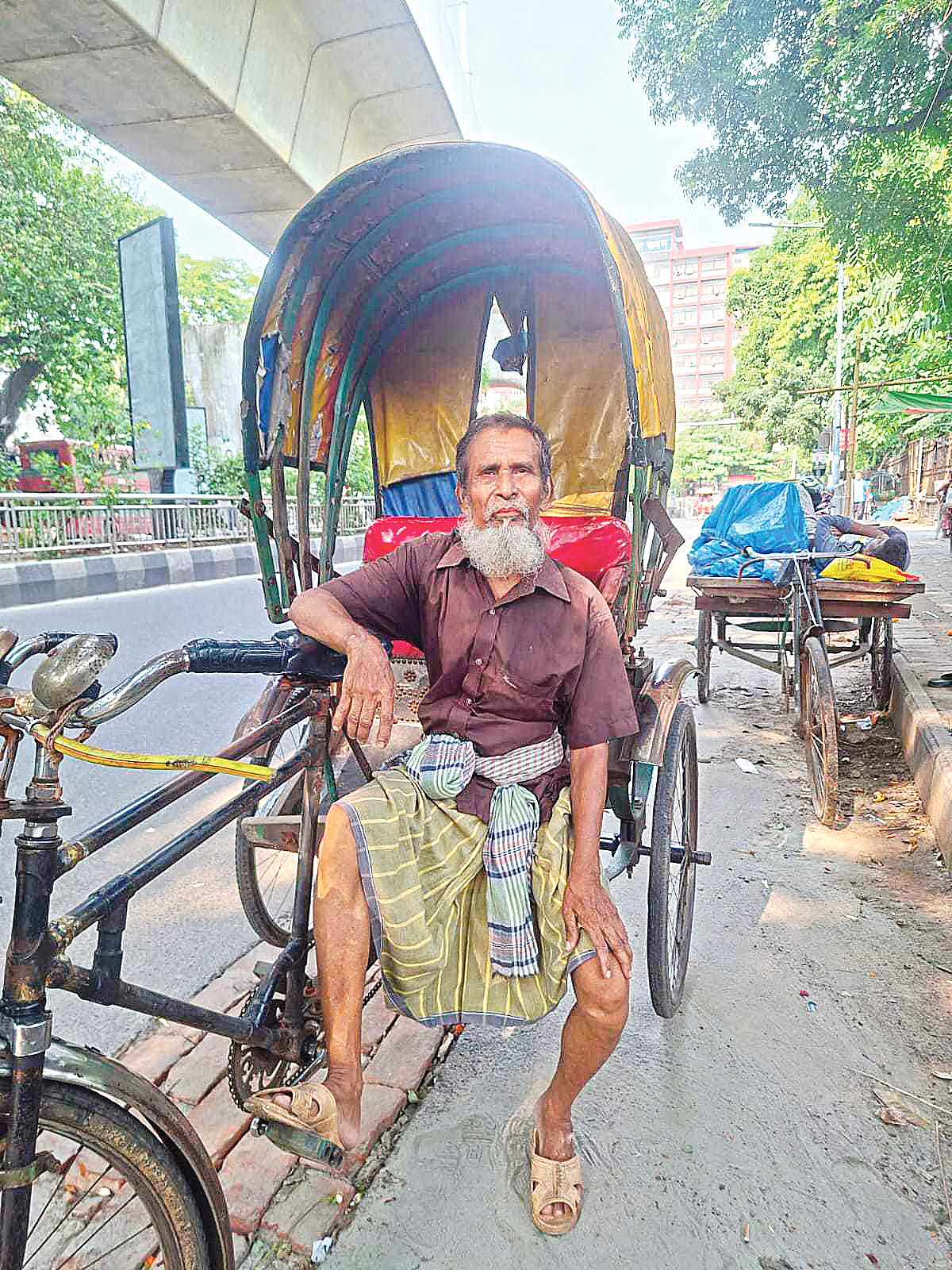
Julhas Mia is 70 years old. At an age when most people are at rest, he is on the streets of Dhaka, pedaling a manual rickshaw to support his family. However, he can no longer drive for more than half a day.
"My body can't take it," Julhas says.
We spoke with Julhas on Monday afternoon in the capital's Fulbaria area. He used to sell vegetables once. But failing to balance make a profit, he took up pulling a rickshaw 20 years ago.
Julhas lives in a two-room house in Kamrangirchar. There are five members in his family. His wife, their only son, daughter-in-law and a grandson. His son's income alone is not enough to run the family. So, driven by the need to survive, Julhas too has to hit the streets every day.
Pedaling for half a day earns him no more than Tk 400. Out of this, Tk 60 has to be paid to the rickshaw owner.
"When there were no autos (battery-run rickshaws), I used to earn even a thousand taka a day," Julhas said. "Income has dropped since the autos came out. Passengers don't want to get on these rickshaws."
Explaining that it is impossible to run the family on this meager income, Julhas said, "We barely survive on lentils and rice. We got to eat a little meat this Eid only because a few people gave us some."
"I earn Tk 400 and there is house rent to pay. There are illnesses too," Julhas added. "Calculating all this, we have to live very carefully."
‘There is less work these days’
Shawkat Matbar repairs the kind of pedal-powered rickshaws that Julhas pulls. Now in his fifties, Shawkat was found resting on the pavement near the Curzon Hall at the University of Dhaka Monday afternoon. Beside him lay various small tools for repairing rickshaws.
During the conversation, Shawkat Matbor shared that he has been repairing rickshaws and vans for nearly 30 years. At one point, he has also worked decorating wedding venues and has driven rickshaws himself.
Shawkat has two sons, both of whom live separately with their own families. He lives with his wife in a single-room house in the Anandabazar area of the capital. The monthly rent is five thousand taka.
Asked about his earnings from repairing rickshaws, Shawkat said, "I don’t make more than four to five hundred taka a day. Not every day is the same. If there's some work today, there may be none tomorrow.”
As he was speaking, a rickshaw pulled up in front of him. After working on the front wheel for a while, he received just Tk 10 for the repair. He later remarked, "Business is not very good. There is less work these days."
When asked how his household is running, Shawkat Matbor said, "We somehow get by. Sometimes it’s dal and alu bhorta (lentils and mashed potatoes), other times it’s greens and fish. Meat is very rare."
‘I am struggling to keep up’
Swapan Rishi works as a barber on the footpath opposite the High Court Mazar Gate. He has been doing this work for 30 years. Previously, he used to sit on the footpath beside the mazar.
A small mirror, a comb, a pair of scissors, and a razor—these are Swapan’s only assets. It is mostly low-income people who come to him for a haircut.
Swapan's family consists of his wife, two sons and two daughters. What he earns is not enough to support a family in Dhaka, so they live in Brahmanbaria. He stays in a "mess" (shared lodging) in Moghbazar.
Swapan charges Tk 50 for a haircut and Tk 30 for a shave.
"Some days I earn six to seven hundred taka. After my own food and expenses, maybe four to five hundred remains,” he says.
“The price of everything is going up. I have to cut down on many necessities. I am struggling to keep up."