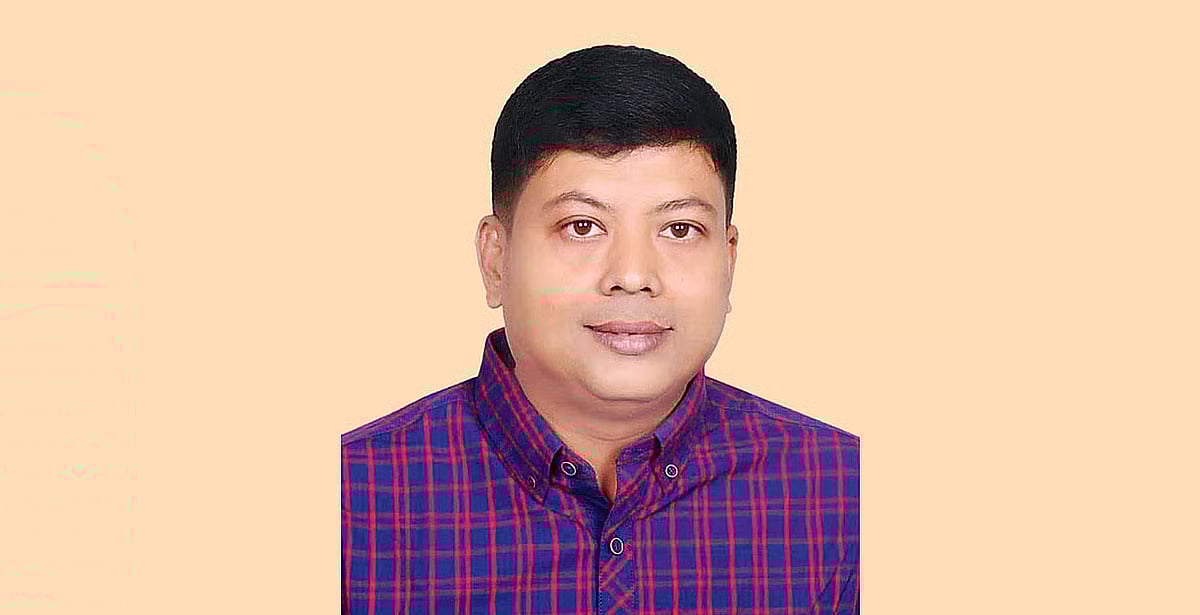
Swecchasebak Dal leader Musabbir Murder
A blurry seven-second footage led detectives to the killers
Even before the sound of gunfire faded, the narrow alley of the busy city of Dhaka fell silent. Swecchasebak Dal leader Azizur Rahman Musabbir collapsed on the ground. Where the attackers came from and which way they fled—nothing was clear.
Even after reviewing footage from nearby closed-circuit (CCTV) cameras, Detective Branch (DB) police initially found no reliable leads. Eyewitnesses also could not provide dependable descriptions. Just then, a blurry video captured a seven-second scene—a man peeking from behind a dustbin, holding a mobile phone to his ear. That very scene later unraveled the entire mystery of the murder.
On 7 January at around 8:20 pm, Azizur Rahman Musabbir, former joint secretary of Dhaka north city unit Swecchasebak Dal, was shot dead in front of Ahsanullah Institute in the Tejaturi Bazar area of the capital. Sufian Bepari Masud, who was with him, stepped forward to save Musabbir, too was shot.
Following the incident, Azizur’s wife Suraiya Begum filed a murder case at Tejgaon police station. The case is being investigated by the DB police.
The entire process of identification and arrest is being supervised by Mohammad Nasirul Islam, joint commissioner of Dhaka Metropolitan Detective Police (DB). He told Prothom Alo that the sensational murder was investigated with the highest priority, with multiple DB teams working simultaneously to uncover the mystery.
Seven seconds of footage
During the investigation, DB officials found in a piece of footage that just before Mushabbir entered the alley, a man was peeking from behind a dustbin. He appeared to be holding a mobile phone to his ear. The scene lasted only seven seconds.
Investigators developed the idea that the man might have been speaking to someone, and during that conversation, Mushabbir’s location was being relayed.
The footage was so unclear that nothing could be confirmed at first. However, investigators began analysing it separately and launched a technology-based search. They analysed mobile network data to identify who were active on phones in and around the alley during those seven seconds, producing a long list.
Although the list was large, it became the first effective lead in the investigation. After checking hundreds of numbers, a suspicious number emerged—one that led investigators to the masterminds behind the killing.
According to DB sources, the person receiving the call from that number was also located in the same alley. After identifying locations, three individuals were initially taken into custody and interrogated. Though they denied involvement at first, they eventually broke down and confessed to carrying out the murder as planned.
DB official Nasirul Islam said, “At first, it seemed extremely difficult to derive clues from such a blurry footage. But through continuous analysis and the use of technology, that difficult task became possible.”
Two brothers on either end of the phone
DB officials said the man seen in the footage was Billal, and on the other end of the phone was his brother Abdur Rahim, who carried out the shooting.
According to DB, Billal informed Rahim over the phone that Musabbir was entering the alley. Rahim and his associate Jinnat were already waylaying inside. As Musabbir moved a short distance forward, they opened fire on him. Sufian Bepari Masud, who was with him, was also shot. Everything happened within seconds, after which the attackers quickly fled the area.
Investigation sources said Billal, Abdur Rahim, and Jinnat—directly involved in the murder—have been arrested. Two others, Abdul Qadir and Md Riaz, were also arrested for their involvement in planning the killing. Among the five arrested, Billal, Abdur Rahim, and Abdul Qadir are three brothers. Abdul Qadir helped the killers escape.
Arrested while fleeing
DB officials said that after identifying the two individuals from the phone conversation, Jinnat and Riaz were arrested on 10 January from the Gacha area of Gazipur. On the same day, Billal was arrested in Manikganj, and Abdul Qadir was arrested from Nakhalpara. The shooter Abdur Rahim was arrested on 23 January from Narsingdi.
Jinnat gave a confessional statement under Section 164 in court, stating that Billal was the planner, financier, and supplier of weapons for the murder.
According to Jinnat’s statement, after the killing, the shooters went to a ground in Mohakhali, handed over the weapons, and informed Zahidul—who had directed the operation—by phone. Rahim was later given some money and told to leave the area.
Jinnat further said that he stayed at a residential hotel in Uttara Sector 9 with Billal and Riaz. From there, three new mobile phones were purchased by Abdul Qadir. Although he was instructed to flee to Cox’s Bazar with one of the phones, he instead took shelter at his home in Gacha, Gazipur, where he was eventually arrested.
Meanwhile, Billal had hidden in a locked straw room at his home in Manikganj. DB members, suspecting something, broke the lock and arrested him there.
Nasirul Islam said that through coordinated efforts, DB was able to identify and arrest those involved and fully uncover the mystery behind the murder.
Four-month plan, instructions from abroad
Investigating officials say they have found evidence of involvement by a top criminal based abroad.
According to officials, the murder was planned about four and a half months earlier over control of Karwan Bazar and surrounding areas. On instructions from the criminal, Billal and Zahidul were assigned responsibility, and others later joined.
Investigators also said that there had been a previous attempt to kill Musabbir. His movements had been monitored for several days, with Riaz also involved in the surveillance. After the first attempt failed, the plan was revised, appointing Jinnat and Abdur Rahim as shooters.
The agreement was that after the killing, shooter Jinnat would receive Tk 300,000 to Tk 400,000 and a motorcycle, while coordinator Billal would receive Tk 1.2 to Tk 1.5 million along with assurances that legal expenses would be covered.