Dhaka’s underworld
Top criminals go reckless again
It was 27 September, 2000. Rival criminals openly shot dead one of the most notorious gangsters of the time, Humayun Kabir, alias “Murghi” Milon, within the court premises to take control of the underworld and extortion rackets. For a long time afterward, the capital’s underworld remained turbulent with killings, counter-killings, and gunfights.
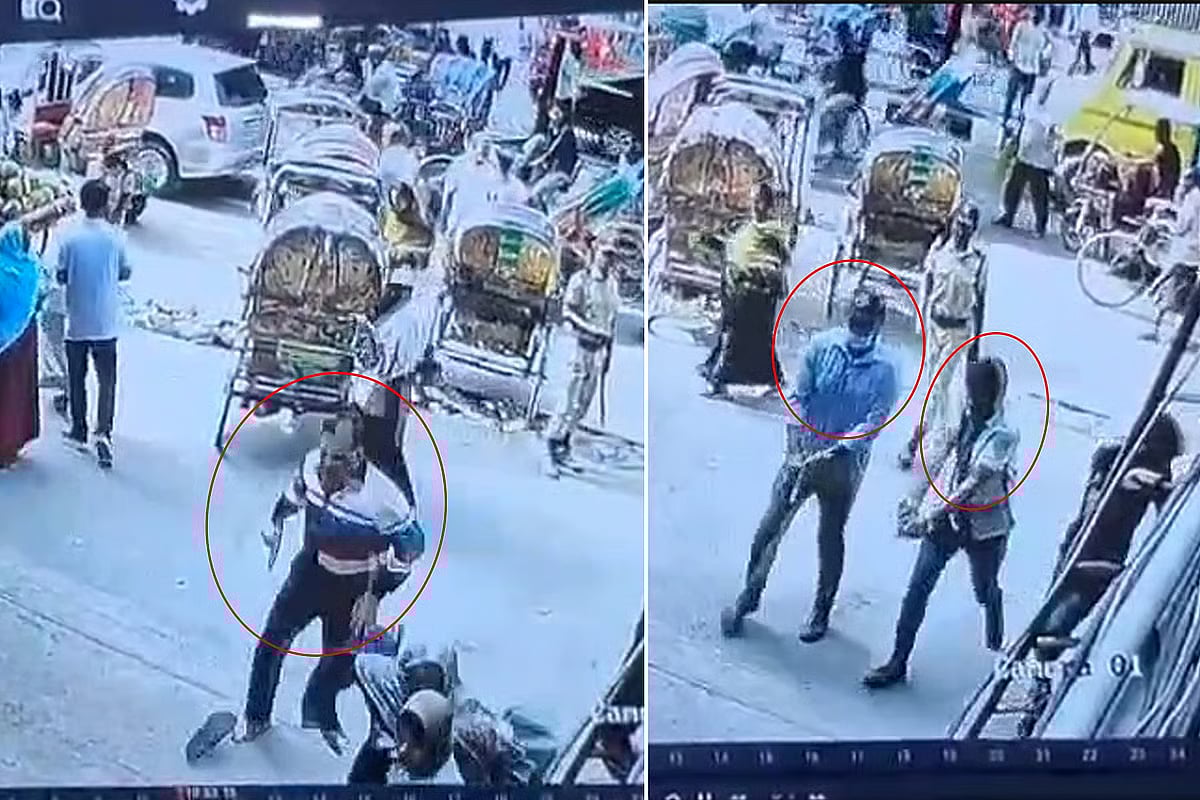
A similar incident occurred on 28 April this year. Rival criminals openly shot dead top criminal Khandakar Nayeem Ahmed, alias Titon, on the streets. This incident has once again brought Dhaka’s underworld and the dominance of professional criminals into the limelight. In the past 21 months, 23 such incidents have occurred in the capital, in some of which professional criminals were directly involved, and in others they operated from behind the scenes.
Among the 23 notable incidents, seven were murders. In six of these, members of rival groups were killed in gunfire from professional criminals. The remaining one involved killing by hacking. Apart from the murders, the other incidents included shootings inside business establishments, bomb explosions, hacking and injuring, shows of force, and threats.
These 23 underworld-related incidents occurred in areas including Dhanmondi, Hazaribagh, Rayerbazar, Mohammadpur, Adabor, Mirpur, Pallabi, Kafrul, Gulshan, Badda, Moghbazar, Hatirjheel, and Motijheel. These areas are now highly significant on the map of Dhaka’s underworld. In some places, former top criminals, in others their associates, and elsewhere politically affiliated local groups are involved in shifts of power within the underworld.
Following 5 August 2024, due to the weakened condition of law enforcement agencies, including the police, professional criminals began to become active in various ways. At least seven notable criminals—such as Imam ul Hasan Helal alias “Picchi Helal” of Mohammadpur, Sanjidul Islam alias Iman of Hazaribagh, Khandakar Nayeem Ahmed alias Titon, Abbas Ali of Mirpur (known to police as “Killer Abbas”), and Sheikh Mohammad Aslam alias “Sweden Aslam” of Tejgaon—were released on bail. Among them, at least three left the country immediately after release. Some were already abroad and have been operating criminal activities in the country from there. Subrata Bain also suddenly became active after 5 August 2024.
During the BNP-led four-party alliance government, a list of 23 “top criminals” was published in 2001. Law enforcement agencies were supposed to keep figures like Iman, Titon, and Picchi Helal—who were on that list—under surveillance. However, there has been no effective monitoring of where these criminals currently are, the status of their bail, or whether they are appearing in court. Criminal groups have taken advantage of this gap.
Sources in law enforcement say that criminals based abroad are recruiting a segment of unemployed youths facing financial hardship. Those without regular income and who are disillusioned with life are being used as hired operatives in exchange for money. Many of the shooters involved in recent incidents come from such backgrounds.
Additional Commissioner (Crime and Operations) of Dhaka Metropolitan Police, SN Md Nazrul Islam, told Prothom Alo that most top criminals are now outside the country and are “pulling the strings” of Dhaka’s underworld from abroad. Some may still be inside the country. He said, “Lists of these area-based criminals and their associates are being prepared. A combing operation will be conducted against them very soon.”
Crime-driven economy
Analysis of the 23 recent incidents shows that, in one way or another, they are tied to a crime-driven economy. Even in murders stemming from prior enmity, disputes often centered on control over illegal income streams. Although many of these criminals have political affiliations, most conflicts revolve around control of garment factory waste fabric, household garbage collection, cable and internet businesses, transport extortion, sacrificial animal markets, contracting work in various institutions, and area-based extortion, as well as illegal earnings from construction projects be exerting power.
Investigations show that, in many cases, extortion demands are made via foreign phone numbers. If payments are not made, criminals carry out shootings at business premises, attack owners, or even force closures. The most recent such incident occurred on 19 April, when professional criminals opened fire inside a business establishment in Mirpur after failing to collect a Tk 10 million extortion demand.
Earlier, on 13 March last year, BNP ward no. 36 member Md Rajan was severely injured in a hacking attack in Hatirjheel. He was attacked inside a club built on railway land near the Wireless Railgate in Moghbazar, his head smashed, and left for dead. Law enforcement later found involvement of top criminals Subrata Bain and Md Molla Masud. On 27 May, the army arrested these two notorious criminals from Kushtia.
Rajan told Prothom Alo that the attack stemmed from a dispute over garbage collection money.
“They thought I was dead and left me. These people work as hired criminals for money. I know them, but there is no justice,” he said.
Earlier, from 21 to 24 October last year, garbage collection in Mohakhali and Niketan had to be halted due to threats and attacks by criminals. The disruption followed phone calls from foreign numbers and attacks linked to top criminal Bikash Kumar Biswas, who sought to take control of the business from local BNP leaders.
Those concerned say many businesspeople are silently paying extortion. Fear of attacks if they complain, and insecurity even after filing cases, prevent many victims from speaking out. As a result, not all incidents are recorded by police, meaning the actual scale of criminal activity is far wider than reflected in the 23 incidents, including seven murders.
Pattern of killings remains the same
Analysis of the seven murders over the past 21 months shows a similar pattern. In most cases, fugitives abroad planned the killings—selecting targets, conducting surveillance, executing swift attacks, and coordinating escapes via motorcycles or fast vehicles, often online. Some cases also involved attempted killings. In many instances, the victims themselves had links to criminal networks, political identities, or economic control.
Investigations into two murders in Badda and Gulshan revealed similar patterns. On 20 March last year, internet businessman Suman Mia alias “Tele Suman” was shot dead in Gulshan. On 25 May, BNP leader Kamrul Ahsan Sadhan was shot dead in Badda. A source in Dhaka Metropolitan Detective Branch said both killings stemmed from rivalry between two groups over control of cable TV, internet business, and extortion. Suman, linked to the Mehdi group, was killed by members of rival groups led by Robin, Dalim, and Mahbub. Sadhan’s killing was in retaliation.
Earlier, on 10 November last year, top criminal Tariq Saif Mamun was shot dead at close range outside the National Medical Institute Hospital in Old Dhaka after appearing in court. About two years earlier, on 18 September, 2023, there had been an attempt to kill him in Tejgaon while he was stuck in traffic. During that attack, a motorcyclist named Bhuban Chandra Shil was killed by stray bullets.
The cycle of killings among top criminals effectively began with a double murder in Rayerbazar on 20 September, 2024. One of the accused in that case was Imam ul Hasan alias Picchi Helal. Another accused, Iman Hossain—leader of the teenage gang “Alex Group”—was hacked to death on 12 April this year.
In the 19 April, 2024 killing of Jubo Dal leader Arif Sikdar in Hatirjheel, top criminal Subrata Bain was named as a suspect. Most recently, in the New Market area killing of top criminal Khandakar Nayeem Ahmed Titon, the names of three top criminals have surfaced in various ways.
In some of these cases, law enforcement has arrested suspects, taken them on remand, and recovered weapons. However, the masterminds behind the killings remain out of reach, with some reportedly having acquired foreign citizenship. As a result, the chain of killings continues. Observers say these incidents send a message to the public that the “network” of top criminals has returned to its previous strength.
This resurgence has also affected other crimes. Under the patronage of professional criminals, various groups, including teenage gangs, have become active. Mohammadpur, Basila, and Hazaribagh are major examples, where after 5 August, 2024, more than ten smaller groups, alongside major criminals, carried out public shows of force with local weapons and firearms, as well as attacks and takeovers of establishments.
A city of fear
Crime analysts say Dhaka’s underworld has now taken on a hybrid form combining old criminal politics and a new urban economy. Unless five layers are dismantled—bail-released top criminals, hidden masterminds, local gangs, political patronage, and extortion markets—it will be difficult to stop the cycle of killings, shootings, and fear in the capital.
Associate Professor Touhidul Haque of the Institute of Social Welfare and Research at Dhaka University told Prothom Alo that many criminals were released on bail after 5 August. Monitoring whether they re-engaged in crime after release was the responsibility of law enforcement agencies. However, recent incidents suggest that such monitoring has not been effective.
He added that top-level criminals often require political patronage to operate. In Bangladesh’s context, political actors sometimes also rely on such criminals to maintain their positions. When these two sides exchange power, criminality in society increases, along with the dominance of top criminals. Therefore, political parties must ensure that criminals do not receive any form of patronage. If the government seeks to establish the rule of law, it must take visible action against all types of criminals, including those at the highest level.