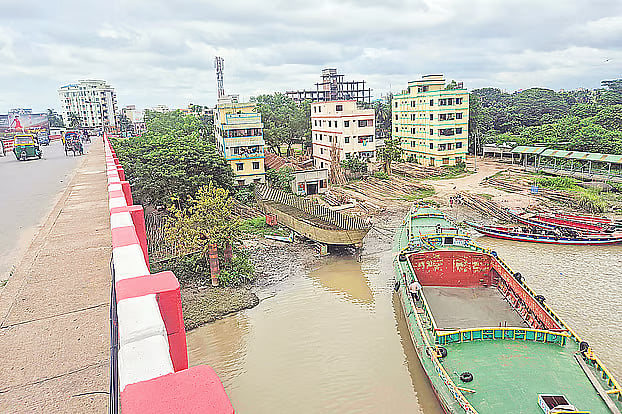
736 illegal occupiers on the Dakatia River
For years, no government agency had a specific list of illegal occupiers or encroachers along the Dakatia River in Chandpur. A joint survey by the Bangladesh Inland Water Transport Authority (BIWTA) and the Chandpur district administration has now identified at least 736 encroachers. The survey was conducted last year. The district administration said an eviction drive would soon be launched to remove encroachers occupying land within the river’s boundary.
Alongside the encroachers, BIWTA and the Chandpur district administration have also prepared a list of those polluting the river. Preparations are underway to take action against the polluters as well, according to district administration sources.
Sheikh Farid Ahmed, MP for Chandpur-3 and president of the district BNP, told Prothom Alo, “We have asked the administration to take swift action to evict everyone who has illegally occupied the Dakatia River and its banks. No one should be given any exemption.”
The list of encroachers includes various businesses in the Chandpur New Market area, including Elama Shahreen Ice Factory, New Pubali Auto Rice Mill and Bismillah Auto Rice Mill. More than 100 multistorey buildings and establishments stand along the stretch from Mukherjee Ghat to the Stand area in the town. The list also includes two schools, a book warehouse and several government establishments. Numerous businesses have also been built illegally along the southern bank of the Dakatia in the Puran Bazar area.
BIWTA Chandpur Deputy Director Md Kamruzzaman said 62 boundary pillars have already been installed from the town’s Boro Station Molehead to the Gachhtala Bridge to protect the Dakatia from encroachment. Another 28 boundary pillars are currently being installed, he said.
Prothom Alo spoke to the owners of three buildings and two businesses named on the list. They claimed that they had built their houses and buildings several years ago after obtaining leases from the district administration. They questioned how their names came to be included on the list of encroachers.
Eviction drive to follow survey list
The Dakatia has been gradually shrinking and losing navigability for years due to encroachment and pollution. According to government records and maps, the river has an average width of about 220 feet. However, illegal encroachment has reduced its width to as little as 30 to 40 feet in some parts of Chandpur. Most of the structures are privately owned, although several government and private institutions are also among them.
Chandpur Deputy Commissioner Ahmed Ziaur Rahman told Prothom Alo, “We will very soon conduct an eviction drive against illegal structures on both sides of the Dakatia River in Chandpur town based on the list of illegal encroachers.”
We have asked the administration to take swift action to evict everyone who has illegally occupied the Dakatia River and its banks. No one should be given any exemption.Sheikh Farid Ahmed, MP, Chandpur-3
A joint survey by the district administration and BIWTA identified private power generation company Desh Energy Limited as one of the major encroachers and polluters of the Dakatia. According to the government’s CS (Cadastral Survey) map, the company has occupied 285 decimals of land, the survey report said.
Enayet Kabir, head of the Finance and Accounts Department at Desh Energy Limited, told Prothom Alo on Sunday evening that the company had purchased land included in the BS (Bangladesh Survey) records. They have not occupied any part of the river, he said.
‘The drive must not be a token exercise’
Household and solid waste from Chandpur municipal areas is dumped at various points along the Dakatia every day. Untreated toxic chemicals from factories around the river, as well as hazardous medical waste from various clinics and hospitals are also discharged into the water. Plastic, polythene and rice mill husks have accumulated on the riverbed, causing the water to turn dark and foul-smelling.
BIWTA has identified 15 such dumping and pollution hotspots. These include Boro Station VIP Ghat, 5 no. Ghat, Chowdhury Ghat, the municipal slaughterhouse, the area in front of Sadar Hospital, Bhuiyan Ghat in Puran Bazar, Chaulpatti and the Ichhli ferry ghat area.
Environmental activists say pollution has caused oxygen levels in the Dakatia to fall alarmingly. Native fish species are on the verge of extinction in the river, directly affecting the livelihoods of local fishermen. Large cargo trawlers and launches once used to operate on the river but navigation has become almost impossible due to the loss of navigability.
The river’s siltation has also disrupted drainage during the monsoon, increasing the risk of waterlogging and flooding across a vast area, including the Chandpur Irrigation Project.
Mosharraf Hossain, a local environmental activist and principal of Baburhat School and College, told Prothom Alo that the eviction drive must not turn into an activity just for show. River encroachers must be identified and severely punished through the legal process. At the same time, effective steps must be taken to restore the navigability of the Dakatia River through dredging or excavation.