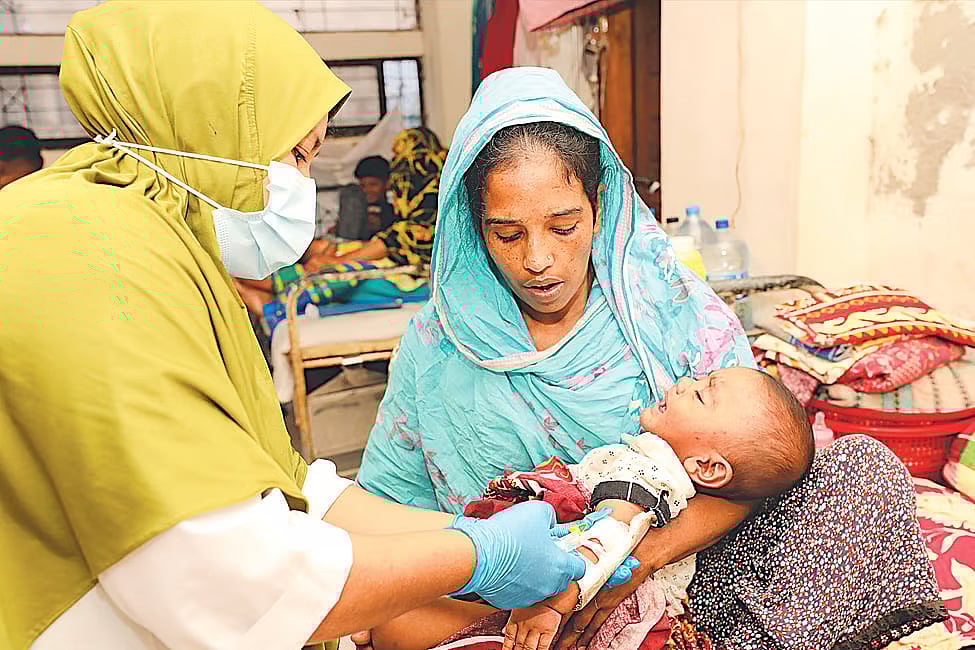
Highest measles deaths in two decades, death rate also higher
The number of deaths from measles this year is the highest in the past two decades. During this period, deaths from measles were recorded five times. The highest number of deaths previously was 10 in 2017.
According to the Directorate General of Health Services (DGHS), in the last 20 days (15 March to 4 April), 98 children have died from suspected measles. The number of confirmed measles deaths stands at 16.
In the last 24 hours alone, four deaths from suspected measles and two confirmed measles deaths have been reported. However, over the past two weeks, Prothom Alo has learned through communication with various hospitals across the country that the number of deaths from measles is 61.
Public health experts say that although the number of measles infections is regularly recorded each year, deaths are not consistently monitored. The measles mortality rate in the country used to be 1 per million, which has now risen to 16.8 per million.
The DGHS has reported that 826 people have been confirmed infected with measles in the past 20 days, while the number of suspected cases stands at 4,628. If the figure of 826 confirmed cases is considered, it is the highest in the last five years.
According to data from the World Health Organization (WHO), there were 2,410 measles cases in Bangladesh in 2020. In the following years, the number of infections remained below 400.
An official of an international organisation working in the health sector, speaking on condition of anonymity, said that since the introduction of measles vaccination in the country, there has been no record of such a high number of deaths from the disease.
Professor Halimur Rashid, Director of the Disease Control Wing of the DGHS, told Prothom Alo on Saturday, “As far as I can estimate, there has never been a year in which so many patients have died from measles in the country.”
Measles Deaths: What the Records Show
Measles surveillance in Bangladesh is conducted with the support of the WHO. This monitoring is carried out under the Expanded Programme on Immunisation (EPI).
Vaccine expert and public health specialist Tajul Islam Bari said that in 2016, one death from measles was recorded in the country. The following year, 10 Tripura children died in Sitakunda, Chattogram.
In 2018, six children died in Hathazari, Chattogram, although their samples could not be collected. Their causes of death were determined through verbal autopsy.
A verbal autopsy is a method used to determine the probable cause of death by collecting information from family members or close associates when no direct medical certification or reliable hospital data is available.
Tajul Islam said that in 2020, seven children died of measles in the hill district of Bandarban. Since then, there has been no record of such a high number of deaths from measles in the country.
In 2006, a survey was conducted by the Institute of Epidemiology, Disease Control and Research (IEDCR) to estimate the number of measles cases and deaths. Funded by the WHO, the survey was led by the then Director of IEDCR, Professor Mahmudur Rahman. He told Prothom Alo, “At that time, we found information on four deaths.”
Public health expert Dr Mushtuq Husain, who was involved in the survey, said that the nationwide random sampling survey found a relatively low number of deaths. In that context, it can be said that the current number of measles deaths is the highest in the country’s history.
Measles Infection: From 2004 to Present
Experts believe that long-term trends must be examined to understand the measles situation. According to WHO data on Bangladesh, there were 9,743 reported measles cases in 2004.
The number rose sharply to 25,934 the following year, indicating a major outbreak. It then dropped to 6,192 in 2006. In 2007, there were 2,924 cases; in 2008, 2,660; in 2009, 718; and in 2010, 788. This shows a rapid decline after the severe situation in 2004–2005.
However, Bangladesh has not been able to fully control measles. WHO reviews show that the number of cases jumped again to 5,625 in 2011. It declined to 1,986 in 2012.
In 2013, there were 237 cases; in 2014, 289; and in 2015, 240—indicating a relatively controlled situation during those years. But in 2016, the number rose again to 972. Reviews suggest that despite increased vaccination between 2000 and 2016, another outbreak occurred in 2016.
‘The Country Has Fallen Behind’
In Bangladesh, children receive measles vaccines in two doses—first at nine months and then at 15 months. Initially, only a single dose was administered. The second dose was introduced on 26 September, 2012.
The national immunisation programme began in 1979, initially in urban areas. From 1985, it expanded nationwide under the DGHS’s Expanded Programme on Immunisation (EPI).
At the beginning of the EPI, vaccines were provided against six infectious diseases—tuberculosis, diphtheria, whooping cough, tetanus, polio, and measles. Later, vaccines for hepatitis B, Haemophilus influenzae, rubella, and pneumococcal pneumonia were added.
Six years after the launch of EPI, in 1985, only 2 per cent of children in the country were covered. According to the EPI Coverage Evaluation Survey 2019, that figure has now increased to 84 per cent.
Experts believe that the low vaccination coverage in 2025 is the main reason behind the rise in measles cases this year. Professor Mahmudur Rahman, head of the National Verification Committee for Measles and Rubella/Congenital Rubella Syndrome (CRS) Elimination, said, “We suffered a major setback last year. Measles vaccination coverage was insufficient, even though the target was to eliminate measles by December last year. The country has fallen behind that goal.”