BBS stats doubtful, country’s population is 190m: Election Commissioner Tahmida
Election Commissioner Tahmida Ahmed has said the country’s population now stands at 190 million. Some 15.1 million people live in Dhaka alone.
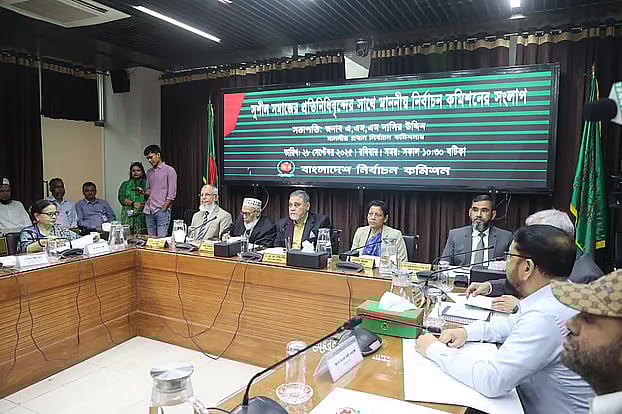
She disclosed this information in a dialogue held at the conference room of the Election Commission Secretariat at the Nirbachan Bhaban (election commission building) in the capital’s Agargaon today, Sunday.
The Election Commission (EC) organised the dialogue with the representatives of the civic society ahead of the 13th parliamentary election.
While addressing the dialogue, Election Commissioner Tahmida also raised questions regarding the accuracy of the figures of the Bangladesh Bureau of Statistics (BBS).
She said the stats regarding the number of population of Bangladesh are questionable. First they published a figure, which they reduced later at the behest of the then government.
“We got the figure while making the voter list going door to door. It’s an accurate figure. Our population is 190 million. Some 15.1 million people are expatriates. Besides, some 15.1 million people live in Dhaka alone,” Tahmida Ahmed said.
Chief Election Commissioner (CEC) ASM Nasir Uddin presented the welcome speech at the beginning of the event.
He said, “We have already accomplished many tasks ahead of the upcoming election. The most significant among them is updating the voter list through door-to-door visits. This was a massive undertaking, and we were able to remove nearly 2.1 million deceased voters.”
Referring to the amendment of nine laws, the CEC further said, “We have made considerable progress in doing what is necessary to conduct the election in a fair manner.”
He also remarked that the reform commission formed under the interim government has advanced much of the Election Commission’s work.
Taking part in the dialogue, journalist and poet Sohrab Hassan said, “The more important question than whether we have confidence in the Election Commission is, whether the commission itself believes that a free, fair, and inclusive election is possible under the incumbent government. If it does, then the Election Commission must take responsibility for the upcoming election.”
Noting that the Election Commission could have avoided certain controversies, Sohrab Hassan said, “There is an attempt to exclude one side from the election. Suppose they cannot contest. But if any of the political parties that reached a consensus with the government and sat with the commission feel that the situation is not favourable or that they will not win, and therefore withdraw from the election, then think about what the situation would be.”
Former caretaker government adviser Rasheda K Choudhury urged that in prioritising the opinions of the younger generation, the elderly, the poor, women, and minorities should not be pushed aside.
Referring to the proposal of 5 to 7 per cent representation for women in the upcoming parliamentary election, she said, “Political parties are saying they will give us five to seven per cent seats. Is this charity? Hearing this after 55 years is shocking.”
Urging the Election Commission to ensure 33 per cent women’s representation in the election, Rasheda K Choudhury told the political parties, “I will keep saying it: we do not accept five to seven per cent.”
Chittagong University vice-chancellor Professor Muhammad Yahya Akhtar, former ambassador Humayun Kabir, Dhaka University Professor Robayet Ferdous, Jahangirnagar University Professor Al Mahmud Hasanuzzaman, security analyst Mahfuzur Rahman, Police Reform Commission member Mohammad Harun Chowdhury, BGMEA director Rashid Ahmed Hossaini, poet Mohan Raihan, TIB director Mohammad Badiuzzaman, and student representative Zarif Rahman attended the dialogue.