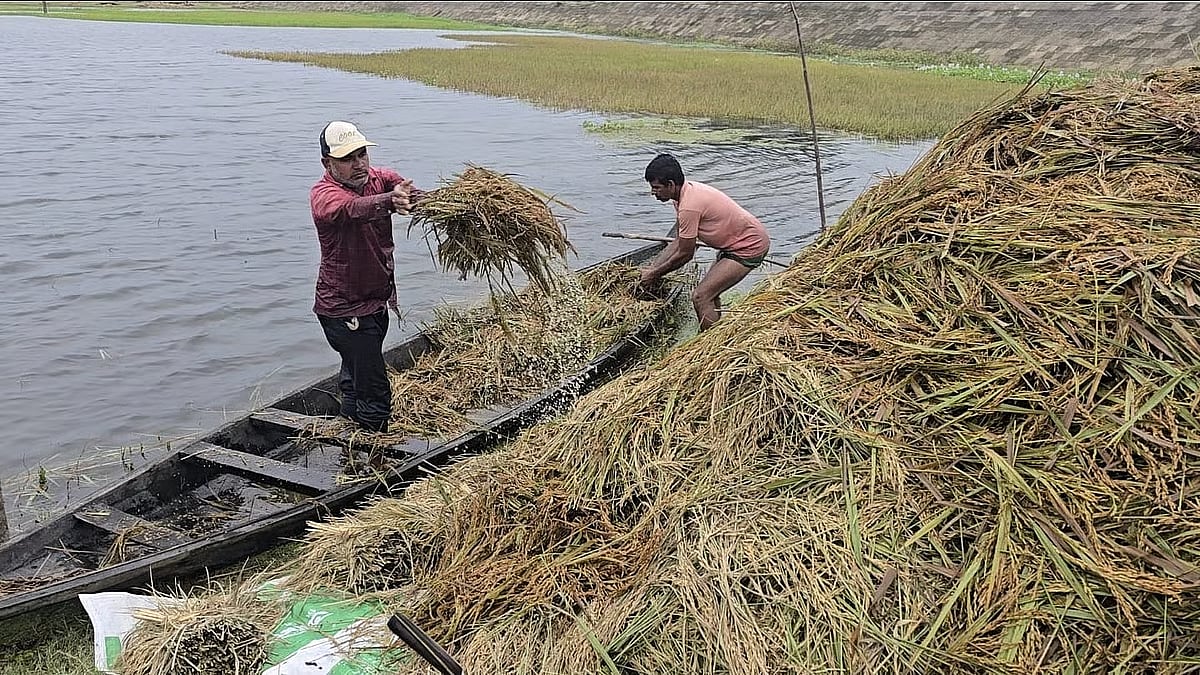
Haor rice losses surpass 200,000 tons, prices rising
The total rice loss has been estimated at nearly 214,000 metric tons — around 1 per cent of total boro season production following rain and flash floods from upstream hills in the haor wetlands. However, its impact is already beginning to show in the market. Rice prices are rising again.
Visits to wholesale shops at Babubazar in Old Dhaka, Mohammadpur Krishi Market, and Karwan Bazar in the capital revealed that rice prices have increased by Tk 2 to Tk 5 per kilogram over the past three to four days. The impact has not yet reached the retail market.
Traders say the boro season is the country’s principal rice production season. Normally, rice prices fall at the beginning of this season. This year too, prices had been declining, but the trend did not last. Prices are now climbing again.
In 2017 as well, rain, early flooding, and flash floods from India submerged crops in the haor region. At that time, rice prices surged sharply. According to the Bangladesh Bank annual report (2017), rice losses during that year’s boro season amounted to 2 million tons. Floods also damaged aman crops, reducing aman rice production by 1.5 million tons.
Bangladesh Bank says the price of coarse rice rose to Tk 48 per kilogram in September 2017, which was Tk 17 higher than the previous year. This was the sharpest increase in the country’s history.
Rice is the staple food of the country. When its price rises, low-income groups and the middle class suffer the most. Rice prices have remained high since 2020. Various efforts have been made to reduce prices, but due to the absence of effective measures, prices have not declined as expected.
At the beginning of this year’s boro season, a good harvest had been anticipated. But irrigation was disrupted mid-season due to a diesel shortage, and toward the end of the season, rain and flash floods damaged paddy fields.
Extent of the damage
The Department of Agricultural Extension (DAE) has prepared an estimate of the damage. According to its data, 236,811 small, marginal, and sharecropper farmers suffered losses from nine days of rain and flash floods between 26 April and 4 May.
The estimate covers seven districts: Sylhet, Moulvibazar, Habiganj, Sunamganj, Netrokona, Kishoreganj, and Brahmanbaria. The report says Sunamganj suffered the highest amount of crop damage, followed by Netrokona and then Kishoreganj.
Paddy in varying degrees was also damaged in districts outside the haor region due to excessive rainfall, though no formal estimate has yet been made. A full picture will emerge after the Bangladesh Bureau of Statistics (BBS) completes production estimates at the end of the season.
This year, boro paddy was cultivated on 455,153 hectares of land in the haor region. Of that, 49,000 hectares were damaged — about 11 per cent of the total haor farmland.
The Department of Agricultural Extension classifies haor agricultural land into three categories based on water flow and geographical characteristics: upper basin, middle basin, and lower basin. According to the department, 30 per cent of haor farmland lies in the lower basin area, where rice cultivation is always risky. Excessive rainfall and early floods strike the region every three to four years.
Mohammad Jamal Uddin, additional director of the DAE’s field services wing, said there had been no such floods or early rains over the past two years. This year, water receded late from the haors, delaying rice cultivation by 10 to 12 days. At the same time, early rainfall and flash floods occurred. Altogether, farmers suffered losses.
Meanwhile, the government plans to provide Tk 7,500 each to affected farmers. The DAE estimates that this will require a total of Tk 1.77 billion.
Speaking to Prothom Alo, Jamal Uddin said, “We have submitted the list of affected farmers and the extent of losses to the Ministry of Disaster Management and Relief. The ministry will provide financial assistance.”
Nurun Akhtar, additional secretary of the Ministry of Disaster Management and Relief (Disaster Forecasting, Response, and Coordination), told Prothom Alo, “We will begin the financial assistance programme this month. It will continue through May, June, and July.”
Prices rising
According to DAE data, boro paddy was cultivated on 5 million hectares nationwide this year. The production target is 22.7 million tons. Between 55 and 60 per cent of the country’s rice output comes from the boro season. According to BBS estimates, more than 21.3 million tons of rice were produced in the previous boro season.
Mahiuddin Reza, manager of Barishal Rice Agency at Mohammadpur Krishi Market, told Prothom Alo that rice prices usually fall during the boro season. This year too prices had been declining considerably. But now they are increasing again.
Kawsar Rahman, owner of Shilpi Rice Agency at Babubazar in Old Dhaka, echoed the same view. He said newly harvested rice usually costs less. About a week ago, newly arrived fine rice was selling Tk 10 per kilogram cheaper than old rice. Now prices have risen again by Tk 4–5 per kilogram. Coarse and medium-grade rice had also become cheaper earlier, but now prices of all types have risen by Tk 2 to Tk 5.
At Babubazar, newly harvested coarse rice is selling at Tk 45–46 per kilogram, Pajam and BR-28 rice at Tk 51–52, Miniket at Tk 60–66, and Nazirshail rice at Tk 70–85 depending on quality.
According to the state-run Trading Corporation of Bangladesh (TCB), retail prices of coarse rice currently range between Tk 48 and Tk 60 per kilogram depending on quality. Medium-grade rice sells for Tk 52–68, while fine rice costs Tk 70–85.
Rice prices have remained high for several years. They were comparatively lower at the beginning of 2020. TCB data shows that on 1 January, 2020, coarse rice sold for Tk 30–35 per kilogram, medium rice for Tk 40–50, and fine rice for Tk 45–60. Prices began rising again from March that year.
Global market situation
According to the World Bank’s global commodity price report, rice prices in Thailand and Vietnam have remained broadly stable over the past four months, ranging between USD 350 and USD 400 per ton.
Rice imports are generally restricted in Bangladesh and are permitted only when necessary. However, analysts believe imports should remain open with a certain level of tariff imposed. This would allow imports to increase and stabilise the market whenever prices rise. A complete ban creates opportunities for market manipulation.
The country is still experiencing high inflation. In April, inflation stood at 9.04 per cent. Analysts believe the rise in fuel prices has contributed to inflation. They say the broader economic situation is not good, with limited opportunities for employment and income growth. In such circumstances, steps must be taken to ensure rice prices do not push inflation even higher.
Former director general of the Bangladesh Rice Research Institute, Mohammad Shahjahan Kabir, told Prothom Alo that rice prices are increasing, but farmers are not receiving fair prices for paddy. A syndicate of rice mill owners may emerge in the coming days. A situation could even arise where there is a rice shortage in the market.
Shahjahan Kabir said the only way out of the crisis is for the government to increase its rice stockpile. Under no circumstances should government rice stocks fall below 1.25 million tons, noting that the current stock stands at 1.261 million tons. Whenever rice prices begin to rise, the government should increase market supply to control prices.