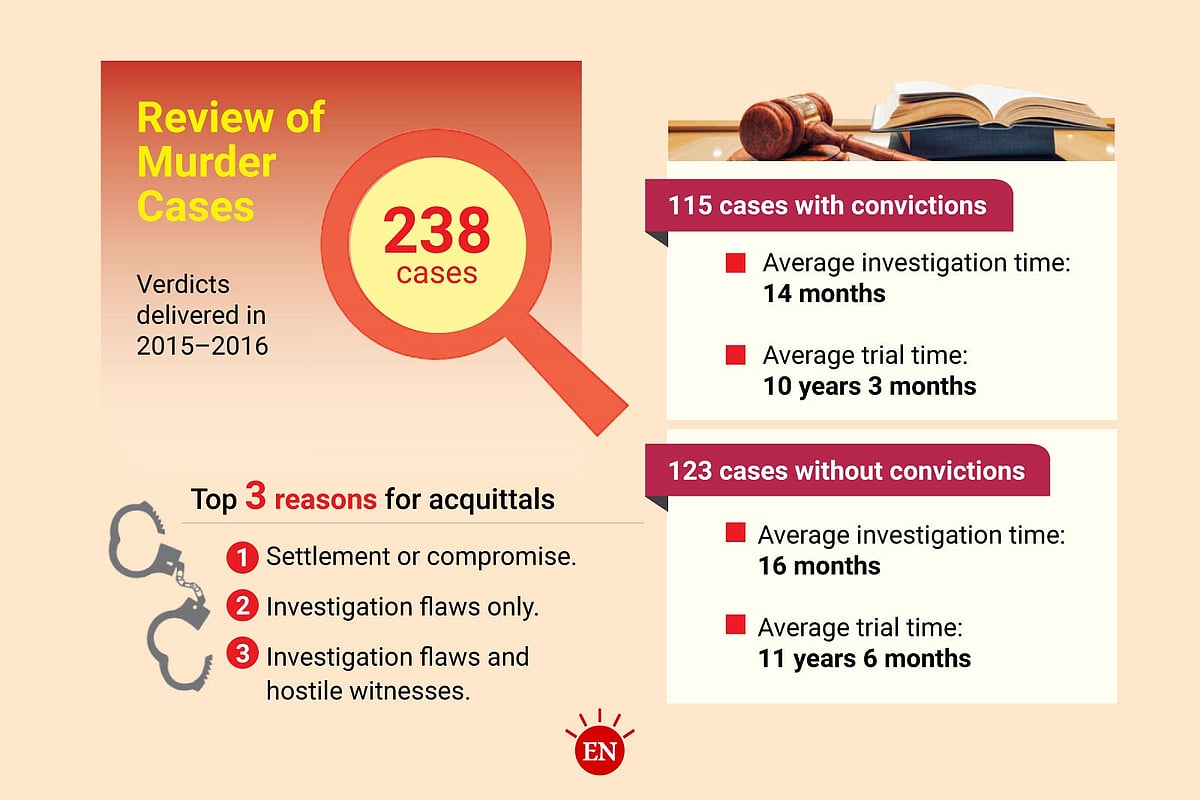
Political rival attacks, family disputes, hostility, or robbery—Whatever the cause may be, defendants are acquitted in 52 percent of murder cases.
In other words, in more than half of all murder cases filed in the country, the accused ultimately receive no punishment. In some cases, the accused may be arrested and temporarily imprisoned, but are later acquitted after trial. This information has emerged from police research.
The study, titled “Investigation Report on the Causes Behind the Low Conviction Rate in Murder Cases,” was conducted by the Police Bureau of Investigation (PBI) and published in May of this year.
The study reveals that in more than half of all murder cases, defendants are acquitted mainly for four reasons. Among them, settlement or compromise between the complainant and the defendant is the most common cause. Other reasons include weaknesses in the FIR, errors in investigation, delays in completing investigations, incompetence or bias of investigating officers, discrepancies among the FIR, inquest, and autopsy reports, inconsistencies in postmortem findings, political influence, failure to produce witnesses in court, intimidation of witnesses, and improper recording of statements. Additionally, in many cases, trial delays also lead to acquittals.
PBI analyzed 238 murder cases whose verdicts were delivered between 2015 and 2016. The cases themselves were filed between 1986 and 2015. Among them, 123 cases resulted in acquittal of all defendants, while 115 cases led to convictions.
The analyzed cases included murders stemming from property and family disputes, conflicts over the distribution of gambling or drug trade money, financial disagreements, robbery-related killings, and murders arising from political rivalry or intra-party feuds.
According to Mustafa Kamal, Additional Inspector General of Police and Head of PBI, the research was conducted to determine why the conviction rate in murder cases is so low. He told Prothom Alo that report helps identify the causes behind the low conviction rate. The weaknesses at different stages—from investigation to trial—have been pinpointed. If these issues are addressed, the conviction rate will rise, and the families of murder victims will receive justice.
Among the cases examined by PBI is one from Fatepur, Gowainghat, Sylhet. On 28 August, 2007, a clash broke out near a mosque pond over the cutting of an old jackfruit tree, resulting in the death of a local resident named Foyzur Rahman. His relatives filed a case against five people at the local police station. A year later, police filed a charge sheet against the same five individuals. In 2015, the court acquitted all the accused. In its verdict, the court observed that the witnesses did not testify in support of the FIR and noted that the plaintiff and defendants may have reached a settlement outside the court.
The PBI’s research also includes cases from 2012, such as the murder of Khairul Anam, a leader of the now-banned Volunteer League, who was killed in his own business establishment in Bogra in December that year. His family had claimed at the time that the killing was the result of intra-party conflict. A decade later, in 2022, all 13 accused were acquitted.
Although this case was not part of PBI’s study sample, the reasons cited by PBI for acquittals match the statement of the victim’s father, Abdul Kaiyum, who told Prothom Alo in early July that they were dissatisfied with the investigation and that many witnesses did not appear in court due to threats from the accused.
PBI’s analysis also points to weak investigations, witness intimidation, and threats as key reasons behind acquittals in murder cases.
More acquittals due to settlements
According to the PBI study, of the 123 cases resulting in acquittal, 47 involved compromise or settlement between the two sides. In 32 cases, defendants were acquitted due to investigative flaws or witnesses being declared hostile. In 14 cases, defendants were acquitted solely due to investigative errors.
In 11 cases, PBI identified several problems leading to acquittals—inconsistencies in postmortem reports, hostile witnesses, absence of witnesses, and investigative mistakes. In 4 cases, magisterial errors led to acquittals. In another 15 cases, the crimes could not be proven.
According to Police Headquarters, between 2009 and 2024, a total of 60,037 people were murdered in Bangladesh—an average of 3,752 murders per year.
Under the Penal Code, murder cases cannot be settled out of court. However, in many cases, parties reach secret settlements, after which plaintiffs and witnesses provide false testimony in court. Such witnesses are declared hostile, but the state continues prosecution because ensuring justice in murder cases is the state’s responsibility. False testimony, however, makes it extremely difficult to ensure justice. In most instances, judges can sense that the witnesses are lying, but they have no legal means to intervene, and eventually acquit the accused.
In March 2024, a court in Bhola acquitted all defendants in a murder case that had dragged on for nearly a decade. The verdict document shows that the murder occurred in September 2014, when a man from Bholanathpur village in Mehendiganj was killed while fishing in the Meghna River near Daulatkhan, Bhola. Four witnesses, including the complainant, told the court that they had not witnessed the incident and knew nothing about it.
An investigative report published by Prothom Alo on 26 June last year shows that in one upazila, 90 murders in 14 Years, even murder cases settled. It analysed 30 murder cases (2010–2024) in Shailkupa Upazila, Jhenaidah. The report found that in 12 of those 30 cases, plaintiffs and defendants reached settlements. In eight cases, plaintiffs said they were forced to compromise under political pressure, and money exchanged hands in every case. This indicates that even in murder cases, social and political pressure often forces complainants to settle.
Investigation errors
The 2022 murder of expatriate Yusuf Ali in Rangunia, Chattogram gained widespread attention. In 2024, all 12 defendants were acquitted. Yusuf Ali was allegedly killed by rivals amid a political dispute with his elder brother.
Ashok Kumar Das, former public prosecutor of the Chattogram Divisional Speedy Trial Tribunal, told Prothom Alo that the acquittal occurred due to errors made by the investigating officer. “The court acquitted all the accused, citing flaws in evidence collection and investigation. The officer failed to properly document the crime scene, and the court even recommended departmental action against him,” he said.
The PBI report also attributes investigative failures to incompetence, lack of sincerity, work overload, and poor coordination among investigating personnel. The report recommends forming a monitoring team to provide effective guidance to investigating officers, along with proper training for all officers involved in criminal investigations.
The Judicial Reform Commission, formed by the interim government, has proposed creating a separate investigative agency outside the police to handle criminal cases. The proposal emphasizes that the new agency must be competent and reliable, capable of functioning free from influence.
Currently, police investigate murders and other criminal offenses through local police stations as well as specialized units like the Criminal Investigation Department (CID) and the Police Bureau of Investigation (PBI). However, both units operate under the police and are staffed through transfers within the force.
The commission proposes that personnel of the new investigative agency be completely independent from the police, with separate recruitment, employment terms, budget, infrastructure, and organizational framework. The agency would typically begin its work as soon as a case is filed.
The commission notes that investigation is a critical stage in the criminal justice process. If the investigating officer is not honest, courageous, skilled, and professional, weaknesses will inevitably remain in the report. Often, due to political influence or other reasons, the true facts are not reflected accurately. The speed and quality of an investigation largely determine the outcome of a case.
Delays in trials
The PBI study also identified trial delays as a major issue. Reviewing 238 cases, the agency found that on average, trials took nearly 11 years to conclude. Prolonged proceedings increase the chances of witness absenteeism or flawed testimony. Similarly, delayed investigations make it difficult to collect evidence. The PBI report noted a clear link between delays in investigation and trial and failure to prove cases.
In cases resulting in conviction (115 cases), police took an average of 1 year and 2 months to investigate, while trials lasted 10 years and 3 months. For acquitted cases, investigations took 1 year and 4 months, and trials lasted 11 years and 6 months. The report states that the longer investigations and trials take, the lower the likelihood of conviction.
The PBI considers the long duration of murder investigations and trials deeply concerning. It notes that due to these delays, many key figures from the complainant’s side are forced to leave their local areas, while many witnesses die. Over time, defendants can intimidate or bribe victims’ relatives and witnesses into reaching settlements.
Due to lengthy trials, witnesses often fail to provide accurate testimony. For example, in Chandgaon, Chattogram, a man was killed in April 1997 over a personal dispute. The court delivered its verdict in 2016, acquitting all accused. Police took 1 year and 2 months to investigate, but the trial dragged on for 18 years. The report states that due to the prolonged proceedings, the plaintiff and defendants reached a settlement, leading witnesses to give false testimony, and all accused were acquitted.
Ehsanul Haque Samaji, Special Prosecutorial Adviser to the Ministry of Home Affairs, told Prothom Alo that the reasons cited by PBI for acquittals—such as lack of evidence, compromised or absent witnesses, and trial delays—are not unfounded. He said that it is the responsibility of state prosecutors to identify which witnesses are relevant for proving the case. If guilt cannot be established through oral and documentary evidence, acquittal is only natural.
Supreme Court lawyer Ehsanul Haque Samaji added that investigating officers in criminal cases may consult with state prosecutors, even before submitting the charge sheet. Better coordination between investigators and prosecutors would make evidence collection easier and help ensure faster resolution of trials.