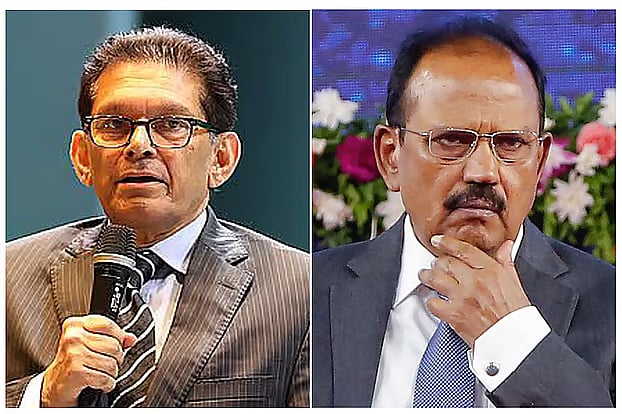
National security adviser set to visit Delhi
The interim government’s National Security Adviser, Khalilur Rahman, will travel to Delhi on 19 November 19 to attend a conference of National Security Advisers from the Indo-Pacific region.
The Colombo Security Conclave (CSC) conference, involving five countries from the Indian Ocean region, will be held in Delhi on 20 November.
Khalilur Rahman is visiting Delhi for two days at the invitation of India’s National Security Adviser, Ajit Doval.
In the second half of October, Ajit Doval invited Khalilur Rahman to participate in the conference. This year, India is hosting the seventh meeting of the Colombo Security Conclave (CSC) for National Security Advisers.
A government source, speaking to Prothom Alo on condition of anonymity, confirmed Khalilur Rahman’s Delhi visit last Tuesday.
It has not been confirmed by Bangladeshi diplomatic sources whether there will be a bilateral meeting between the National Security Advisers of Bangladesh and India during the conference.
However, an Indian source indicated that such discussions are likely. Given Bangladesh’s changing and unstable political situation, both countries are interested in direct talks between their key officials. Therefore, the possibility of a brief meeting on the sidelines of the conference on 20 November cannot be ruled out.
It is noteworthy that this will be only the second visit of a government adviser to Delhi since the interim government, led by Professor Yunus, took office in August last year. Earlier, in February of this year, Energy Adviser Muhammad Fouzul Kabir Khan visited India to participate in India Energy Week.
On 5 August last year, nearly a month after the fall of the Awami League government following the student-people's uprising, discussions were held in New York between India’s External Affairs Minister S Jaishankar and Bangladesh’s Foreign Adviser Md Touhid Hossain.
In September, they held talks on the sidelines of the United Nations General Assembly session in New York. Following this, at Bangladesh’s proposal, a meeting at the Foreign Secretary level between the two countries was held in Dhaka in December last year.
Later, in April this year, on the sidelines of the BIMSTEC Summit in Bangkok, India’s Prime Minister Narendra Modi held a courtesy meeting with Chief Adviser Professor Muhammad Yunus.
Outside of these discussions, there have been meetings at the Director-General level of the border security forces of the two countries, as well as technical committee meetings of the Joint River Commission.
In May this year, Bangladesh proposed a consular dialogue, and in June, a meeting at the Trade Secretary level; India did not respond to these proposals.
It is noteworthy that the Colombo Security Conclave is a multilateral regional security forum for the Indian Ocean region. Its member countries are India, Sri Lanka, the Maldives, Mauritius, and Bangladesh, with Seychelles as an observer.
Bangladesh became a full member of this forum in 2024. During a meeting in Colombo in August 2024, the member countries signed a charter and a memorandum of understanding to establish a secretariat in the capital of Sri Lanka.
The forum’s primary objective is to strengthen regional security, focusing on five key areas: maritime safety and security; counterterrorism and prevention of extremism; combating human trafficking and organised international crime; cybersecurity and protection of critical infrastructure and technology; and humanitarian assistance and disaster relief.
The conclave, established to enhance maritime security, counterterrorism cooperation, and the capacity to address international threats, facilitates the exchange of intelligence, joint policy coordination, and capability development among member countries.
Although the forum’s secretariat is based in Colombo, Sri Lanka, meetings at various levels, including with National Security Advisers, are held in a rotational manner among the member countries.